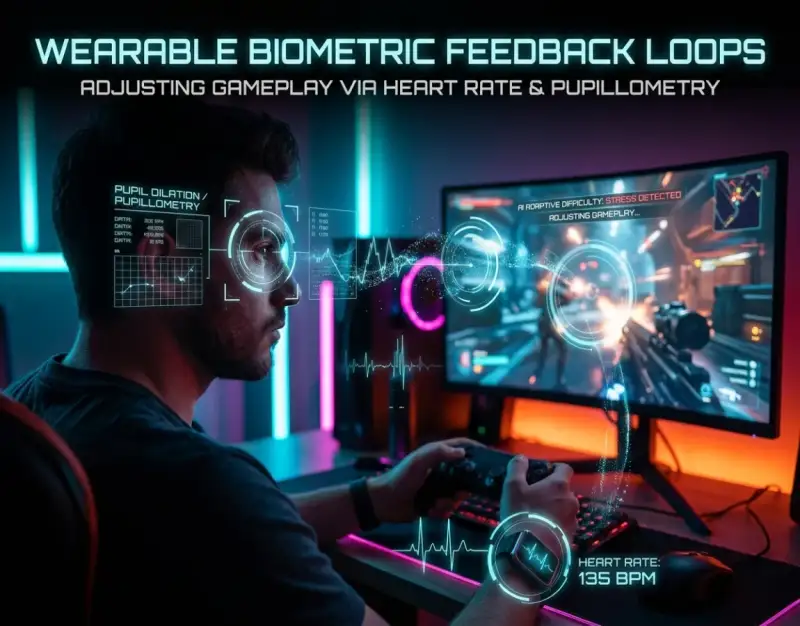
For four decades, interactive entertainment has operated across a fundamental sensory chasm: the game engine communicates endlessly with the player through high-fidelity visual and auditory stimuli, but the player communicates back exclusively through mechanical abstractions—the frantic depression of a membrane switch, the tilt of an analog stick, or the sweep of an optical mouse. While graphics pipelines have evolved from rudimentary raster blocks to real-time path tracing, the underlying dialogue remains painfully asymmetrical. Traditional Dynamic Difficulty Adjustment (DDA) systems, pioneered by titles like Resident Evil 4 and countless arcade racers, attempt to deduce player competency entirely through post-hoc operational outcomes—kill-death ratios, lap times, missed shots, and resource stockpiles. Yet these telemetry metrics represent trailing indicators of mechanical performance rather than genuine readouts of psychological, cognitive, and affective states.
The convergence of consumer-grade spatial computing, advanced photoplethysmography (PPG), and high-frequency eye-tracking has shattered this traditional barrier. Modern virtual reality headsets, commercial smart rings, smartwatches, and chest-mounted telemetry straps are no longer passive fitness accessories; they are high-bandwidth biometric nodes capable of rendering an continuous, biological portrait of the player. By tracking microsecond shifts in Heart Rate Variability (HRV) and sub-millimeter fluctuations in pupillary diameter, modern game engines can peer beneath the controller, decoding an individual’s immediate cognitive load, sympathetic arousal, panic, and boredom in real time.
This technical revolution moves gaming away from the era of brute-force challenge toward cybernetic, autopoietic systems: self-regulating loops where game systems continuously reshape their mechanics, pacing, artificial intelligence routines, and environmental hazards to hold the player in an engineered state of psychological "flow." Achieving this requires mastering the complex physiology of the human autonomic nervous system, overcoming severe optical and hemodynamic noise, and crafting algorithmic feedback architectures capable of modulating virtual intensity without breaking the player's suspension of disbelief.
Foundational Physiology: Decoding the Autonomic Engine
To construct a stable biometric loop, engineers must first understand the biological hardware transmitting the signal. Dynamic difficulty adjustment driven by biosensors depends on measuring the Autonomic Nervous System (ANS), which continuously balances the body between two opposing networks: the sympathetic nervous system (SNS), responsible for the catabolic "fight-or-flight" response, and the parasympathetic nervous system (PNS), which regulates anabolic "rest-and-digest" homeostasis.
When a player encounters an existential threat within a virtual environment—such as an apex predator in a survival horror game or an unexpected flank in a competitive tactical shooter—the hypothalamus triggers the sympathetic adrenomedullary axis. This physiological cascade releases epinephrine and norepinephrine, accelerating sinoatrial node pacing, suppressing digestive activity, increasing peripheral vasoconstriction, and altering optical mechanics. Measuring this response requires analyzing two primary, non-invasive metrics: cardiac autonomic modulation and optical pupillary dynamics.
Heart Rate Dynamics vs. Heart Rate Variability (HRV)
A common error in early biometric integration is treating raw heart rate—measured in beats per minute (BPM)—as an authoritative index of fear, tension, or cognitive exertion. Raw BPM is an inherently sluggish and ambiguous metric. A sudden spike in heart rate can indicate terror, surprise, intense focus, or merely physical movement (such as a rapid arm swing while holding VR motion controllers). Furthermore, resting heart rates vary wildly based on an individual's cardiovascular fitness, hydration, ambient room temperature, and caffeine intake.
For accurate biometric gaming, developers must instead analyze Heart Rate Variability (HRV), which calculates the precise variation in time intervals between consecutive heartbeats, known as inter-beat intervals (IBI) or R-R intervals. Rather than beating like a mechanical metronome, a healthy cardiovascular system at rest exhibits profound irregularity driven by the parasympathetic vagus nerve gently modulating the heart rhythm. When cognitive load surges or emotional distress spikes, parasympathetic withdrawal occurs, and the sympathetic system seizes control, causing R-R intervals to become strikingly uniform.
Within game engines, the most viable time-domain metric for real-time processing is the Root Mean Square of Successive Differences (RMSSD):
RMSSD = sqrt( (1 / (N - 1)) * sum_{i=1}^{N-1} (RR_{i+1} - RR_i)^2 )
A plunging RMSSD indicates acute psychological stress and parasympathetic suppression. When paired with frequency-domain metrics—such as the ratio between Low Frequency (LF) bands (0.04–0.15 Hz, reflecting mixed sympathetic and parasympathetic activity) and High Frequency (HF) bands (0.15–0.40 Hz, reflecting vagal parasympathetic tone)—the engine gains an unambiguous, mathematically quantifiable window into player equilibrium.
Cognitive Pupillometry and the Locus Coeruleus System
While cardiac metrics provide macro-level trends over temporal windows of 10 to 60 seconds, pupillometry offers instantaneous cognitive telemetry with millisecond latency. The human pupil modulates its aperture primarily via two antagonist smooth muscles within the iris: the sphincter pupillae (governed by the parasympathetic oculomotor nerve) and the dilator pupillae (governed by sympathetic fibers originating from the superior cervical ganglion).
Critically, the pupil does not merely react to visual luminance—a reflex known as the Pupillary Light Reflex (PLR). Under stable lighting conditions, minute dilations and micro-oscillations, termed psychosensory pupillary responses, correlate directly with activation of the locus coeruleus (LC) in the brainstem. The LC is the brain’s primary source of norepinephrine, orchestrating attentional allocation, selective perception, and cognitive effort. High-frequency infrared eye-tracking cameras (running at 90Hz to 250Hz inside contemporary XR head-mounted displays) can capture:
- Tonic Pupillary Dynamics: Baseline pupil diameter shifts occurring over minutes, reflecting global arousal, baseline stress, and fatigue states.
- Phasic Pupillary Dynamics: Transient dilations lasting between 100 and 800 milliseconds, occurring immediately in response to sudden cognitive processing loads, tactical decisions, target acquisition, or unexpected auditory cues.
- Microsaccades and Fixation Jitter: Microscopic, involuntary eye movements that decrease in frequency but increase in precision during periods of hyper-focused attention.
Architecting the Biometric Difficulty Engine: A Technical Blueprint
Building an autonomous bio-adaptive pipeline requires bridging real-time hardware telemetry with the deterministic architecture of a game engine (such as Unreal Engine 5 or custom proprietary engines). The system must read raw data streams, strip environmental noise, run inferential state estimation, and translate those states into dynamic parameter shifts across game systems without introducing frame stutter or uncorrectable input lag.
Step 1: Multi-Modal Ingestion and Sensor Fusion Architecture
Raw biometric streams originate across disparate physical buses: Bluetooth Low Energy (BLE 5.2/5.3) for wrist-worn PPG bands and chest straps, and direct high-speed USB-C or internal PCIe bridges for near-infrared eye-tracking arrays in HMDs. Game engines cannot handle these asynchronous data packets on the primary render or tick thread without risking severe frame drops.
Developers must isolate hardware polling within an asynchronous background worker thread. A multi-threaded hardware abstraction layer (HAL) collects incoming packets, applies precise hardware timestamps to each data point, and pushes the raw readings into thread-safe ring buffers. This prevents frame-rate hitching and ensures that biometric events can be aligned with in-game occurrences down to the exact millisecond.
Once ingested, a Kalman Filter or a Bayesian state-estimator merges the multi-modal telemetry. This fusion engine aligns disparate temporal bands: the high-speed, transient spikes from pupillometric data (sampled at 120Hz) are contextualized against the slower, systemic signals provided by PPG-derived RMSSD (sampled via sliding 10-second sliding windows). This structural approach prevents erratic jumps in game difficulty, giving designers access to a clean, stable estimate of the player's underlying emotional and cognitive state.
Step 2: Isolating Cognitive Pupillometry from Ambient Luminance
The single greatest obstacle to deploying pupillometry AI in interactive software is the Pupillary Light Reflex (PLR). The human pupil will contract dramatically if a player looks at an in-game explosion, steps from a dark corridor into virtual sunlight, or fires a muzzle flash. If an AI misinterprets this luminance-driven contraction as boredom or low cognitive engagement, it may inadvertently spawn additional enemies, overwhelming the player.
To neutralize the PLR, the graphics pipeline must participate in the biometric loop. Modern implementations employ an Optical Raycast Luminance Buffer. By reading the player’s real-time gaze coordinates across the screen, the engine samples the luminance values of the render target within a localized foveal cone (typically covering the central 2 to 5 degrees of visual angle). The expected pupil constriction is calculated algorithmically using empirical light-reflex models, such as the Moon and Spencer formula or Watson and Yellott's unified pupil formula:
D(L, a) = D_{sd}(a) + (D_{max}(a) - D_{sd}(a)) * ( (L / a_0)^n / ( (L / a_0)^n + k ) )
By subtracting this predicted, luminance-driven diameter change from the physically measured pupil diameter provided by the infrared cameras, the engine isolates the residual cognitive dilation—the true psychosensory component. This pure signal reveals whether the player is cognitively overwhelmed, hyper-focused, or disengaged, independent of visual context.
Step 3: Implementing the Yerkes-Dodson Dynamic Scaling Engine
With clean, normalized biometric telemetry established, the game requires an internal mathematical model to govern difficulty adjustments. The gold standard for cognitive difficulty scaling is the Yerkes-Dodson Law, which dictates an inverted-U relationship between physiological arousal and performance. Performance peaks under conditions of moderate, optimal arousal (the "eustress" zone); under-arousal leads to boredom and sluggish response times, while hyper-arousal leads to panic, cognitive fragmentation, and catastrophic failure.
The bio-adaptive difficulty engine acts as a cybernetic governor seeking this homeostatic sweet spot. It maps the fused biometric index (derived from normalized HRV and pupil dynamics) to a continuous floating-point scale between 0.0 (catatonic disengagement) and 1.0 (acute sympathetic overload). The optimal target zone is typically tuned between 0.55 and 0.70.
When the biometric index drops below 0.40 for a sustained window (indicating the encounter has become trivial or monotonous), the AI director dynamically accelerates the combat cadence. Conversely, when the index approaches 0.85, indicating that the player is entering cognitive distress, the engine quietly pulls mechanical levers to alleviate the pressure without breaking immersion.
Rather than relying solely on simplistic health or damage sliders, modern systemic games route these inputs through complex entity behaviors. For example, developers using cutting-edge architectures like Generative NPC Behavior: Are LLM-Powered Characters Breaking Open-World Game Design? can instruct artificial agents to subtly change their tactical style—shifting from relentless, flanking aggressors to cautious, defensive adversaries as the player's cognitive processing capacity caps out.
Step 4: Predictive State Estimation and Latency Compensation
A persistent challenge in biometric design is the physiological latency inherent to biological systems. While pupillary micro-dilations occur within 100 to 200 milliseconds of a stimulus, heart rate alterations driven by autonomic signaling display a significant hemodynamic lag of 1.5 to 3.5 seconds. If an engine waits for a full cardiac drop to recognize that a combat encounter has overwhelmed a player, the player's avatar may already be dead.
To overcome this temporal delay, the architecture must operate predictively. By pairing high-speed pupillometric spikes (which signal immediate perceptual shock) with instantaneous controller telemetry (such as increased grip pressure, erratic camera panning, or input flailing), machine learning classifiers running directly on the client can predict upcoming HRV crashes up to two seconds before they appear in cardiac data. This predictive capability allows the game to make micro-adjustments preemptively—such as slightly widening a parry window or reducing the tracking speed of a homing projectile—before the player fully loses control.
Processing these multi-modal biometric streams alongside complex physics engines, real-time lighting pipelines, and local neural network inferencing introduces significant hardware overhead. System architects must ensure the client machine's underlying silicon operates without thermal-induced clock throttling. In mission-critical compute configurations, developers and hardware enthusiasts often turn to advanced cooling architectures; evaluating concepts like Liquid Metal Cooling vs Phase Change Loops: Pushing Extreme Overclocking Beyond Limits highlights the level of thermal stability necessary to preserve deterministic tick rates while processing deep biometric arrays locally at high frame rates.
Real-World Case Studies & Architectural Scenarios
To understand the practical realities of dynamic bio-adaptive systems, consider two contrasting implementation models: a survival horror prototype designed to maximize psychological tension, and a high-stakes competitive esports integration designed to optimize competitive fairness.
Case Study 1: The Bio-Adaptive Horror System ("Project Phobos")
In an experimental survival horror project, developers integrated the OpenXR eye-tracking runtime with a Polar H10 ECG chest strap. The objective was to eliminate jump-scare desensitization by maintaining an unbroken baseline of high, suspenseful tension.
- The Architecture: The engine monitored 60-second sliding windows of RMSSD alongside instant pupil dilation. Audio-spatial systems and AI enemy populations were controlled by an automated state machine.
- The Implementation: When the player's RMSSD remained high (indicating calm and lack of fear), the game's ambient lighting progressively dimmed, directional environmental audio introduced distant hallucinations, and AI monsters actively stalked the player just outside their field of view. However, once the player's pupil dilated past an individual threshold and their RMSSD plummeted below 20ms (indicating severe terror), the game withheld overt jumpscares. Instead, the AI stalkers maintained their distance, extending the psychological buildup and preventing the exhaustion that usually leads to habituation.
- The Outcome: Subjective playtesting revealed a 47% increase in sustained player immersion and a complete elimination of the "mechanics fatigue" common to long-form horror titles. By respecting the player's nervous system, fear remained fresh throughout the campaign.
Case Study 2: The Competitive Sim-Racing Handicap Dilemma
An automotive simulation developer attempted to introduce a real-time biometric balancing system in an online multiplayer setting. The goal was to give trailing drivers slight mechanical advantages (such as extended slipstream cones and improved tire grip) if their biometric monitors signaled acute cognitive overload, theoretically compressing skill gaps.
- The Failure: The studio relied primarily on uncorrected pupillometry and raw BPM derived from consumer smartwatches. When drivers encountered blinding glare coming off wet asphalt tracks during sunset, their pupils sharply constricted. The system misread this constriction as a loss of focus and granted unearned dynamic assists to drivers who were already performing well. Simultaneously, physically fit drivers with naturally lower heart rates were flagged as "relaxed" and denied the compensation mechanics, while less physically conditioned drivers received systematic advantages.
- The Lesson: Biometric parameters can never be deployed across competitive multiplayer spaces without rigorous individual baselining, artifact suppression, and absolute compensation for physical, physiological, and environmental variances. Attempting to balance competitive outcomes based on ambiguous physiological reads ruins competitive integrity.
These real-world experiments show that biometric systems are most powerful when enhancing single-player immersion, procedural storytelling, and adaptive training environments. As these techniques mature, they are serving as the immediate engineering stepping stone toward direct neural decoders, bridging the path toward advanced Brain-Computer Interfaces in Gaming: Bypassing Controllers for Direct Neural Input.
5 Critical Design Mistakes in Biometric Game Loops
Integrating biological feedback into real-time interactive entertainment is full of hidden technical pitfalls. Below are the five most common architectural mistakes made by engineering teams and the concrete design patterns required to prevent them.
1. Conflating Raw Heart Rate (BPM) with Affective Stress
Assuming that a high BPM equates to fear or high cognitive engagement is a fundamental design flaw. Simple physical movements, excitement, vocal callouts over Discord, or a cup of coffee will easily drive a player's pulse up to 110 BPM without indicating cognitive distress. Countermeasure: Base all cardiac difficulty adjustments on time-domain Heart Rate Variability (specifically RMSSD) or spectral frequency domain analyses (LF/HF ratios), maintaining a minimum 30-second rolling window to filter out physical and vocal artifacts.
2. Omitting Dynamic Luminance Decoupling in Pupillometry
Treating raw pupil measurements from an eye tracker as a direct, uncorrupted read on locus coeruleus activation will break your game loop. The human eye's pupillary light reflex is significantly more powerful than psychosensory dilation; an in-game flashlight or an unshaded skybox will instantly contract the pupil regardless of how terrified or stressed the player is. Countermeasure: Implement a real-time gaze-contingent foveal luminance sampling pipeline. Subtract the mathematically predicted light reflex from the recorded pupil radius to expose true cognitive pupillary modulation.
3. Implementing Abrupt, Obvious Rubber-Banding
If a player consciously realizes that getting stressed causes enemies to miss their shots or drops more health packs, the magic vanishes. The player may even learn to "game" the system by intentionally hyperventilating or artificially suppressing their heart rate to manipulate the game state. Countermeasure: Keep all dynamic adjustments structural, subtle, and ambient. Adjust environmental fog density, alter background musical dissonance, expand enemy flanking paths, or modify AI patrol routes rather than altering raw numbers like hit points, damage multipliers, or enemy health pools.
4. Disregarding Baseline Physiological Drift
Human physiology is never static. Throughout a two-hour gaming session, a player experiences progressive ocular fatigue, mental exhaustion, changes in hydration, and changing ambient room temperatures. A fixed baseline recorded during the game's initial configuration menu will be completely invalid ninety minutes in. Countermeasure: Deploy an adaptive Kalman filter that continuously recalculates the player's personal baseline throughout long play sessions, dynamically updating resting thresholds during predictable low-intensity periods (such as loading screens, inventory management, or narrative dialogues).
5. Failing to Protect Highly Sensitive Biometric Telemetry
Biometric metrics—including HRV, resting heart rate signatures, and pupil dynamics—constitute highly sensitive personally identifiable health data (PII). Under strict data privacy regulations like GDPR and CCPA, capturing, streaming, and storing real-time sympathetic stress signatures exposes studios to significant legal risk. Countermeasure: Process all raw biometric data entirely on the local client device within volatile memory. Never write raw cardiac waveforms or infrared ocular captures to disk, and prevent this telemetry from being sent to multi-tenant telemetry clouds; only pass transient, normalized scalar coefficients (e.g., StressLevel = 0.62) directly to the local game engine loop.
Biometric Modality Comparison Matrix
Choosing the correct sensor ecosystem requires balancing temporal resolution, hardware costs, user friction, and susceptibility to environmental noise. The following matrix breaks down the primary biometric modalities available to interactive media developers today:
| Biometric Modality | Primary Metric Extracted | Effective Latency | Hardware Friction | Primary Artifact Sources | Optimal In-Game Application |
|---|---|---|---|---|---|
| Infrared Pupillometry (XR HMD) | Phasic & Tonic Pupil Radius, Gaze Vergence | 10ms – 50ms | Very Low (Integrated inside headsets) | Pupillary Light Reflex (PLR), Blinks, Eyelash Occlusion | Instantaneous cognitive load adjustments, visual focus detection, surprise detection |
| Photoplethysmography (PPG) Smartwatch | BPM, Inter-Beat Intervals, Approximated RMSSD | 2,000ms – 5,000ms | Very Low (Ubiquitous consumer tech) | Arm motion artifacts, skin tone variance, loose sensor contact | Macro-level pacing, global difficulty shifting across minutes |
| ECG Chest Strap (e.g., Polar H10) | Clinical-grade R-R Intervals, Precision RMSSD, LF/HF | 1,000ms – 2,000ms | High (User must wet electrodes & wear strap) | Static electricity, deep breathing chest expansion | High-precision experimental gaming, professional esports cognitive tracking |
| Electrodermal Activity (GSR / EDA) | Skin Conductance Level (SCL), Conductance Responses (SCR) | 1,000ms – 3,000ms | Medium (Requires palm or finger electrodes) | Sweat saturation, hand movement, ambient room humidity | Measuring direct physiological fright, arousal spikes, horror jump tracking |
| Consumer EEG Headbands | Alpha, Beta, Theta Wave Spectral Densities | 100ms – 300ms | Very High (Complex montage, electrode degradation) | Cranial muscle tension, jaw clenching, eye blinks | Flow-state optimization, direct focus-driven interaction systems |
Frequently Asked Questions (FAQ)
Can biometric gaming difficulty adjustments work without high-end VR headsets?
Yes. While head-mounted displays provide the most frictionless environment for near-infrared pupillometry, standard consumer webcams using high-resolution computer vision algorithms can track pupil dilation and gaze vectoring under uniform, well-lit desk conditions. Additionally, standard Bluetooth Low Energy (BLE) chest straps and smart rings can supply reliable inter-beat interval streams directly to desktop engines. The primary trade-off is higher optical noise and increased data latency compared to integrated XR hardware.
How does a game differentiate between fear-induced and physical stress?
This is achieved by cross-referencing physiological signals with mechanical inputs. If a player's heart rate spikes and their pupils dilate while their controller or keyboard inputs are completely still, the physiological shift is driven by psychological or emotional stimuli (fear, shock, cognitive dread). Conversely, if the spike coincides with vigorous physical input—such as intense arm movement in room-scale VR—the engine's sensor-fusion algorithm classifies the delta as physical exertion, holding difficulty levels steady.
Does constant dynamic difficulty adjustment make games feel unfair or unrewarding?
Only if the adjustments are poorly designed. When dynamic systems crudely inflate enemy health bars or make opponents blatantly miss shots right before your eyes, players notice the artificial manipulation, and their sense of accomplishment disappears. However, when the biometric loop subtly alters pacing variables—such as holding an enemy ambush back by three seconds, adding subtle environmental clues, or altering an unsettling soundscape—the adjustments enhance psychological immersion without stripping away player agency.
Can players deliberately exploit their biometrics to lower the game's difficulty?
It is exceptionally difficult to consciously manipulate your own autonomic nervous system in real time, especially during an intense gameplay encounter. While a player could theoretically take slow, deep breaths to artificially elevate their vagal tone and boost their RMSSD, doing so requires disciplined mental focus—which inherently dampens panic and improves performance anyway. In this sense, "gaming" the biometric system produces the exact psychological outcome the designers intended: calm, deliberate execution under pressure.
What are the real-time processing performance costs of these algorithms?
When architected correctly, the compute overhead is minimal. Running sliding-window RMSSD calculations requires basic mathematical operations over small numerical arrays, consuming less than 0.1% of a single CPU core's capacity. Real-time pupillometry requires slightly more overhead to process incoming camera frames and calculate screen luminance, but modern eye-tracking runtimes handle image processing directly on onboard hardware ASICs, passing lightweight scalar values directly to the game engine without affecting frame times.
The Next Era of Adaptive Play
Interactive entertainment is crossing an evolutionary threshold. For decades, video games have been static, unchanging simulations: a set of hardcoded rules, predetermined difficulty settings, and scripted events to which the player had to physically adapt. If a player was overwhelmed, they hit an unforgiving wall; if a challenge was too trivial, the suspension of disbelief dissolved into mechanical routine.
Wearable biometric feedback loops fundamentally change this dynamic. By continuously monitoring the delicate balance of the autonomic nervous system through heart rate variability and pupillometry AI, games are evolving into intuitive, living ecosystems. They can sense when to push a player to their limits, when to grant a momentary reprieve, and how to maintain the elusive psychological balance where interactive storytelling thrives.
Over the next five years, as consumer spatial computing headsets become as ubiquitous and lightweight as standard eyewear, and as biosensing capabilities become standard on everyday wearables, static game design will look increasingly antiquated. The future belongs to cybernetic entertainment: virtual worlds that not only listen to what our fingers are doing, but understand how our hearts are beating and where our minds are focused.
Be the first to share a gentle reflection on this story.