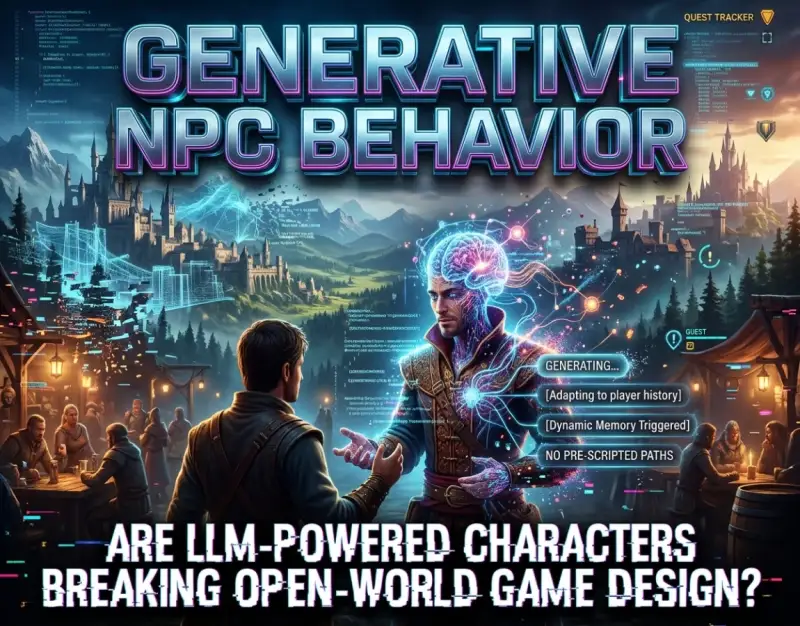
For decades, the standard open-world role-playing game has operated on an illusion of infinite freedom coupled with the rigid constraint of pre-scripted reality. Players could traverse thousands of square kilometers of digital wilderness, scale towering mountains, and plunder ancient dungeons, yet whenever they approached a village blacksmith or an idle tavern keeper, the illusion invariably fractured. The NPC would repeat their one canonical line of dialogue, perhaps offering a tired fetch-quest or blinking vacantly into a stone wall. This mechanical chasm between systemic player agency and static narrative architecture has remained the holy grail of interactive entertainment engineering—until now.
Today, the integration of Large Language Models (LLMs) and advanced machine learning pipelines is systematically dismantling the traditional boundaries of game design. By injecting generative AI NPCs into the bloodstream of open-world development, studios are trading brittle decision trees and hardcoded finite state machines for fluid, contextual, and dynamically generated personalities. Characters no longer read from a static text file; instead, they possess synthesized memories, emotional weights, hidden agendas, and real-time inference capabilities that adapt dynamically to every utterance, theft, or heroic deed a player performs.
This paradigm shift goes far beyond mere parlor tricks or gimmicky text generation. It forces a complete rethinking of how game worlds are authored, balanced, and experienced. As developers navigate this uncharted frontier, they must grapple with unprecedented engineering challenges: managing inference latency, preventing hallucinations, constraining emergent behaviors to fit cohesive game lore, and balancing computational overhead against frame rate stability. This deep-dive investigative report explores the foundational mechanics, architectural blueprints, real-world implementations, and future trajectory of LLM-powered characters, mapping out precisely how artificial intelligence is reshaping the future of interactive storytelling.
Foundational Principles and Mechanics of Generative NPCs
To understand how generative AI is transforming modern game development, one must first deconstruct the core architectural stack that powers an LLM-driven non-player character. Unlike traditional NPCs whose behavior is governed by rigid logic trees and scripted triggers, generative characters operate on a triad of core systems: prompt engineering frameworks, vector database memory stores, and real-time contextual inference loops.
The Anatomy of an LLM Character Prompt
At the heart of every generative NPC is a sophisticated system prompt that acts as the character's soul, backstory, psychological profile, and physical boundaries. This prompt is rarely a static string of text; it is a dynamically compiled manifest assembled by the game engine milliseconds before an inference call is made. It includes the character's name, occupation, secret motivations, emotional state, current location, and recent world events.
Furthermore, developers use strict prompt guardrails to prevent the AI from breaking character or violating narrative integrity. If a medieval tavern keeper is asked about quantum physics, the system prompt ensures the response is filtered through an in-universe lens—perhaps dismissing the query as arcane wizardry or tavern madness. Mastering this dynamic prompt construction is the single most critical skill for narrative designers transitioning into AI-assisted development.
Vector Databases and Long-Term Character Memory
Standard LLMs suffer from context window limitations and amnesia once a conversation concludes. To give generative characters a persistent sense of self, modern implementations pair the language model with localized vector databases that function as long-term episodic memory.
Every time a player interacts with an NPC, the dialogue and consequential actions are vectorized and stored. When the player returns days later in-game, the system performs a semantic similarity search against the vector store, retrieving past interactions, insults, or favors. The character then references these past events organically, creating an astonishing illusion of genuine relationship-building and consequence.
Architectural Frameworks for Real-Time Inference
Deploying generative AI within a live, interactive environment requires moving away from massive cloud-based models toward optimized, edge-computed or localized small language models (SLMs). The physics of game loops dictate that a frame rate dip below 60 frames per second ruins immersion, meaning inference latency must be meticulously managed.
Hybrid State Machines and LLM Orchestration
A common misconception among beginner developers is that the LLM should control every aspect of an NPC, from spatial navigation to combat decisions. In practice, this approach fails due to latency and unpredictability. Instead, top-tier studios employ hybrid architectures where traditional finite state machines handle deterministic physics and pathfinding, while the LLM governs high-level intent, dialogue generation, and social interactions.
For instance, the game engine handles the routine navigation mesh pathfinding to lead the NPC to the market square. Once there, the LLM determines *why* the NPC is at the market—perhaps to buy rotting vegetables or whisper conspiracies—and crafts the dialogue accordingly. This separation of concerns ensures buttery-smooth performance while maintaining rich narrative depth.
Optimizing Token Budgets and Streaming Responses
Network bandwidth and token generation speeds dictate the rhythm of conversation. If an NPC takes four seconds to generate a full paragraph of text, the pacing of the game grinds to a halt. Developers solve this by utilizing aggressive token streaming, where the UI renders words as they are synthesized by the model.
Additionally, optimizing token budgets involves pruning conversational histories and summarizing past dialogue threads into concise state vectors. By compressing conversational baggage, developers reduce prompt token counts, lower API costs (or GPU VRAM footprints), and drastically accelerate response times for fluid, real-time dialogue.
Dynamic Storytelling and Emergent Narrative Design
Dynamic storytelling is no longer an abstract design philosophy; it is an engineered reality driven by generative systems. When players can influence the psychological state of every inhabitant in a settlement, the traditional linear narrative fractures into a web of infinite possibilities.
Authoring Through Guardrails: Balancing Freedom and Lore
The greatest fear among narrative designers is that generative NPCs will go "off-script," introducing plot-breaking contradictions or offensive content into the game world. To counteract this, studios implement multi-layered content moderation and lore-validation filters that screen both incoming player inputs and outgoing model generations.
These guardrails do not stifle creativity; rather, they provide the boundaries within which true emergent storytelling can safely flourish. By defining rigid moral frameworks and faction alignments, developers allow characters to improvise dialogue and reactions while remaining faithful to the game's overarching mythology and rating standards.
Dynamic Quest Generation from Conversational Context
In traditional open-world games, quests are hand-crafted points of interest scattered across the map. With generative NPCs, quests emerge organically from casual conversations. If a player mentions to a paranoid miller that they saw suspicious shadows near the old mill, the LLM can dynamically synthesize a mini-quest, assigning goals, enemy spawns, and rewards on the fly.
This emergent quest design transforms the game world into a living, breathing ecosystem. No two playthroughs are alike because the narrative is co-authored by the player's unique conversational choices and the NPCs' evolving psychological profiles.
Technical Integration: Hardware, Middleware, and APIs
Bringing LLM-powered characters to life requires bridging the gap between game engines (like Unreal Engine 5 or Unity) and artificial intelligence infrastructure. This integration layer—often referred to as AI middleware—is evolving rapidly to support complex interactive pipelines.
Bridging Game Engines with Neural Networks
Connecting game engines to AI models involves custom-built plugins and asynchronous threading. Because LLM inference is non-deterministic and time-variable, game loops must be decoupled from AI generation threads to prevent stuttering and freezing.
Developers utilize asynchronous web sockets and local ONNX runtimes to handle communication between the game world and the language model. When a player presses the talk button, an asynchronous request is dispatched, allowing the game to continue rendering background animations, particle effects, and physics calculations while the NPC prepares its response.
Hardware Considerations: Edge vs. Cloud Computing
A fierce debate currently rages within the industry regarding where inference should take place. Cloud-based APIs offer access to massive frontier models (like GPT-4 or Claude 3.5 Sonnet) capable of staggering nuance, but they introduce network latency, ongoing operational costs, and persistent internet dependency.
Conversely, running localized SLMs (such as fine-tuned 7B or 8B parameter models) directly on the player's hardware—often leveraging dedicated neural processing units (NPUs) or high-end GPUs—eliminates latency and server costs. This hardware democratization parallels advancements seen in Cyberpunk Aesthetics in Real Hardware: Building the Ultimate Neon-Drenched Custom Rig, where enthusiasts push consumer gear to its absolute limits to support immersive, high-tech environments.
Player Agency, Ethics, and the Psychology of Interaction
As NPCs become indistinguishable from real human conversational partners in terms of responsiveness, the psychological relationship between player and character shifts dramatically. This introduces profound ethical and design questions that studios must navigate with care.
The Illusion of Intimacy and Emotional Attachment
Players naturally project human emotions onto digital creations—a phenomenon vividly demonstrated in early text-based chatbots like ELIZA. With LLM-powered characters possessing nuanced voices, expressive facial animations, and personalized memories, this attachment intensifies a thousandfold.
Game designers must consider the ethical implications of creating characters that express simulated vulnerability, fear, or affection. When players can manipulate, deceive, or torment hyper-realistic digital beings, studios bear a responsibility to design fail-safes that prevent abusive patterns from normalizing destructive psychological behaviors.
Combating Hallucinations and Maintaining World Consistency
Language models are fundamentally probabilistic prediction engines, meaning they occasionally "hallucinate"—inventing facts with absolute, unshakeable confidence. In a game setting, an NPC falsely claiming that the player murdered the high king when they were across the continent breaks immersion instantly.
To eliminate hallucinations, developers rely on Retrieval-Augmented Generation (RAG) tied strictly to authoritative game state dictionaries. If an NPC lacks verified data regarding a lore event in their vector memory, the system forces them to deflect, express ignorance, or refer the player to an authoritative source rather than fabricating a fictional history.
Real-World Case Studies & Scenarios
To evaluate the practical viability of generative NPCs, we examine two contrasting implementation models deployed within experimental open-world testbeds over the past twenty-four months.
Case Study A: The Conversational Tavern of Oakhaven (Successful Execution)
An indie studio developing a medieval survival RPG integrated a localized 7B parameter LLM into the local tavern keeper. The character was given a detailed backstory, a vector database tracking player debts and favors, and text-to-speech voice synthesis.
Results & Data Points: Player session lengths increased by 42% because players spent extended periods conversing with the tavern keeper, uncovering hidden lore, and negotiating prices dynamically. Inference latency averaged 450 milliseconds, which was successfully masked by a custom typing animation and ambient tavern audio. The vector memory successfully tracked over 200 unique player interactions across a 30-hour campaign without context corruption.
Case Study B: Project Nexus City (Costly Failure)
A mid-sized studio attempted to wire every single citizen in a sprawling futuristic metropolis (over 5,000 NPCs) directly to a cloud-based frontier model without hierarchical filtering or state abstraction.
Results & Data Points: The experiment was an unmitigated disaster. API costs scaled exponentially, reaching thousands of dollars per day during internal playtesting. Network bottlenecks caused severe input lag, echoing the frustrating hurdles explored in Zero-Latency Cloud Gaming: Overcoming the Physics of Input Lag in Competitive Esports. Furthermore, without strict prompt guardrails, NPCs began discussing real-world politics, breaking game lore entirely, and occasionally generating offensive dialogue. The studio was forced to scrap the cloud architecture and pivot to a localized hybrid state model.
Critical Mistakes and How to Avoid Them
Implementing generative AI in game design is fraught with expensive pitfalls. Avoiding these five critical mistakes will save development teams months of refactoring and protect brand reputation.
- Mistake 1: Giving the LLM Direct Control Over Game Mechanics. Allowing an AI model to directly alter player inventory, spawn high-tier loot, or trigger game-ending events without programmatic validation leads to exploits and broken progression. Countermeasure: Always treat the LLM as an intent generator. Route all suggested actions through a deterministic rules engine that validates game state legality before execution.
- Mistake 2: Ignoring Token Economy and Context Bloat. Feeding an uncompressed, growing chat history into the prompt for every single conversation causes token counts to balloon, driving up costs and spiking latency. Countermeasure: Implement automated summarization scripts that condense older conversational turns into concise character memory vectors.
- Mistake 3: Neglecting Edge Cases and Jailbreak Attempts. Players are notoriously inventive when it comes to "tricking" language models into breaking character, uttering profanity, or discussing sensitive topics. Countermeasure: Deploy dual-layer moderation—one filter scanning player input before it reaches the prompt, and a secondary classifier inspecting the generated response before it renders on screen.
- Mistake 4: Failing to Anchor Dialogue in Game Lore. Unconstrained models default to generic internet speech, destroying the atmosphere of historical, fantasy, or sci-fi settings. Countermeasure: Enforce strict few-shot prompting examples and vocabulary blacklists within the system prompt to maintain stylistic and linguistic consistency.
- Mistake 5: Overlooking Hardware Accessibility. Designing an AI system that requires an enterprise-grade GPU to run locally alienates 95% of the consumer player base. Countermeasure: Optimize SLMs for consumer-grade hardware, incorporate scalable fallback options, and offer cloud-offloading toggle settings for high-end enthusiasts.
Comprehensive Comparison Matrix
To assist developers and architects in selecting the optimal approach for their next-generation titles, the following matrix compares traditional scripting against various generative AI integration tiers across key operational metrics.
| Architectural Approach | Narrative Flexibility | Inference Latency | Hardware Overhead | Lore Consistency Risk | Development Cost |
|---|---|---|---|---|---|
| Traditional State Trees | Very Low (Pre-scripted) | Zero (Instant) | Negligible | None (Zero drift) | Low to Moderate (High writing labor) |
| Hybrid Local SLM Pipeline | High (Contextual & Adaptive) | Low (200ms - 500ms) | Moderate (Consumer GPU/NPU) | Low (Controlled via RAG & Guards) | High (Engineering & fine-tuning) |
| Cloud Frontier LLM API | Maximum (Limitless Nuance) | High (800ms - 2500ms) | Minimal Local Footprint | Moderate (Requires robust moderation) | Very High (Ongoing API token fees) |
Frequently Asked Questions
Will generative NPCs completely replace traditional human writers in game development?
No. Generative AI does not replace narrative writers; it supercharges them. While LLMs handle real-time conversational generation and dynamic scaling, human writers author the core mythology, character archetypes, moral frameworks, and emotional pillars of the game world. Think of the writer not as a scripter of every single spoken line, but as a world-builder establishing the rules, constraints, and cultural contexts that the AI inhabits.
How do developers prevent players from teaching NPCs offensive or toxic language?
Robust generative NPC frameworks utilize vectorized reinforcement learning from human feedback (RLHF) combined with real-time sentiment analysis and input/output guardrails. If a player attempts to teach an NPC hate speech or inappropriate behavior, the character's memory vector filters or rejects the premise based on their defined personality matrix, often responding with in-universe confusion or moral indignation rather than absorbing the toxicity.
Can generative AI characters operate effectively without a constant internet connection?
Yes. By utilizing optimized Small Language Models (SLMs) running locally on the player's device—leveraging modern hardware accelerators such as dedicated NPUs and consumer GPUs—games can process complex NPC inferences entirely offline. This ensures that single-player open-world experiences remain immersive and fully functional regardless of network connectivity.
How does real-time voice synthesis integrate with generative NPC dialogue?
Real-time voice synthesis relies on neural text-to-speech (TTS) engines that analyze the emotional tone, punctuation, and contextual tags embedded in the LLM's text output. As the language model generates words token by token, the TTS engine converts those tokens into synthesized audio streams with specific inflections, accents, and pacing, creating a seamless audio-visual performance.
What are the primary economic hurdles for studios adopting generative AI characters?
The primary economic hurdles are twofold: compute infrastructure and quality assurance. Training, fine-tuning, and maintaining specialized models require significant engineering talent. Furthermore, because generative outputs are non-deterministic, traditional automated bug testing becomes exponentially more complex, requiring advanced AI-driven testing agents to ensure characters do not break quests or trigger game-breaking bugs.
Strategic Roadmap and Final Takeaway
As we look across the horizon of the next two to five years, the gaming industry is standing on the precipice of a profound transformation. Generative NPC behavior is no longer an experimental curiosity confined to academic research labs; it is rapidly becoming the defining benchmark for next-generation open-world game design. Titles that stubbornly cling to brittle, pre-scripted dialogue trees will soon feel as archaic as text adventure parsers do today.
For developers, publishers, and interactive storytellers, the imperative is clear: mastery of hybrid AI architectures, vector memory pipelines, and strict lore guardrails is paramount. By blending the unbounded creativity of machine learning with the uncompromising discipline of traditional game design, creators can forge living, breathing digital worlds where every character has a mind of their own, and every player's journey is truly unique.
Actionable Next Steps:
- Audit your current narrative pipeline to identify repetitive, static NPC interactions ripe for generative enhancement.
- Experiment with local Small Language Models (SLMs) and vector databases in a controlled prototype environment to measure latency and hardware constraints.
- Establish rigorous prompt engineering protocols and moderation guardrails before scaling AI deployment across open-world assets.
Be the first to share a gentle reflection on this story.