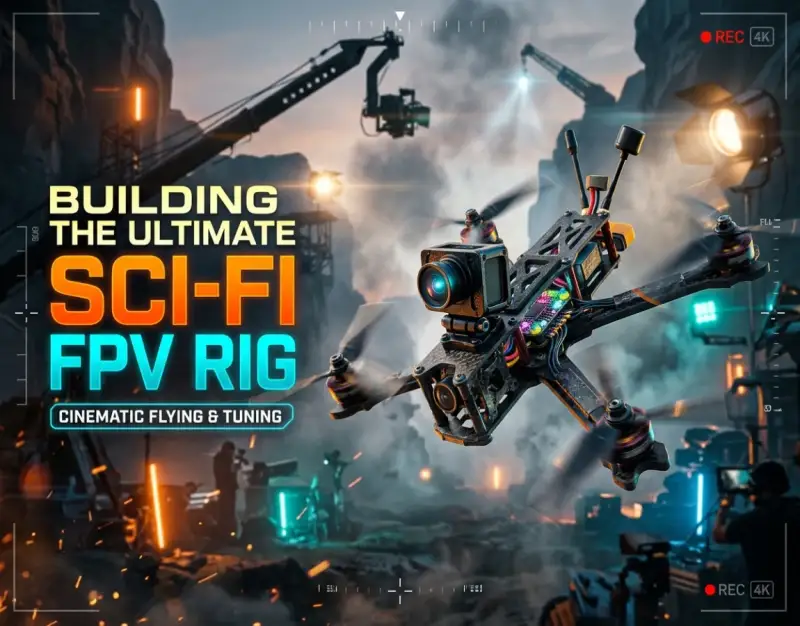
Modern sci-fi cinema demands visual movements that push far beyond the boundaries of traditional physical camera rigs. Standard camera cranes, motorized gimbals, and conventional GPS-stabilized commercial quadcopters are bound by dynamic inertia and automated safety envelopes. They lack the extreme angular acceleration, raw thrust-to-weight performance, and sub-millisecond control authority required to thread through tight neon-drenched alleyways, follow high-speed vehicles in enclosed urban canyons, or mimic hypersonic spacecraft maneuvers. When a film director visualizes an relentless, seamless sequence shot diving down a mega-structure's maintenance shaft, conventional cinematic tools fall short.
Enter specialized acrobatic FPV (First-Person View) cinematic rigs. Merging high-voltage electronic propulsion architectures pioneered in competitive FPV drone racing with ultra-high-definition, high-dynamic-range cinema payloads, these custom quadcopters represent the bleeding edge of kinetic camera work. By liberating the camera operator from automated flight stabilization algorithms and placing raw, manual 6-DOF (Degrees of Freedom) control directly into the hands of an experienced pilot, cinematic FPV opens unprecedented creative horizons for speculative fiction, cyberpunk, and action filmmaking.
However, bridging the gap between high-speed manual flight dynamics and surgical visual stability is one of the most demanding engineering challenges in modern production. It requires an intimate understanding of structural carbon dynamics, high-frequency electronic speed controller (ESC) switching frequencies, custom proportional-integral-derivative (PID) loop calibration, sensor fusion, and digital radio-frequency (RF) signal propagation. This comprehensive guide breaks down the end-to-end engineering blueprint for designing, constructing, and fine-tuning an ultra-agile 6S FPV cinematic rig explicitly engineered for high-octane sci-fi filmmaking sets.
Foundational Principles & Mechanics of Cinematic FPV Systems
To engineer a flight platform capable of pulling 5+ Gs of acceleration while keeping a cinema sensor vibration-free, you must first master the fundamental mechanics governing high-performance FPV physics. Unlike commercial photography drones that rely heavily on optical flow sensors, barometers, and satellite lock to hover stationary, an acrobatic cinematic FPV quadcopter operates in complete manual mode (also known as Acro or Rate mode). In this regime, pilot stick inputs translate directly to target rotation rates along the Roll, Pitch, and Yaw axes, executed instantaneously by changing motor RPMs.
The primary performance metric for a cinematic rig is its power-to-weight ratio (or thrust-to-weight ratio, TWR). While a standard freestyle rig operating on a 4S (14.8V) lithium-polymer architecture might achieve a 5:1 TWR, a modern sci-fi filming rig carrying a cinematic camera like a RED Komodo, Freefly Wave, or customized naked GoPro requires a high-voltage 6S (22.2V) or 8S (29.6V) architecture to achieve a dynamic TWR between 7:1 and 10:1. This immense power envelope ensures that the drone retains immediate control authority during hard evasive pull-outs, sharp dives, and instantaneous reversals, preventing prop wash turbulence from corrupting the shot.
Equally critical is understanding sensor mechanics and dynamic resonance. High-kv brushless motors spinning custom-pitched propellers generate structural harmonics across multiple frequency bands (typically between 100Hz and 500Hz). If these high-frequency vibrations leak into the flight controller's internal Gyroscope (IMU) or the cinematic camera's optical sensor, the result is double-vision motion artifacts known as "jello" or severe rolling shutter distortion. Achieving smooth sci-fi motion graphics requires balancing structural mass distribution, isolating motor vibrations through tuned dampening silicone, and configuring multi-stage digital filters within the flight controller firmware.
Section 1: Frame Dynamics and Structural Geometry for Sci-Fi Sets
Carbon Fiber Layup, Weave Patterns, and Resonance Suppression
The structural foundation of any high-velocity cinematic FPV rig begins with its chassis. Traditional carbon fiber frames utilize standard 3K plain weave carbon, which provides adequate tensile strength for general flying but lacks the dampening properties required for high-speed cinema payloads. For an ultra-agile film rig, frames constructed from Japanese Toray T700 or T800 high-modulus carbon fiber are necessary. T700 carbon offers exceptional torsional rigidity and significantly higher impact resistance, ensuring that motor vibrations dissipate predictably along the arms without creating unpredictable frame resonance nodes.
When selecting a frame, evaluate arm thickness and chamfering. Thin 4mm arms flex violently under heavy motor load, creating high-frequency arm oscillations that confuse the flight controller's PID loop. A cinematic sci-fi rig should feature a minimum of 6mm to 8mm thick carbon arms with 45-degree chamfered edges to reduce aerodynamically induced drag. Additionally, integrating interlocking central sandwich plates with titanium structural hardware eliminates frame play, ensuring that every movement commanded by the flight controller translates directly into physical displacement without energy loss.
True-X vs. Deadcat vs. Hybrid Cine-Geometries
Frame geometry fundamentally dictates both flight characteristics and optical clarity. Standard "True-X" frames feature equal spacing between all four motor shafts, positioning the center of thrust directly over the center of gravity. While True-X provides the absolute purest acrobatic feel and perfectly symmetrical roll-to-pitch handling, the front propellers will inevitably protrude into the field of view (FOV) of wide-angle cinema lenses (such as 10mm to 14mm focal lengths typical in sci-fi establishing shots).
To solve this, specialized frame architectures must be deployed based on filming demands:
- Deadcat Geometry: The front arms are swept backward and widened, pushing the front propellers out of the camera's FOV. However, this offsets the center of gravity (CG) relative to the center of thrust, requiring discrete PID offset tuning to prevent pitch authority degradation.
- Wide-X / Hybrid Geometry: The front arms are slightly widened while retaining symmetrical distance from the CG along the roll axis. This minimizes spatial asymmetry while keeping props out of view for lenses up to 120-degree diagonal FOV.
- Inverted Ducted (Cinewhoop) Geometries: Designed for close-proximity filming near actors or delicate props. Highly inefficient at high speeds due to duct drag, but structurally mandatory for interior sci-fi set penetration.
Section 2: Propulsion System Engineering: Motors, ESCs, and Power Delivery
Stator Sizing and Motor KV Selection for Heavy Cinema Payloads
The heart of an ultra-agile rig is its brushless propulsion system. Brushless motors are designated by their stator diameter and stator height (e.g., 2207, 2306, 2808). For a lightweight cinematic rig carrying a stripped-down action camera, a 2207 or 2306 motor provides rapid throttle response due to lower rotational inertia. However, for carrying actual cinema cameras or pushing through high-speed wind currents on outdoor set locations, larger stators like 2807, 2808, or 3110 are required to provide the raw electromagnetic torque necessary to maintain precise RPM control under load.
Motor KV (revolutions per minute per volt applied) must be meticulously matched to operating voltage and propeller pitch. Running a high-voltage 6S (22.2V nominal) LiPo setup with a 2807 stator requires a KV rating between 1300KV and 1750KV. Selecting too high a KV results in excessive thermal build-up, motor desynchronization (desyncs), and severe battery voltage sag during aggressive maneuvers. Conversely, choosing too low a KV reduces maximum top-end speed, compromising high-speed tracking shots alongside accelerating vehicles.
High-Frequency ESCs and AM32/BLHeli_32 Configurations
The Electronic Speed Controller (ESC) acts as the bridge between the flight controller’s mathematical requests and the physical motors. Modern 4-in-1 ESC architectures utilized in cinematic rigs must support high continuous current loads (60A to 80A per channel, with 90A burst capacity) and operate on 32-bit ARM microprocessors running AM32 or BLHeli_32 firmware platforms. These high-speed processors permit variable Pulse-Width Modulation (PWM) drive frequencies, shifting drive switching rates from traditional 24kHz up to 48kHz or 96kHz.
Increasing the ESC PWM frequency to 48kHz or 96kHz fundamentally transforms motor dynamics. It smooths out low-throttle motor response, dramatically reduces prop wash turbulence, and lowers motor temperatures by eliminating micro-stutters during high-speed decrescendo moves. High-demand sustained maneuvers generate immense thermal output, making heat management paramount; just as extreme computing demands aggressive thermal dissipation through Liquid Metal Cooling vs Phase Change Loops: Pushing Extreme Overclocking Beyond Limits, high-amp cinematic ESCs require dedicated aluminum heat-sinks, high-conductivity thermal pads, and continuous airflow to prevent thermal throttling mid-flight.
Section 3: Digital Video Transmission and Signal Propagation
Low-Latency High-Definition VTX Architectures
Precision cinema piloting requires absolute spatial awareness and real-time visual feedback. Legacy analog video transmissions provided near-zero latency (under 15ms) but suffered from low resolution, static noise, and severe interference, making it dangerous to navigate complex, obstacle-dense sci-fi sets. Modern digital FPV system platforms—such as the DJI O3 Air Unit, Walksnail Avatar HD, and HDZero—have revolutionized set operations by transmitting high-definition 1080p or 4K video feeds directly into the pilot's FPV goggles.
For cinematic flying, system latency stability is far more critical than average latency speed. A system that sits at 20ms but unpredictably spikes to 70ms during low-signal events will cause the pilot to over-correct stick inputs, introducing visible jitter into the camera's trajectory. Cinematic pilots should utilize locked-bitrate modes (e.g., locking DJI O3 at 50Mbps or Walksnail at 25Mbps) rather than variable modes to ensure predictable frame delivery, allowing the pilot to maintain surgical trajectories through tight geometric openings.
Antenna Array Optimization and RF Penetration
Sci-fi film sets are often heavily fortified structures featuring reinforced concrete, metallic structural trusses, reflective glass, and high-power wireless equipment (such as wireless follow-focus systems, video village transmitters, and radio communications). This creates a brutal RF environment dominated by multi-path interference—where video signals bounce off metallic surfaces and collide with the primary signal, causing video packet loss or total blackout.
To guarantee signal integrity, the drone's video transmitter (VTX) must be paired with high-gain, circular-polarized antennas (LHCP or RHCP) configured in a dual-diversity array. Equipping the quadcopter with long-stem omnidirectional antennas elevates the radiating elements above the carbon fiber frame and cinema camera battery stack, preventing the frame’s dense carbon structure from casting RF shadows over the receiver. On the ground station end, combining dual omnidirectional antennas with directional patch antennas ensures robust signal penetration deep into industrial sets.
Section 4: Flight Controller Architecture and Sensor Fusion
STM32 H7 Processing Power and SPI Bus Speeds
At the center of the control loop sits the Flight Controller (FC). The processing demand placed on a cinematic FC is immense: calculating real-time dynamic notch filters, processing bi-directional DShot telemetry, computing multi-axis PID loops, and running state estimation algorithms hundreds of times per millisecond. Cinematic rigs should exclusively deploy STM32 H7 microcontrollers (such as the H743 or H722 processors operating at clock speeds up to 480MHz).
The processing architecture must utilize high-speed Serial Peripheral Interface (SPI) buses to communicate with onboard sensors. A high-bandwidth SPI connection enables the FC to read raw gyro telemetry at rates of 8kHz (8,000 samples per second) without experiencing bus saturation or processing bottlenecks. This ultra-fast loop allows the FC to identify and filter out motor noise before it ever affects flight stability, creating a buttery-smooth flight characteristic essential for wide-format cinematic sensors.
Neural and Manual Flight Control Parallels
Achieving perfect visual compositions in acrobatic manual mode demands complete sync between human intention and physical vehicle rotation. When flying at 80 miles per hour through narrow gaps, muscle memory must execute stick commands instinctively. The cognitive link between pilot visual processing and motor response closely mirrors research into direct brain control; just as advanced neural interfaces blur the line between thought and action in Brain-Computer Interfaces in Gaming: Bypassing Controllers for Direct Neural Input, high-frequency flight controllers eliminate system latency to make the quadcopter feel like a natural extension of the pilot's own nervous system.
Section 5: Precision Flight Controller Tuning for Cinematography
Master PID Loop Calibration for Zero Prop-Wash
Proportional-Integral-Derivative (PID) tuning is where mechanical engineering transforms into cinematic performance. The PID controller continuously calculates the error between the pilot's desired rotation rate (set by stick position) and the physical quadcopter's actual rotation rate (measured by the gyro), adjusting motor output to compensate. A stock-tuned quadcopter will exhibit "prop wash"—a violent shaking phenomenon caused when the drone drops through its own turbulent downwash air during vertical dives or hard turns.
To tune out prop wash for heavy cinematic builds, follow this methodical calibration approach:
- P-Gain Optimization: Increase Roll and Pitch P-gains until the frame responds instantly to stick inputs without overshooting or high-frequency oscillation during sharp snaps.
- D-Gain Dampening: Increase D-gains to smooth out P-term overshoots and dampen prop wash turbulence. Monitor motor temperatures carefully—excessive D-gain causes motors to overheat within seconds.
- I-Gain Stabilization: Raise I-gain (Integral) on Pitch and Roll to ensure the drone maintains its precise angle when fighting external aerodynamic crosswinds or asymmetric center-of-gravity drag profiles.
- Anti-Gravity Configuration: Increase the Betaflight Anti-Gravity gain multiplier (typically to 5.0 - 8.0). This momentarily boosts I-gain during rapid throttle punches, preventing the nose of the drone from dipping when accelerating hard down film set pathways.
Feedforward Smoothing and RC Rate Curves
While dynamic P and D gains handle physical disturbance rejection, Feedforward (FF) dictates how the drone reacts directly to control stick movements. High feedforward yields hyper-reactive stick response essential for gate-racing, but introduces jittery, robotic movements into cinema footage. For smooth sci-fi camera moves, Feedforward must be tuned alongside dedicated smoothing algorithms.
Configure "Actual" or "Quick" rates in firmware to create an ultra-smooth exponential curve around center-stick (Expo), while capping maximum angular rotation rates to around 400°/s to 600°/s (compared to racing rates which often exceed 1000°/s). Enable Feedforward Transition filters to ensure that initial stick movements accelerate the camera smoothly into wide arcs, producing the sweeping, cinematic motion profiles characteristic of big-budget space-opera sequences.
Section 6: Cinema Payload Integration and Mechanical Isolation
Alpha-Gel and Silicone Damping Matrix Engineering
Attaching a $5,000+ cinematic camera to a high-speed FPV drone frame without proper isolation will instantly ruin shot captures. Mechanical vibrations generated by propeller rotation and aerodynamic vortex shedding travel directly through carbon fiber plates into the camera body. If these high-frequency vibrations match the resonant frequency of the camera sensor’s rolling shutter, severe image warping ("jello") occurs across every frame.
Isolation requires a tuned multi-point dampening matrix using specialized polymers such as Alpha-Gel or high-durometer silicone dampeners (typically rated between 30A to 50A durometer depending on camera mass). Soft dampeners (30A) isolate low-mass action cameras effectively, while heavier cinema payloads require stiffer 50A silicone bobbins arranged in a 4-point or 6-point compression-shear pattern. The mounting tray must isolate the camera in both the vertical (thrust) axis and rotational (pitch/roll) axes simultaneously.
Center-of-Gravity (CG) Balancing across Pitch and Roll Axes
Mass centralization is critical for multirotor agility. If a cinema camera is mounted far forward on the top plate to avoid prop visibility, the quadcopter becomes nose-heavy. To balance the aircraft, the heavy 6S LiPo battery (typically 1800mAh to 4500mAh) must be offset backward along the bottom or top deck. The combined Center of Gravity (CG) of the frame, camera, battery, and VTX must sit precisely at the geometric center of the four motor shafts.
An unbalanced CG forces specific motors to operate continuously at higher baseline RPMs just to keep the drone level. This severely degrades available thrust headroom, causes uneven motor heating, and induces severe asymmetric prop wash during complex maneuvers. Test the CG by balancing the fully loaded rig on a fingertip placed beneath the center of the top plate—the aircraft must rest perfectly level in both pitch and roll axes.
Advanced shot pre-visualization software and virtual simulation environments are increasingly used to plan complex aerial camera trajectories before deploying physical rigs on set. Much like how modern gaming environments utilize adaptive algorithms detailed in Generative NPC Behavior: Are LLM-Powered Characters Breaking Open-World Game Design? to predict dynamic entity motion, cinematographers use 3D flight simulators to pre-render precise FPV flight lines through digital twin environments, ensuring absolute safety before executing high-risk real-world takes.
Real-World Case Studies & Filming Scenarios
"Building a custom cinematic FPV platform isn't just about raw speed—it is an exercise in absolute balance between brute kinetic force and surgical mechanical vibration suppression."
Scenario A: The High-Speed Cyberpunk Alley Chase
The Production Objective: Track a high-speed vehicle driving down a tight, neon-lit industrial alleyway at night, dive past metal fire escapes, execute a 180-degree yaw re-alignment overhead, and pull out through a second-story window gap.
Execution Strategy: The team deployed a custom 6-inch Wide-X hybrid frame running 2807 1500KV motors on a 6S 2200mAh LiPo stack. The camera mount utilized a 45A silicone isolation plate hosting a naked GoPro Hero12 shooting at 4K 120fps with shutter speed locked at 1/240s for natural motion blur. Dynamic RPM filtering was tuned specifically to suppress 2nd and 3rd harmonic vibrations caused by high-pitch 6x4.5x3 propellers.
Outcome & Metrics: The rig sustained a top speed of 78 mph down the alleyway while maintaining less than 0.2 degrees of dynamic tilt variance. Signal strength via DJI HD video transmission remained solid at 50Mbps despite surrounding concrete structures, producing a seamless, ultra-fluid single-take shot that was stabilized in post-production using Gyroflow telemetry data.
Scenario B: The Enclosed Industrial Turbine Tunnel Dive
The Failure Mode (Initial Attempt): Operating a standard 5-inch freestyle quad inside an abandoned power plant's steel turbine tunnel resulted in severe violent prop wash, unrecoverable roll wobbles, and an eventual high-speed crash into a steel bulkhead.
Root Cause & Resolution: The initial failure was caused by two main factors: static low-frequency PID tuning that couldn't clear recirculating airflow turbulence inside the enclosed tunnel, and severe multi-path radio interference from surrounding steel walls. The build was upgraded to an STM32 H7 flight controller running Betaflight 4.4 with dynamic notch filters set to 4 count, ESC PWM frequency locked at 48kHz, and a specialized directional patch antenna array on the pilot's receiver. The re-tuned rig
Be the first to share a gentle reflection on this story.