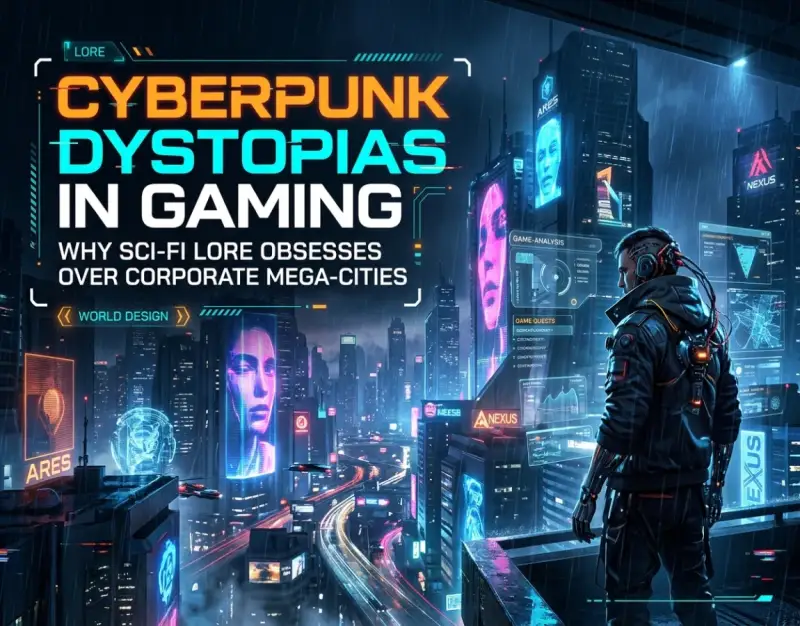
From the rain-slicked, holographic canyons of Night City to the suffocating, tiered industrial hives of The Ascent’s Veles, interactive entertainment maintains an unrelenting obsession with the corporate mega-city. For decades, speculative fiction toyed with various apocalypse vectors—nuclear winter, fungal plagues, and planetary ecological collapse. Yet, no speculative canvas has embedded itself quite so deeply into modern sci-fi gaming lore as the hyper-dense, privatized metropolis ruled not by sovereign nations, but by monopolistic conglomerates. The mega-city is not merely a visually arresting backdrop designed to showcase volumetric lighting and ray-traced reflections; it functions as a comprehensive sociological apparatus, a narrative crucible that reflects contemporary anxieties about unchecked techno-feudalism, systemic commodification, and environmental devastation.
The contemporary evolution of cyberpunk tropes within gaming marks a radical departure from the genre’s initial literary emergence in the 1980s. Early cyberpunk literature, penned by luminaries like William Gibson and Bruce Sterling, functioned as an urgent cautionary subversion of Reaganomics and the sudden emergence of the personal computer. Today, game developers and narrative designers do not treat the corporate mega-city as an eccentric future hypothetical, but rather as an amplified, extrapolated mirror of our present reality. The ubiquity of global corporate consolidation, algorithmic surveillance, spatial inequality, and transhuman labor extraction has turned the urban arcology into the premier playground for systemic conflict. Gamers do not merely observe these spaces; they survive within them, navigate their strata, and interface with their brutalist architectures.
To understand why this motif commands such disproportionate real estate in interactive media requires dissecting how dystopian worldbuilding interfaces with ludic systems. Mega-cities provide a uniquely perfect alignment between environmental design, systemic gameplay loops, and thematic resonance. Within the boundaries of an arcology or a sprawling corporate sprawl, every physical boundary is justified by socioeconomic stratification, every enemy type represents a specific tier of the corporate hierarchy, and every mechanical upgrade mirrors the tragic erosion of human agency in exchange for survival. This investigative analysis deconstructs the architectural, economic, and psychological frameworks that make the corporate mega-city the enduring apex of speculative narrative design.
Foundational Principles: The Anatomy of the Corporate Sprawl
Before examining the tactical implementation of these worlds in contemporary game design, we must establish the core structural mechanisms that differentiate a generic science fiction metropolis from an authentic corporate dystopia. The genre does not operate solely on aesthetic signifiers like neon typography, synthetic rain, and trench coats; it relies on an interconnected architecture of economic theory, spatial psychology, and sociological mechanics.
At the center of this framework lies the complete erosion of the public sphere. In traditional urban planning, civic architecture serves communal, administrative, or leisure functions theoretically open to all citizens. In corporate dystopian lore, the concept of public land is obsolete. Every square meter of concrete, every breath of scrubbed oxygen, and every photon of synthetic sunlight is proprietary real estate owned by competing cartels. This fundamental shift converts citizenship into consumer tenancy, immediately raising the ludic stakes: the player-character is permanently trespassing, defaulting on service fees, or operating as an unsanctioned variable within a closed, privatized ecosystem.
This dynamic manifests through three governing mechanics of narrative design:
- Extraterritorial Sovereignty: Corporate entities maintain autonomous legal jurisdictions. Transgressions are not handled by public judiciary systems, but by private paramilitaries and internal asset-recovery divisions. In game mechanics, this provides clean factional borders where different rules of engagement, law enforcement thresholds, and aesthetic paradigms seamlessly collide across adjacent street blocks.
- Spatial Stratification: Topography directly mirrors wealth distribution. The atmospheric upper decks house executive boards in pristine, bio-engineered aeries, while the undercity drowns in the literal and metaphysical runoff of the strata above. This vertical divide serves as a direct spatial map for player progression, gating higher-tier content behind socioeconomic ascendance.
- The Transhuman Ledger: Biological reality is subordinated to industrial efficiency. Cybernetic augmentations, neural implants, and biometric monitoring are not voluntary cosmetic enhancements; they are mandatory workplace equipment amortized over lifetimes of debt-bonded labor.
1. Deconstructing Hyper-Verticality: Spatial Stratification as Socioeconomic Narrative
The Basal Underbelly vs. The Stratospheric Arcology
Hyper-verticality is the defining architectural signature of the corporate mega-city. By stacking civic layers atop one another, worldbuilders create a physical manifestation of class warfare that players can comprehend intuitively without reading a single codex entry. In games like Deus Ex: Mankind Divided (specifically within Golem City) or The Ascent, the transition from bottom to top is a masterclass in visual semiotics. At ground level—or beneath the bedrock—infrastructure is corroded, improvised, and dark. Industrial heat exchangers vent superheated toxic exhaust directly into living quarters, and architecture is composed of salvaged corrugated plating and discarded shipping containers.
As the camera or player ascends toward the apex of the arcology, the visual grammar undergoes a profound systemic transformation. Rust, exposed cabling, and flickering fluorescent lights give way to clean brutalist marble, self-cleaning composite alloys, panoramic skyboxes, and filtered atmospheric biomes. The narrative design reinforces a crushing thematic reality: the lower levels exist solely to thermally, mechanically, and metabolically sustain the paradise perched upon their shoulders. The physical sky becomes an unattainable luxury good, hoarded by corporate elites who have commodified clean air and daylight.
Vertical Level Design: Guiding Player Psychology Through Elevation
From a spatial design perspective, hyper-verticality solves an enduring dilemma in game development: environmental containment. Open-world games often struggle with artificial boundaries, relying on invisible walls, radiation zones, or impassable mountain ranges. The vertical arcology, conversely, weaponizes claustrophobia. Elevation shifts allow level designers to stack dense, highly detailed playable environments directly on top of each other, drastically reducing the physical footprint of the map while exponentially increasing environmental density.
When the player moves downward into the subterranean infrastructure, gameplay mechanics naturally adapt to feelings of vulnerability, resource scarcity, and mechanical isolation. Ammunition caches thin out, ambient audio shifts toward grinding machinery and dripping sewage, and encounter spaces contract into brutal, close-quarters choke points. Conversely, infiltration missions into upper corporate penthouses reward the player with expansive sightlines, luxurious vertical traversal mechanics, and advanced technological loot—yet frame the protagonist as a filthy pathogen invading a surgically sterile host.
2. Corporate Extraterritoriality and Synthetic Feudalism in Sci-Fi Gaming Lore
The Ergonomics of Corporate Hegemony: Logos as Sacred Iconography
In modern dystopian worldbuilding, the state has not withered away; it has been acquired through leveraged buyouts. The sovereign flags of history have been replaced by corporate heraldry. Narrative designers treat corporate branding not as decorative visual noise, but as the primary vehicle for political storytelling. Fictional conglomerates—such as Arasaka and Militech in Cyberpunk 2077, the Sarif Industries and Tai Yong Medical duopoly in Deus Ex, or the Weyland-Yutani Corporation throughout science fiction media—are developed with rigorous brand identities that govern their architecture, weaponry, uniforms, and dialect.
This branding is deeply psychological. Corporate logos saturate every available surface, operating as persistent visual reminders of subjugation. Billboards utilize biometric scanning to broadcast personalized advertisements directly to the player's HUD, transforming sensory perception into an advertising battleground. By weaponizing modern marketing semiotics, developers turn ordinary consumer touchpoints into tools of existential horror. The player realizes that within these concrete canyons, life itself is licensed, subject to terms of service, and revocable upon insolvency.
"The ultimate victory of corporate dystopian lore is convincing the citizen that there is no alternative to the arcology. When the outside world is painted as an uninhabitable wasteland, the corporation's concrete cage is perceived not as a prison, but as a benevolent life-support system."
Private Security States and Ludic Conflict Generators
Corporate extraterritoriality provides narrative design with an elegant solution for dynamic, factional conflict. Because national law enforcement does not exist, different municipal zones are policed by competing private military contractors (PMCs). This structure generates organic ludic friction. A player might be hunted mercilessly by a heavy-weapons security division in an industrial manufacturing district, only for the pursuit to abruptly terminate at an invisible border crossing into a commercial sector governed by a rival security apparatus.
This fragmentation of civic authority allows developers to construct complex systemic gameplay loops. Players can manipulate corporate rivalries, playing PMCs against one another in mercenary contracts, smuggling operations, and corporate espionage. The city ceases to be a static backdrop and becomes an aggressive, volatile ecosystem where the player's survival relies entirely on navigating the precise margins between competing quarterly revenue goals.
3. The Transhuman Ledger: Augmentation as Labor Enslavement and Mechanical Agency
Cyberware Mechanics: Balancing Mechanical Power with Narrative Alienation
No element of cyberpunk tropes is more intrinsically linked to player progression than cybernetic augmentation. From a purely ludic standpoint, cyberware is the perfect RPG upgrade loop: players trade acquired capital for double-jump legs, dermal armor, reflex boosters, and retinal displays. However, high-tier sci-fi gaming lore distinguishes itself by subverting this power fantasy, ensuring that every mechanical advancement carries a distinct existential and socioeconomic cost.
When narrative design is executed correctly, cyberware is not framed as a transhuman triumph of the will, but as an extreme manifestation of industrial alienation. In games like Syndicate (2012) or Ruiner, mechanical enhancements are industrial tools designed to squeeze maximum productivity out of human capital. Workers install pneumatic limbs to survive twelve-hour shifts in deep-bore mines, only to find themselves permanently indebted to the manufacturer for maintenance, synthetic anti-rejection immunosuppressants, and firmware subscriptions. The flesh becomes a battleground where the worker's biological autonomy is systematically foreclosed by corporate property claims.
Neural Interfacing and the Disappearing Biological Self
The logical endpoint of this mechanical commodification is the direct subjugation of human consciousness. Neural interfaces collapse the distinction between user and operating system. While games explore this through hacking mini-games and tactical time-dilation mechanics, the narrative implications are far more unsettling: the brain becomes susceptible to data corruption, memory manipulation, and direct psychological override. For a deeper examination of how cutting-edge hardware mirrors these speculative anxieties, explore how real-world innovations are shaping interactive experiences in Brain-Computer Interfaces in Gaming: Bypassing Controllers for Direct Neural Input.
By forcing the protagonist to interface directly with corporate mainframes, narrative designers strip away the last sanctuary of human agency. Memories can be bought, sold, or forged; trauma can be commodified into entertainment braindances; and deceased assets can be digitally reconstituted into compliant, non-unionized cognitive software. The corporate mega-city does not merely conquer physical territory—it strip-mines the soul.
4. The Aesthetics of Decay: Environmental Storytelling in Megacity Infrastructure
Thermal Inefficiency and Industrial Brutalism
The physical atmosphere of the corporate mega-city is governed by the laws of extreme thermodynamics. Millions of servers, cooling towers, industrial fabricators, and millions of living bodies concentrated into a narrow geographic footprint produce unimaginable quantities of waste heat. Authentic dystopian environmental design communicates this through persistent microclimates: constant localized acid rain condensed from chemical cooling towers, eternal steam billowing from storm drains, and an inescapable, oppressive thermal haze.
In high-performance gaming, rendering these harsh thermodynamic realities requires immense visual processing, matching the raw, extreme thermal management demanded by real-world elite enthusiast rigs—a dynamic detailed in our breakdown of Liquid Metal Cooling vs Phase Change Loops: Pushing Extreme Overclocking Beyond Limits. Within the game engine, this physical infrastructure tells a brutal narrative: the mega-city is a machine that burns through human lives to prevent its internal components from melting down.
Clutter, Refuse, and Architectural Parasitism
Exceptional environmental storytelling in modern dystopian worlds relies heavily on "architectural parasitism"—the concept of unauthorized, improvised human structures clinging to the exterior shells of massive corporate monoliths. Where a megacorporation erects a 200-story sheer concrete support pillar, hundreds of dispossessed citizens anchor makeshift shacks, hanging walkways, tapped power conduits, and bootleg communications arrays to its flanks.
This parasitic aesthetic creates an intoxicating visual tension between corporate megalomania and raw human resilience. Every dangling fiber-optic line, spliced power junction, and black-market vendor stall represents an act of everyday defiance against an urban landscape designed to eradicate human messiness. The density of visual clutter communicates survival: citizens use the blind spots of corporate surveillance networks to carve out micro-economies, turning the architectural waste products of late-stage capitalism into the scaffolding of their daily existence.
5. Populating the Sprawl: NPC Dynamics and Systemic Societal Friction
The Illusion of Society: Simulating Urban Despair at Scale
A mega-city is only as convincing as the citizens who walk its pavement. Historically, open-world cities have suffered from a fundamental disconnect: breathtaking architecture populated by lifeless, repetitive non-player characters (NPCs) wandering on simplistic patrol routes. However, modern narrative design demands that the population of a corporate dystopia visibly carry the weight of their systemic oppression.
This requires complex behavioral programming, procedural animation systems, and layered audio design. Citizens are seen lining up for synthetic water rations, panhandling outside automated luxury clinics, or huddling around radioactive waste barrels for warmth. To fully understand how emergent computational paradigms are transforming these dense, populated urban ecosystems, examine the structural shift toward Generative NPC Behavior: Are LLM-Powered Characters Breaking Open-World Game Design? When background characters exhibit unscripted, reactive behaviors driven by systemic desperation, the mega-city transitions from a static digital film set into an unpredictable, living sociopolitical pressure cooker.
The Narrative Contrast: Corporate Suits vs. Street Mercenaries
The dynamic tension of the corporate sprawl is sustained by sharp contrasts in social archetypes. Modern sci-fi lore avoids a homogenous aesthetic by emphasizing the sheer, irreconcilable gulf between corporate wage-slaves, executive predators, and the underclass. Corporate middle managers are rendered in sharp, monochromatic geometric suits, speaking in bloodless corporate jargon, completely terrified of demotion or reassignment to lower strata. They represent the quiet horror of institutional compliance.
Opposing them are the denizens of the street: fixers, deckers, solo mercenaries, and black-market bio-surgeons. Dressed in chaotic, highly expressive, anti-surveillance couture, their visual identity is an explosive rejection of corporate homogeneity. By oscillating between these two socioeconomic spheres, game designers grant the player a unique, liminal status. The protagonist is an outsider who walks among both gods and outcasts, exposing the rot at the core of the machine while simultaneously bleeding for its scraps.
Real-World Case Studies: Architectural Narrative in Modern Gaming
Case Study 1: Night City (Cyberpunk 2077) – Spatial Storytelling as Narrative Cartography
CD Projekt RED’s Night City remains one of the most structurally ambitious executions of the corporate mega-city in interactive entertainment history. Designed with the consultation of actual urban planners, Night City avoids the common trap of feeling like a random collection of futuristic buildings. Instead, it is divided into distinct historical and socioeconomic rings that tell a chronological story of corporate colonization.
The City Center represents the unyielding triumph of corporate capital—monumental, unscalable towers designed to dwarf the individual human form. Surrounding this core is Santo Domingo, an endless industrial sacrifice zone of automated factories and impoverished single-family tenements, deliberately neglected to keep a cheap labor pool readily accessible. Pacifica stands as the physical monument to speculative corporate real estate abandonment: an entire luxury district half-built, drained of venture funding, and left to decay into a combat zone. Night City succeeds because its worldbuilding is fully spatialized; you can read the city's economic history simply by driving from its center to its margins.
Case Study 2: Hengsha (Deus Ex: Human Revolution) – The Two-Tiered Metaphor
Eidos-Montréal’s vision of Hengsha in Deus Ex: Human Revolution serves as the genre's purest mechanical realization of hyper-vertical stratification. The city is literally split into two distinct physical plates: the lower Hengsha district, a labyrinth of cramped, lightless streets bathed in amber hues, and the Upper Plate, an enormous suspended megalopolis constructed directly overhead to house Tai Yong Medical's executive class.
What makes Hengsha a triumph of narrative design is the constant, suffocating psychological presence of the Upper Plate. As players navigate the lower city, looking up does not reveal clouds or the cosmos; it reveals the colossal, ribbed steel underbelly of the elite's private sanctuary. This structural ceiling actively blocks the sun, traps pollutants, and serves as an inescapable visual reminder that no matter what the player achieves on the streets, they are operating beneath someone else's floorboards. It translates Marxist socioeconomic theory into direct, physical geography.
Critical Mistakes in Dystopian Narrative Design (And How to Avoid Them)
-
Neon Without Consequence (Style Over Substance):
The most pervasive failure in amateur cyberpunk game design is treating the genre solely as an aesthetic template—a pastiche of glowing pink neon signs, wet asphalt, and kanji characters with zero underlying sociopolitical critique. The Countermeasure: Every visual asset must possess an economic justification. Why is the sign neon? Because synthetic gas is the cheapest available luminescent compound. Why is it in Japanese or Mandarin? Because global transnational conglomerates acquired municipal infrastructure during the last sovereign debt crisis. Ground every stylistic choice in corporate logistics.
-
The Monolithic "Evil Corp" Caricature:
Writing a corporate antagonist as a cartoonishly malicious entity that burns down orphanages for fun immediately dissolves narrative tension. Real corporations commit atrocities through bureaucratic indifference, cost-benefit spreadsheets, and legal arbitration. The Countermeasure: Frame corporate malevolence through systemic inertia, middle-management cowardice, and banal optimization metrics. The horror should stem not from the villain's passion, but from the realization that an algorithm determined human lives were simply more expensive than regulatory fines.
-
Neglecting the Food and Resource Chain:
Amateur dystopian worlds often construct cities of thirty million people without ever answering basic infrastructural questions: What do they eat? Where does their water come from? Where does their solid waste go? The Countermeasure: Embed industrial life support directly into environmental storytelling. Feature automated hydroponic megatowers, algae paste processing factories, artificial meat cloning vats, and gray-water recycling pipelines. These details ground speculative lore in brutal, physical plausibility.
-
Ludonarrative Dissonance in Augmentation Upgrades:
Treating cyberware merely as positive, stackable RPG stat multipliers without mechanical, narrative, or psychological friction strips transhumanism of its cautionary power. The Countermeasure: Introduce systemic mechanical consequences. Force players to manage cyberware rejection, firmware obsolescence, or susceptibility to remote corporate hacks. If augmentations are purely advantageous, the core dystopian thesis of bodily alienation is lost.
-
Static Skybox Syndrome:
Confining the player to street level while treating the massive corporate towers merely as distant, unreactive skybox textures breaks spatial immersion. The Countermeasure: Establish constant systemic interactions between ground and sky. Implement high-speed orbital shuttle flybys, sweeping corporate searchlights that trigger combat alert states, falling construction debris, or dynamic weather systems where acid precipitation actively degrades armor durability.
Mega-City Archetypes in Sci-Fi Gaming: A Structural Comparison
| City Archetype | Defining Spatial Mechanic | Primary Narrative Theme | Exemplary Game Titles | Ludic Gameplay Focus |
|---|---|---|---|---|
| The Fully Sealed Arcology | Contained, self-sustaining vertical hive structure. Movement restricted strictly by security clearances. | Totalitarian containment, irreversible class segregation, absolute corporate micro-governance. | The Ascent (Veles), Citizen Sleeper (Erlin's Eye) | Vertical dungeon crawling, deck-by-deck progression, resource scavenging in dead mechanical zones. |
| The Two-Tiered Megalopolis | A physical plate or artificial ceiling separating the undercity from the executive stratosphere. | Direct architectural oppression, stolen natural resources, spatial and psychological asphyxiation. | Deus Ex: Human Revolution (Hengsha), Final Fantasy VII (Midgar) | Infiltration mechanics, contrasting atmospheric shifts, horizontal hub exploration with vertical payoff. |
| The Sprawl / Combat Zone | Unchecked horizontal and semi-vertical urban decay. Corporate control is concentrated in fortified island citadels. | The complete collapse of public infrastructure, unbridled mercenary capitalism, hyper-individualism. | Cyberpunk 2077 (Night City), Shadowrun: Dragonfall | Open-world vehicle navigation, multi-faction reputation systems, emergent street-level combat encounters. |
| The Sub-Oceanic / Orbital Habitat | Hostile exterior environment where catastrophic hull failure threatens every resident constantly. | Commodification of basic life support (oxygen, atmospheric pressure), ultimate escapism for the wealthy. | System Shock (Citadel Station), BioShock (Rapture - Proto-Dystopia) | Survival horror, environmental pressure hazards, spatial claustrophobia, systemic resource management. |
Frequently Asked Questions (FAQ)
Why do video games favor corporate dystopias over governmental totalitarian regimes?
While governmental totalitarianism (such as the bureaucratic surveillance states seen in George Orwell's 1984 or Lucas Pope’s Papers, Please) provides profound psychological horror, corporate dystopias provide far superior mechanical alignment with traditional video game loops. Corporations naturally introduce consumerism, competitive commercial factions, commercialized weapon manufacturing, modular body modification, and mercenary labor contracts directly into the narrative. This makes the corporate setting exceptionally versatile for RPG mechanics, crafting systems, and open-world mission structures.
Furthermore, contemporary audiences harbor deep, visceral anxieties regarding the real-world unchecked power of multinational tech monopolies, data harvesting, and privatized public spaces. A totalitarian government feels like a threat from the 20th century; an algorithmic, profit-maximizing conglomerate weaponizing private military contractors feels like an imminent, plausible trajectory for the 21st century.
How does environmental storytelling convey socioeconomic class in mega-cities?
Environmental storytelling communicates class primarily through the visual manipulation of light, materials, space, and acoustics. In lower-class sectors, the environment is defined by sensory overload and material decay: flickering fluorescent bulbs, abrasive synthetic audio ads, exposed conduit cabling, damp concrete, and cramped interior rooms where space is at a premium. Architecture here is reactive and patched together with cheap, disposable materials.
As the narrative shifts to the upper-class corporate tiers, game designers invert these parameters. The greatest luxury signifiers in a hyper-dense mega-city are empty space, silence, organic materials, and clean natural light. Corporate boardrooms feature expansive, minimalist floor plans, genuine wood paneling (a resource rendered nearly extinct in sci-fi lore), soundproof glass, and unrestrained views of natural skylines. The absence of industrial clutter is the ultimate statement of absolute economic dominance.
What is the difference between classic 1980s cyberpunk and contemporary sci-fi game lore?
Classic 1980s cyberpunk was born out of cold-war technophobia, the rapid rise of Japanese corporate manufacturing, and the early dawn of personal computing. Its visual identity was heavily grounded in analog-digital hybrids: CRT monitors, bulky cyberdecks, physical optic cables, cassette-futurism, and street punks fighting street-level battles with low stakes. Its tone was anarchic, gritty, and deeply countercultural.
Contemporary sci-fi gaming lore, by contrast, grapples with post-internet, late-stage digital capitalism. Today’s cyberpunk integrates real-world modern phenomena: decentralized cryptocurrency speculation, algorithmic manipulation, generative artificial intelligence, targeted biometric surveillance, global gig-economy labor exploitation, and catastrophic climate displacement. The technological aesthetic has shifted from bulky wires to sleek, subcutaneous nanotech, cloud-based neural networks, and augmented-reality projections that seamlessly contaminate the physical environment.
How can narrative designers avoid the "cliché trap" when creating a new cyberpunk city?
To avoid derivative worldbuilding, developers must aggressively interrogate the historical, geographic, and economic context of their world before placing a single neon asset. Most generic cyberpunk settings fail because they simply re-skin contemporary Tokyo, Hong Kong, or Los Angeles with glowing lights. A truly unique mega-city answers specific materialist questions: What specific historical crisis caused the collapse of municipal governance in this region? What is the city’s primary export commodity? How do the geography, local climate, and native cultural traditions push back against corporate American/East-Asian aesthetic hegemony?
Games that successfully evade the cliché trap often locate their dystopias in non-traditional environments or foreground unexpected thematic lenses. Setting an arcology in an arid post-colonial salt desert, a thawed arctic shipping basin, or framing the corporate conflict entirely through the lens of domestic municipal transit infrastructure immediately generates fresh, authentic narrative tension that transcends tired genre tropes.
Does hyper-verticality impact modern game performance and engine optimization?
Hyper-vertical level design introduces unique technical challenges for modern game engines like Unreal Engine 5 or proprietary studio tech. Traditional rendering pipelines and level streaming systems are heavily optimized for horizontal traversal; as the player walks forward, distant landscape chunks load in while the terrain behind them is occluded and unloads from memory. In a vertical mega-city, these traditional occlusion culling techniques become exponentially more complex.
When a player looks down from a 150th-floor balcony across a multi-tiered urban chasm, the engine must render dozens of overlapping vertical layers simultaneously, each packed with geometry, volumetric smoke, ray-traced reflections, dynamic crowds, and complex lighting grids. Studios must rely on aggressive Level of Detail (LOD) transitions, intelligent portal culling, and asynchronous compute pipelines to prevent catastrophic frame rate drops. Hyper-verticality is as much a test of software engineering prowess as it is of artistic narrative design.
Strategic Roadmap: The Evolution of the Mega-City (2025–2030)
As video game technology accelerates over the coming half-decade, the narrative design of corporate mega-cities is poised for a massive evolutionary leap. The static, curated illusions of past generations are dissolving in favor of dynamic, systemically interconnected urban simulations that adapt in real time to player choices and algorithmic parameters.
1. Procedural Megastructures and Fully Traversable Arcologies
The next frontier of dystopian worldbuilding will eliminate the barrier between set dressing and playable space. Currently, even in expansive titles like Cyberpunk 2077, ninety percent of the towers are hollow geometry designed to frame the sky. Over the next three to five years, improvements in automated procedural interior generation will allow developers to construct fully realized, mile-high arcologies where every single room, service duct, and residential suite can be seamlessly entered, searched, and lived in. The narrative focus will shift from street-level transit to micro-scale urban exploration, where entire campaigns can take place entirely within the confines of a single, colossal corporate mega-structure.
2. The Systemic Integration of Dynamic Corporate Warfare
Future narrative architecture will increasingly break away from rigid, pre-authored quest trees. By integrating persistent socioeconomic simulations, developers will empower players to actively influence the stock values, operational security, and physical territory of competing conglomerates. Sabotaging a corporate logistics node in the industrial underbelly will have tangible, dynamic repercussions across
Be the first to share a gentle reflection on this story.