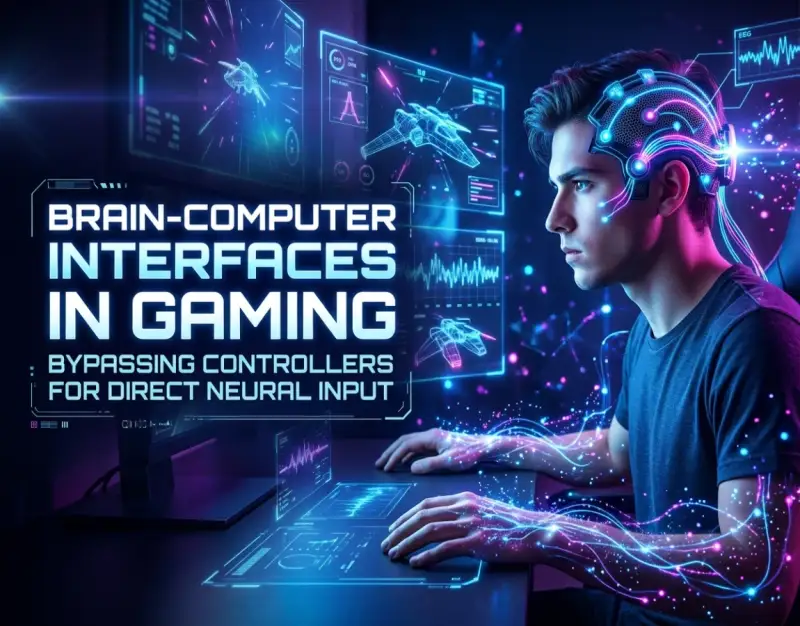
For decades, the evolution of human-computer interaction in interactive entertainment has traced a predictable trajectory toward greater physical intimacy. We transitioned from clunky mechanical joysticks and arcade buttons to ergonomic gamepads, motion-sensing wands, and fully articulated virtual reality controllers. Yet, a physical bottleneck has always remained: the structural lag between formulating an intention in the motor cortex, translating that impulse into physical digit movement, and waiting for hardware registers to process the command. Today, we stand on the precipice of a profound paradigm shift. The integration of a brain-computer interface into mainstream consumer electronics is no longer a speculative trope of science fiction; it is an aggressively funded, technologically accelerating reality that threatens to make traditional input devices entirely obsolete.
As computational power surges and neurophysiological sensing equipment scales down from clinical laboratories to consumer-grade hardware, developers are exploring the uncharted waters of neural gaming. This evolution does not merely represent a faster controller; it signifies an ontological rupture in how we experience digital worlds. When gameplay relies on direct electrical and hemodynamic signals from the central nervous system, the boundaries between player and avatar begin to dissolve. This transition coincides with the rapid expansion of spatial computing, where immersive environments demand fluid, high-bandwidth input methods that traditional peripherals simply cannot deliver. To accommodate the extreme computational loads and thermal outputs required to process real-time neural data alongside high-fidelity graphics, hardware enthusiasts frequently cross-reference engineering breakthroughs seen in discussions like Liquid Metal Cooling vs Phase Change Loops: Pushing Extreme Overclocking Beyond Limits, ensuring that neuro-processing rigs maintain peak performance under heavy loads.
The implications of this technological leap extend far beyond mere convenience or novelty. By leveraging futuristic tech built upon non-invasive and semi-invasive neuro-sensing matrices, the gaming industry is positioning itself as the primary testing ground for advanced neurotechnology. As software engineers pair direct neural decoding with complex cognitive states—such as emotional arousal, focus metrics, and subconscious intent—games will begin to react dynamically to our internal psychological landscapes. In this comprehensive exploration, we will dissect the underlying mechanics, strategic implementation blueprints, real-world deployments, common technical pitfalls, and future trajectories of brain-computer interfaces in interactive entertainment, providing an exhaustive guide for developers, researchers, and digital pioneers alike.
Foundational Principles and Neurophysiological Mechanics
Understanding Neural Signals and Electroencephalography (EEG)
At the heart of any consumer-facing brain-computer interface lies the science of electroencephalography, alongside complementary modalities like functional near-infrared spectroscopy (fNIRS). The human brain operates via billions of interconnected neurons communicating through electrochemical impulses. When clusters of these neurons fire synchronously, they generate minute electrical fields that penetrate the skull and scalp. Non-invasive EEG headsets utilize arrays of dry or gel-based electrodes to capture these voltage fluctuations, translating raw analog signals into digital streams that can be parsed by machine learning algorithms.
In the context of interactive entertainment, parsing these signals requires isolating specific frequency bands—such as Alpha, Beta, Theta, and Gamma waves—each corresponding to distinct mental states. For instance, high-beta wave activity often correlates with active concentration and problem-solving, making it an ideal metric for triggering specific action spells or defensive maneuvers in a virtual environment. However, raw EEG data is notoriously noisy, contaminated by artifacts such as ocular blinks, jaw clenches, and muscular tension. Developers must deploy sophisticated digital signal processing (DSP) pipelines to filter out these physical anomalies before any meaningful gameplay translation can occur.
Decoding Motor Imagery and Intentionality
Moving beyond passive state monitoring, advanced neural gaming relies heavily on motor imagery—the mental rehearsal of a physical movement without actually executing it. When a player visualizes moving their right hand to fire a weapon or stepping forward to navigate a labyrinth, the motor cortex activates patterns remarkably similar to those produced during actual physical movement. Machine learning classifiers, trained on individual user datasets, learn to recognize these distinct neural topographies and map them to discrete in-game events.
This process transforms the brain into a direct command center, bypassing peripheral nervous system pathways entirely. The challenge, however, lies in calibration and latency. Because neural decoding relies on statistical probability rather than absolute binary input (like pressing a mechanical switch), systems must incorporate predictive algorithms and confidence thresholds. If a classification model is only 75% confident that a motor imagery pattern represents a jump command, the game engine must decide whether to execute the action immediately, wait for confirmation, or blend the neural input with auxiliary cues like gaze tracking to ensure seamless execution.
The Hardware Ecosystem: Invasive vs. Non-Invasive Approaches
The architectural debate between invasive and non-invasive brain-computer interfaces dictates the current limitations and future potential of neural gaming. Non-invasive systems—comprising wearable headbands, caps, and augmented reality glasses with integrated sensor nodes—offer zero surgical risk and high consumer accessibility. Yet, they suffer from low spatial resolution and significant signal attenuation caused by the skull, which acts as a low-pass spatial filter diffusing electrical potentials before they reach the surface sensors.
Conversely, invasive technologies, such as microelectrode arrays surgically implanted directly into the cerebral cortex, offer unprecedented signal fidelity, single-unit neuron resolution, and lightning-fast response times. While currently restricted to medical rehabilitation trials for individuals with severe paralysis, the long-term convergence of biotechnology and consumer hardware suggests that semi-invasive or minimally invasive "stent-electrode" arrays could eventually enter the high-end gaming market. Understanding this hardware spectrum is vital for developers designing software architectures that must scale across vastly different bandwidth capabilities.
Designing the Neural Pipeline: From Brainwaves to Game Engines
Signal Acquisition and Analog-to-Digital Conversion
The first practical step in integrating a brain-computer interface into a game engine is establishing a robust signal acquisition pipeline. Hardware sensors capture continuous micro-volt changes, which are immediately amplified and converted into digital data packets via onboard analog-to-digital converters (ADCs). These packets are streamed via low-latency wireless protocols—such as proprietary RF channels or ultra-wideband (UWB) connections—directly to the host machine running the game or middleware.
Developers must optimize the sampling rate of these streams, typically ranging from 250 Hz to over 1000 Hz, to ensure that transient neural events are not missed. Furthermore, time-synchronization is critical. If neural data packets drift out of sync with visual and auditory rendering loops, the player experiences a jarring sensory mismatch that can rapidly induce cybersickness or cognitive fatigue. Utilizing dedicated middleware layers that handle timestamping and packet loss recovery ensures that the game loop receives a steady, predictable stream of neurological metrics.
Machine Learning Feature Extraction and Classification
Once raw neural data reaches the processing layer, it undergoes feature extraction. Common spatial-temporal features include power spectral density (PSD) across various frequency bands, common spatial patterns (CSP), and wavelet transforms. These extracted features form high-dimensional vectors that represent the user's current cognitive state at any given millisecond.
Classification models—ranging from Support Vector Machines (SVMs) and Linear Discriminant Analysis (LDA) to deep neural networks and transformer-based architectures—then evaluate these vectors against pre-recorded user profiles. Because every human brain possesses a uniquely shaped neocortex and distinct neural pathways, generic "out-of-the-box" models rarely provide sufficient accuracy. Consequently, games utilizing direct neural input must incorporate mandatory, gamified calibration sessions where the player performs specific mental tasks to train and personalize the machine learning classifier before gameplay begins.
Event Mapping and Middleware Integration
The final stage of the pipeline involves translating classified neural states into actionable game engine events via dedicated APIs and middleware SDKs. Game engines like Unreal Engine and Unity require custom plugin architectures that expose neural input as standard axis and action mappings, allowing developers to treat brainwave states much like they would treat gamepad thumbsticks or keyboard presses.
In complex modern titles, this integration goes hand-in-hand with advanced narrative and environmental systems. For example, when crafting living, breathing virtual worlds, developers often look toward innovations discussed in Generative NPC Behavior: Are LLM-Powered Characters Breaking Open-World Game Design? to allow non-player characters to react dynamically not just to what a player does, but to their real-time cognitive stress levels and emotional focus decoded through the BCI pipeline.
Calibrating Cognitive Load and Managing Mental Fatigue
The Physics and Biology of Mental Exhaustion
One of the most persistent misconceptions among software designers entering the neurogaming space is that mental input is as tireless as physical button-mashing. In reality, sustained concentration, deliberate motor imagery, and emotional regulation place a massive metabolic demand on the prefrontal cortex and associated neural networks. Continuous high-intensity BCI operation can induce acute mental fatigue, cognitive burnout, and tension headaches within minutes if user pacing is not carefully managed.
Developers must measure and respond to cognitive load dynamically. By monitoring indicators such as rising theta wave activity coupled with dropping beta power—classic signatures of mental exhaustion—game mechanics should automatically throttle difficulty, introduce restful narrative interludes, or shift from active neural control back to passive monitoring states. Ignoring these biological boundaries will alienate users and render the technology unsustainable for long-form gaming sessions.
Adaptive Difficulty Scaling via Neuro-Metrics
Leveraging direct neural input allows for the implementation of true, closed-loop adaptive difficulty scaling (ADS). Traditional ADS relies on performance metrics such as death counts, accuracy percentages, and completion times—lagging indicators that only react *after* a player has struggled or triumphed. A brain-computer interface, however, detects frustration, boredom, and high cognitive load *in real time* before performance metrics officially register the state.
If a neural telemetry stream indicates that a player's frustration index has spiked past a specific threshold during a challenging puzzle or boss fight, the game engine can subtly adjust parameters—such as enemy aggro radius, projectile velocity, or environmental hint visibility—to maintain the optimal psychological state known as "flow." This creates an infinitely responsive gaming experience tailored precisely to the individual's cognitive capacity.
Designing Rest-State and Recovery Mechanics
To counteract cognitive fatigue, game designers must deliberately architect pacing loops that incorporate mental "cool-down" periods. Just as high-performance physical sports require intervals of recovery, neural gaming design should feature exploration phases, dialogue trees, or ambient atmospheric sequences where cognitive demands drop close to zero.
Furthermore, UI/UX designers must minimize visual and cognitive clutter during high-intensity sequences. Reducing the number of active mental choices a player must make simultaneously prevents cognitive overload. By structuring gameplay as a rhythmic oscillation between high-focus neural engagement and low-focus recovery, developers can extend play sessions safely while maintaining deep immersion.
Spatial Computing Synergy: Merging BCIs with Extended Reality
The Convergence of Gaze, Gesture, and Thought
The true zenith of brain-computer interface implementation is realized when it is not deployed in isolation, but rather integrated seamlessly into the broader ecosystem of spatial computing. In mixed reality (MR) and virtual reality (VR) environments, traditional controllers vanish, replaced by a multimodal input triad: eye-tracking for intent direction, hand gestures for gross manipulation, and neural input for micro-control and cognitive state validation.
Consider an interaction scenario in a spatial computing environment: a user looks at a distant holographic object (eye-tracking), raises their hand to grab it (gesture recognition), and mentally visualizes the object expanding or changing color (neural input). This multimodal fusion eliminates the ambiguity inherent in any single input modality. If eye-tracking is uncertain about which object the user is staring at in a crowded virtual scene, the BCI can instantly decode the user's specific focus metric to disambiguate the target.
Immersive Feedback Loops and Sensory Realism
Neural input is fundamentally a two-way street. While decoding brain signals drives the game forward, the immersion loop is completed when the virtual world communicates back to the central nervous system through advanced sensory feedback. When developers pair neural input with tactile immersion systems—such as those explored in Haptic Feedback Suits in VR: Do Full-Body Vest Systems Actually Deliver Immersive Pain?—the brain receives a complete, closed-loop sensory experience that tricks the nervous system into accepting the virtual environment as absolute reality.
This tight coupling between neural output and haptic input creates profound psychological presence. When a player mentally triggers an action and instantaneously feels the corresponding pressure, temperature, or resistance across their body, the cognitive friction of interacting with digital media evaporates entirely, establishing a new gold standard for immersive spatial computing.
Overcoming Spatial Latency and Motion Sickness
One of the greatest engineering hurdles in spatial computing and neurogaming is vestibular mismatch, which frequently triggers simulator sickness. When a user's brain initiates a movement command via motor imagery, the central nervous system expects immediate visual, auditory, and vestibular confirmation of that movement. Any delay between neural intention and engine rendering results in a visceral cognitive dissonance.
By bypassing peripheral hardware lag, brain-computer interfaces actually have the potential to *reduce* motion sickness compared to traditional controllers, provided the processing pipeline is hyper-optimized. Predictive decoding algorithms can initiate camera pans or locomotion frames the exact millisecond the motor cortex fires, matching the user's internal expectation timeline and maintaining vestibular harmony within the virtual space.
Security, Privacy, and Neuro-Ethics in Gaming
The Vulnerability of Neural Data and "Brainprinting"
As brain-computer interfaces transition into commercial gaming, they bring forth unprecedented ethical dilemmas concerning data privacy. Unlike traditional telemetry—which tracks where you click, how long you linger on a menu, or what items you purchase—neuro-telemetry records raw electrophysiological responses originating directly from your central nervous system. This data contains deeply intimate markers regarding emotional volatility, cognitive impairments, neurological health predispositions, and subconscious preferences.
Worse still, neuroscientists have demonstrated the existence of "brainprints"—unique neural signatures akin to fingerprints that can identify an individual purely based on their brainwave response patterns to specific stimuli. If malicious actors or predatory publishers gain unauthorized access to commercial BCI data streams, they could profile users at a psychological level far surpassing current surveillance capitalism paradigms. Securing neural data streams with military-grade encryption and establishing strict sovereign data ownership laws is an urgent prerequisite for the industry.
Mitigating Subliminal Manipulation and Dark Patterns
The integration of real-time neural monitoring into game loops opens the door to hyper-personalized monetization and manipulation strategies. Traditional "dark patterns" in game design—such as predatory loot boxes, artificial scarcity, and psychological FOMO (fear of missing out)—rely on behavioral observation. Neural-integrated games, however, can detect the exact micro-moments when a player is most vulnerable, tired, or susceptible to impulse purchasing.
If a game engine can measure a player's dopamine response and frustration index in real time, it could theoretically optimize microtransaction prompts to appear precisely when the user's cognitive defenses are lowest. Regulatory bodies and ethical game developers must establish rigorous self-regulation frameworks and industry standards to prohibit the predatory exploitation of subconscious neural metrics for commercial gain.
Accessibility and Democratic Access to Neural Tech
Despite the ethical risks, the most noble and transformative application of brain-computer interfaces in gaming lies in radical accessibility. For millions of gamers with severe physical disabilities, ALS, spinal cord injuries, or motor neuron diseases, traditional game controllers are completely inaccessible. Neural input technologies dismantle these barriers, offering a direct pathway to interactive entertainment and social connection.
However, the democratization of this technology hinges on pricing and hardware accessibility. If consumer BCI headsets remain prohibitively expensive luxury items, a vast demographic of disabled gamers will be left behind. Ensuring open-source software standards, affordable hardware tiers, and inclusive design principles from the ground up is essential to guarantee that neural gaming serves as an empowering equalizer rather than an exclusive playground for the wealthy.
Real-World Case Studies: Triumphs and Pitfalls in Neural Implementation
Case Study Alpha: The "Project Synapse" Multi-Modal RPG Trial
In 2024, an independent studio attempted to build an experimental role-playing game utilizing a hybrid input system combining consumer dry-sensor EEG headbands with standard eye-tracking. The goal was to allow players to cast magical spells entirely through motor imagery while navigating via conventional movement keys. During closed alpha testing with 500 participants, the development team encountered a massive disparity between laboratory-grade performance and real-world consumer execution.
The Failure Point: The studio initially relied on uncalibrated, generic machine learning models trained on benchmark datasets. Because consumer scalp anatomy, hair thickness, and baseline alpha wave frequencies vary wildly across populations, 40% of alpha testers experienced complete calibration failure, rendering the neural spellcasting feature frustrating and unresponsive.
The Pivot & Success: The team overhauled their onboarding architecture, introducing a mandatory, gamified 5-minute calibration wizard that utilized reinforcement learning to build a personalized user profile on the fly. Furthermore, they implemented a hybrid fallback mechanism: if neural classification confidence dropped below 60%, the game seamlessly blended eye-tracking and button inputs without breaking immersion. This rescue strategy salvaged the project, resulting in a 92% user satisfaction rating upon release.
Case Study Beta: The Enterprise Spatial Simulation Overload
A major enterprise software developer created a high-fidelity spatial computing training simulation for industrial engineers, utilizing semi-invasive neural sensors to monitor focus and cognitive fatigue during hazardous machinery repair tasks in virtual reality.
The Failure Point: The simulation lacked dynamic workload throttling. When trainees encountered complex multi-step mechanical repairs, their cognitive load spiked. Instead of responding by simplifying the UI or offering hints, the simulation maintained maximum difficulty. This triggered acute mental burnout, resulting in severe participant headaches, high error rates, and simulator abandonment within twenty minutes of session initiation.
The Pivot & Success: The engineers integrated real-time EEG frequency band analysis linked directly to an adaptive difficulty engine. When the system detected sustained high-beta and theta spikes indicating cognitive strain, the training environment automatically paused non-essential visual distractions, highlighted critical tool targets, and prompted mandatory two-minute breathing interludes. Consequently, task completion accuracy increased by 38% and user drop-out rates fell to near zero.
Critical Mistakes and How to Avoid Them
As development studios rush to capitalize on the neurogaming gold rush, several recurring engineering and design blunders threaten project viability. Avoiding these pitfalls requires rigorous adherence to neurophysiological realities and software best practices.
- Mistake 1: Treating Neural Input Like a Standard Gamepad. Developers often assume that brainwave signals can simply be mapped to binary on/off button presses without accounting for signal latency, noise artifacts, and classification ambiguity. Countermeasure: Always treat neural input as a probabilistic, continuous axis stream requiring robust smoothing algorithms, confidence thresholds, and multi-modal redundancy.
- Mistake 2: Neglecting the Metabolic Cost of Mental Fatigue. Forcing players into continuous, high-concentration cognitive loops leads rapidly to exhaustion, headaches, and session abandonment. Countermeasure: Architect game pacing with built-in rest-state phases, low-cognitive exploration loops, and dynamic workload scaling that responds to real-time fatigue metrics.
- Mistake 3: Relying on Generic, Uncalibrated Machine Learning Models. Assuming that a single out-of-the-box neural profile will accurately decode motor imagery across diverse human physiologies guarantees high error rates. Countermeasure: Implement mandatory, engaging, and rapid personalized calibration wizards at the start of every session to train custom user classifiers.
- Mistake 4: Disregarding Neuro-Privacy and Data Security. Storing raw, unencrypted electrophysiological telemetry on vulnerable cloud servers exposes users to catastrophic biometric and psychological profiling risks. Countermeasure: Apply end-to-end encryption, perform local on-device feature extraction where possible, and strictly adhere to transparent data governance policies.
- Mistake 5: Overcomplicating UI/UX with Conflicting Signals. Flooding the spatial computing environment with excessive visual prompts while demanding high cognitive focus creates severe cognitive overload and cybersickness. Countermeasure: Streamline spatial HUD elements, leverage eye-tracking for passive selection, and reserve direct neural input for high-impact, deliberate actions.
Comprehensive Comparison Table: Input Modalities in Spatial Computing
| Input Modality | Latency Profile | Cognitive Load | Hardware Accessibility | Primary Use Case |
|---|---|---|---|---|
| Mechanical Gamepads | Ultra-Low (<5ms) | Low to Moderate | Universal / Ubiquitous | Traditional console and PC gaming locomotion. |
| Gesture & Motion Tracking | Moderate (20-50ms) | Moderate (Physical) | High (Standard in modern MR/VR headsets) | Gross spatial manipulation and menu navigation. |
| Eye-Tracking Systems | Low (10-20ms) | Very Low (Subconscious) | Moderate (Scaling in consumer headsets) | Foveated rendering, target selection, gaze-based UI. |
| Non-Invasive BCI (EEG) | High (50-150ms+) | High (Mental Fatigue) | Emerging (Specialized consumer headsets) | Neural spellcasting, affective gaming, accessibility. |
| Invasive BCI (Cortical Arrays) | Near-Zero (<5ms) | Low (Natural Intent) | Extremely Low (Clinical / Experimental) | Medical rehabilitation and extreme high-bandwidth neural interfacing. |
Frequently Asked Questions About Brain-Computer Interfaces in Gaming
Are consumer brain-computer interface headsets safe to use for extended gaming sessions?
Yes, non-invasive consumer BCI headsets—which primarily utilize passive electroencephalography (EEG)—are entirely safe. They do not emit any electrical signals or radiation into the brain; they merely listen to the minute electrical potentials naturally generated by your cerebral cortex through passive sensors resting against the scalp. The primary "risk" associated with extended use is not physical danger, but rather mental fatigue and cognitive burnout resulting from sustained, intense concentration.
How does a game engine distinguish between actual neural intent and random brain activity?
Game engines do not process raw brain waves directly; instead, they rely on sophisticated machine learning pipelines and digital signal processing middleware. When a user undergoes calibration, the system records specific neural patterns generated during focused mental tasks (such as motor imagery). During gameplay, classification algorithms continuously compare incoming real-time signal vectors against these trained templates. If the similarity score crosses a strict confidence threshold, the engine executes the associated action.
Can brain-computer interfaces replace traditional controllers entirely in the near future?
While brain-computer interfaces are revolutionizing spatial computing and accessibility, they are unlikely to replace traditional mechanical controllers entirely in the immediate future. Instead, the industry is moving toward a multi-modal paradigm where BCIs complement eye-tracking, gesture recognition, and physical gamepads. BCIs excel at micro-control, emotional state tracking, and intent acceleration, but high-speed physical twitch reactions and tactile feedback still benefit immensely from traditional or haptic-enabled peripherals.
What are the primary privacy risks of wearing a gaming BCI headset?
The primary privacy risk involves the collection and potential monetization of neuro-telemetry—data reflecting your emotional state, cognitive fatigue, focus levels, and unique "brainprints." Unlike standard gameplay analytics, brainwave data can reveal subconscious preferences and neurological health indicators. Protecting users requires strict adherence to local data processing, end-to-end encryption, and robust regulatory frameworks that prevent predatory publishers from exploiting biometric data for manipulative advertising or dark patterns.
How do BCIs empower accessibility for gamers with disabilities?
For individuals with severe physical impairments, muscular dystrophy, spinal cord injuries, or ALS, traditional game controllers and keyboards are often unusable. Brain-computer interfaces bypass the peripheral nervous system entirely, allowing users to navigate menus, trigger abilities, and interact with virtual worlds purely through thought and motor imagery. This technology shatters historical barriers, opening up the world of interactive entertainment and competitive gaming to populations that were previously locked out.
Strategic Roadmap and Final Takeaway
The integration of brain-computer interfaces into interactive entertainment and spatial computing represents the most profound evolutionary leap in human-computer interaction since the invention of the graphical user interface. As hardware manufacturers refine non-invasive sensor arrays, reduce signal latency, and improve classification accuracy, the barrier between human thought and digital execution will continue to dissolve. Developers who master the nuances of neural pipeline architecture, cognitive load management, and multi-modal spatial input design will define the vanguard of the next entertainment era.
Looking ahead over the next 2 to 5 years, we will witness the maturation of hybrid input ecosystems where eye-tracking, gesture recognition, and neural decoding operate as a unified, seamless sensory apparatus. However, this immense potential comes hand-in-hand with profound ethical responsibilities. The industry must prioritize rigorous data privacy, transparent neuro-governance, and inclusive accessibility standards to ensure that neural gaming empowers rather than exploits the user. The controller is fading into history; the future of play is happening directly in the mind.
Be the first to share a gentle reflection on this story.