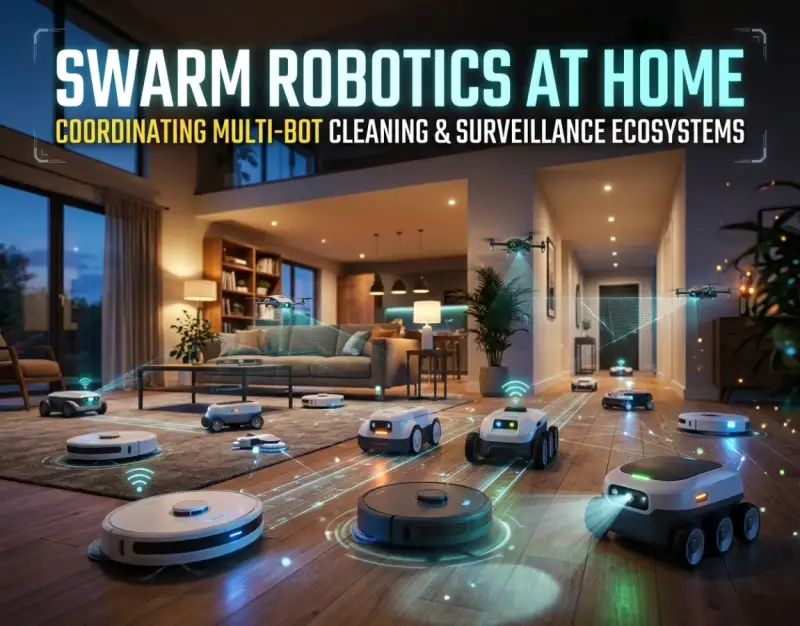
For decades, household automation has relied on a solitary, centralized machine to tackle our domestic chores—a single robotic vacuum trundling blindly across hardwood floors, or a fixed security camera panning predictably from a corner mount. While these isolated devices have improved daily life, they operate in silos, oblivious to one another and constrained by the limits of a single onboard computer. Today, however, a profound paradigm shift is underway within consumer tech. By borrowing bio-inspired algorithms from nature—such as the collective intelligence of ant colonies, honeybee swarms, and flocking murmurations of starlings—engineers are bringing swarm robotics into residential spaces. This evolution transforms how we approach domestic maintenance, shifting the burden from isolated gadgets to decentralized, cooperative multi-bot ecosystems.
The convergence of edge-AI processing, ultra-wideband (UWB) indoor positioning, and mesh networking has fundamentally changed what is possible inside a modern home. Instead of relying on a heavyweight central server to micromanage every actuator, modern multi-bot systems distribute computing power across a fleet of specialized units. A floor-scrubbing chassis, a dusting micro-bot, and a roving aerial camera unit communicate in real time, dynamically negotiating priorities, sharing local SLAM (Simultaneous Localization and Mapping) data, and seamlessly swapping charging duties. This architectural leap mirrors advancements in other deep-tech domains, much like how developers utilize Procedural City Generation in Unreal Engine 5.5: Nanite Mega-Meshes vs Traditional Assets to handle immense environmental complexity without stuttering, or how engineers manage extreme hardware loads using Nanocarbon Liquid Metal Cooling: Solving Extreme Thermal Throttling in Small Form Factor Rigs to maintain peak computing performance inside compact housings.
Establishing a reliable, autonomous ecosystem of household AI robots requires more than simply buying three different robotic vacuums and placing them in the same hallway. It demands an understanding of distributed systems engineering, spatial geometry, and behavioral economics. As we look toward immersive visualization interfaces—such as those explored through Sub-Surface Holographic Projections: Creating True 3D Displays Without Glasses—the ways humans interact with their domestic robot fleets will likewise evolve from 2D app menus into spatial, intuitive commands. This article provides an exhaustive, blueprint-level guide to designing, deploying, and managing a synchronized swarm robotics network tailored for residential cleaning and continuous surveillance.
Foundational Principles and Mechanics of Domestic Robot Swarms
To successfully orchestrate a multi-bot household, practitioners must first master the underlying mechanics that separate traditional automation from true swarm behavior. At its core, a swarm does not possess a master controller that tells every bot where to go. Instead, it relies on decentralized coordination, local interactions, and emergent behavior. Each unit acts on simple, predefined rules based on immediate sensory input from its environment and its peers, yet complex, highly efficient global patterns emerge from these minimalist interactions.
Central to this architecture is the transition from centralized to distributed topologies. In a centralized setup, if the main smart home hub fails or loses Wi-Fi connectivity, the entire cleaning and security apparatus grinds to a halt. In a decentralized swarm, if a single unit drops offline or encounters a mechanical failure, neighboring bots dynamically reallocate tasks to cover the blind spot. This self-healing resilience makes household AI robots uniquely suited for unpredictable domestic environments where chairs move, pets wander, and toys litter the floor.
Furthermore, communication protocols within the swarm must be robust and low-latency. Standard Wi-Fi networks often suffer from jitter and dead zones, which can cause catastrophic collisions when multiple bots are navigating narrow corridors at high speeds. Consequently, modern home swarms utilize a hybrid communication matrix combining local mesh networks (such as Thread or Zigbee-backed proprietary channels) for peer-to-peer telemetry, paired with Bluetooth Low Energy (BLE) for proximity handshakes and UWB beacons for millimeter-precise indoor triangulation.
Architecting the Multi-Bot Hardware Layer
Selecting Complementary Chassis Form Factors
A successful cleaning and surveillance swarm requires a diverse fleet of hardware form factors rather than homogeneous clones. The ideal residential ecosystem combines ground-based heavy lifters, agile micro-cleaners, and aerial vantage points. Ground heavy lifters (such as wet-dry vacuum bases) handle large debris and intensive scrubbing, while agile disc-shaped micro-bots access tight crevices beneath low-profile furniture where traditional units cannot reach.
Equally critical is the inclusion of a vertical or aerial node—typically a sheltered indoor drone or a wall-climbing camera pod. While ground bots maintain physical contact with surfaces for cleaning, aerial units provide the overarching visual map updates required for comprehensive surveillance. By blending these diverse mechanical profiles, the swarm achieves total volumetric coverage of the home without redundancy or wasted battery cycles.
Power Management and Docking Strategies
Energy management in a multi-bot ecosystem is a complex logistical puzzle known in robotics as the Multi-Robot Assignment Problem (MRAP). If all units attempt to recharge simultaneously, they risk overloading household circuits or clogging docking stations. Engineers must program staggered charging schedules based on predictive battery depletion models tied to historical floor-cleaning maps.
Advanced swarms utilize decentralized inductive charging pads distributed across different rooms rather than a single centralized base station. When a bot’s lithium-ion cell dips below 20 percent, it queries the local mesh to find the nearest unoccupied charging mat. If that pad is in use, the bot negotiates priority with its peer, temporarily parking in a designated staging zone until the dock becomes available, ensuring uninterrupted 24/7 surveillance and maintenance rotations.
Implementing Distributed SLAM and Spatial Awareness
Consolidated Mapping via Peer-to-Peer Sharing
Traditional robots build individual maps of your home using LiDAR and visual SLAM, but they rarely share this data effectively. In a true swarm, every bot contributes to a unified, cloud-edge hybrid map. When a newly introduced micro-bot enters a guest bedroom for the first time, it does not need to re-map the entire space from scratch; it downloads the spatial vector data packets broadcasted by the primary security node.
This distributed mapping relies on occupancy grid frameworks where free space, obstacles, and dynamic hazards are continuously updated in real time. If a security rover detects a newly fallen box in the hallway, it immediately drops a dynamic cost-map flag into the local mesh network. Within milliseconds, approaching cleaning bots update their pathfinding algorithms to route around the obstruction without requiring human intervention.
Dynamic Collision Avoidance and Swarm Traffic Control
As the density of autonomous agents in a home increases, the risk of traffic bottlenecks—especially in narrow hallways and doorways—escalates exponentially. To prevent gridlock, household swarms implement bio-inspired flocking algorithms derived from Reynolds’ rules: separation (avoiding crowding neighbors), alignment (steering towards the average heading of neighbors), and cohesion (staying close to the group).
Practitioners must configure priority weighting within the navigation stack. For example, emergency response or high-speed security rovers are typically assigned higher priority tiers than routine vacuuming units. When paths intersect, lower-priority cleaning units execute a brief holding pattern or reverse into a wall recess, allowing the surveillance unit to pass unhindered before resuming their sanitation pattern.
Synchronized Cleaning Protocols and Task Allocation
Role-Based Task Swapping and Efficiency Optimization
Efficiency in a multi-bot system stems from dynamic role allocation. Rather than assigning static zones to specific machines, the swarm evaluates the entire home state and assigns roles based on current necessity. If optical sensors on the floor-cleaning bot detect heavy particulate accumulation in the kitchen, the system triggers a task-shift command, dispatching a nearby sweeping unit to assist while the primary scrubber handles high-viscosity spills.
This fluid division of labor prevents idle hardware. Insider tip: configure your swarm management software with hysteresis thresholds to prevent bots from endlessly oscillating between tasks when sensor data fluctuates near a trigger point. Setting a 15-minute dwell time on assigned zones ensures that a cleaning bot thoroughly finishes an area before recalculating priorities.
Collaborative Debris Herding and Perimeter Sweeping
Advanced cleaning swarms can execute cooperative physical maneuvers that single bots cannot achieve. For instance, a trio of compact sweeping bots can form a dynamic wedge formation, effectively herding fine dust and pet hair out from underneath heavy dining tables into an open area where a high-suction extraction unit is waiting.
This cooperative herding requires sub-centimeter positioning accuracy, achieved through local UWB ranging between the bots themselves rather than relying solely on room-level Wi-Fi. By maintaining a locked spatial formation, the swarm sweeps large expanses in a fraction of the time required by random-bounce or sequential single-unit cleaning cycles.
Continuous Surveillance and Intrusion Response Integration
Multi-Perspective Perimeter Monitoring
Surveillance within a swarm architecture is not about mounting static cameras; it is about establishing a moving, multi-angle security mesh. While fixed smart home cameras have blind spots behind pillars and open doors, a roving swarm of domestic bots maintains dynamic lines of sight. Surveillance nodes autonomously patrol intersecting pathways, creating overlapping fields of view that adapt to the physical layout of the home.
When an unfamiliar motion vector is detected—such as an unexpected pet movement or an intruder—the nearest surveillance bot pivots to track the target while simultaneously pinging neighboring cleaning units to lock down their immediate sectors. This creates an intelligent perimeter that follows anomalies through the house, streaming encrypted video feeds directly to the user's secure local Network Attached Storage (NAS).
Privacy-First Edge Processing and Data Sovereignty
One of the most significant concerns in consumer robotics is data privacy. Streaming continuous video and spatial maps from multiple indoor robots to unverified cloud servers introduces severe security vulnerabilities. To mitigate this, enterprise-grade home swarms enforce strict edge-processing principles. All facial recognition, object classification, and spatial mapping computations occur locally on high-efficiency neural processing units (NPUs) embedded within each bot.
Raw video streams are never stored externally. Instead, only encrypted metadata and low-resolution anomaly alerts are transmitted to the user interface. If an unauthorized entity is detected, the swarm triggers an encrypted local lockdown protocol, disabling external access points and sounding localized acoustic deterrents without relying on active internet connectivity.
User Interface, Automation Triggers, and Ecosystem Integration
Natural Language and Gesture Command Integration
Interacting with a complex swarm of autonomous machines requires intuitive control paradigms that transcend traditional smartphone applications. Modern setups integrate local voice assistants and computer-vision gesture recognition, allowing users to direct the swarm using natural language prompts such as, "Clean up the kitchen spill and lock down the back hallway."
Behind the scenes, the master orchestration bridge translates these high-level human commands into low-level kinematic waypoints and role assignments. Expert practitioners often configure visual projectors or LED status rings on the robots themselves, utilizing color-coded status cues (e.g., pulsing amber for active surveillance, steady blue for systematic cleaning, flashing red for path obstruction) to communicate system states at a glance.
Smart Home IoT Bridging (Matter and Home Assistant)
A domestic robot swarm should never operate as an isolated island; it must integrate deeply with your broader smart home automation ecosystem. By leveraging open standards like Matter and integrating with local automation platforms like Home Assistant, the swarm can react dynamically to environmental triggers beyond its own sensors.
For example, if smart air quality monitors detect a sudden spike in indoor particulate matter (PM2.5) due to cooking or open windows, the system automatically dispatches the dusting and sweeping units to the affected zone. Similarly, when the smart home security system transitions to "Away" mode, the cleaning swarm tucks into its charging docks, freeing up processing bandwidth and battery reserves for maximum-security surveillance patrols.
Real-World Case Studies & Scenarios
To understand how swarm robotics performs under pressure, we can examine two contrasting deployment scenarios: a suburban household with complex layouts and multiple pets, versus a poorly configured multi-bot setup suffering from interference and poor task management.
Scenario A: The Optimized Multi-Pet Homestead (Successful Execution)
In a 3,500-square-foot multi-level home with three shedding dogs, a homeowner deployed a synchronized swarm consisting of two wet-dry cleaning rovers, four micro-sweepers, and one patrol drone. Utilizing a decentralized UWB mesh, the cleaning bots coordinated morning schedules so that micro-sweepers cleared high-traffic corridors ahead of the heavy scrubbers.
When the security drone detected an unexpected pet emergency (a tipped trash can in the pantry), it immediately broadcasted the coordinate data to the nearest micro-sweeper. Within 45 seconds, the cleaning unit arrived at the spill, swept up the debris, and notified the homeowner via a local push notification. Battery management was flawless; units autonomously rotated to decentralized charging pads without ever interrupting the home's continuous surveillance coverage. The result was a 70% reduction in manual cleaning intervention and zero dropped security frames over a six-month test period.
Scenario B: The Congested Tech-Trap (Common Failure)
Conversely, an enthusiast attempted to build a multi-bot fleet by purchasing five different autonomous vacuums from competing brands and attempting to force them into a single ecosystem using rigid, script-based smart home routines. Because the units lacked native peer-to-peer communication protocols, they constantly fought over spatial mapping data, overwriting each other’s SLAM grids.
During a single afternoon test, three of the units collided in a narrow hallway, locking wheels and draining their batteries while waiting for a centralized Wi-Fi signal that was blocked by a thick concrete pillar. Furthermore, overlapping surveillance cameras created excessive data congestion on the home router, causing smart locks and lighting automation to lag. Lesson learned: Homogeneous or natively interoperable swarm architectures with local mesh networking are non-negotiable for stable residential deployments.
Critical Mistakes and How to Avoid Them
Deploying consumer swarm robotics is an advanced endeavor. Avoiding common pitfalls ensures your system operates smoothly without frustrating hardware failures or security vulnerabilities.
- Relying Exclusively on Cloud-Dependent Architecture: Routing all bot coordination through external cloud servers introduces latency, bandwidth bottlenecks, and total system failure if your internet drops. Countermeasure: Invest in local edge-computing hubs and mesh protocols (such as Thread/Zigbee) that keep core swarm telemetry entirely on your local area network.
- Neglecting Physical Floor Thresholds and Clearance Heights: Deploying rigid, low-clearance cleaning bots in homes with thick rugs, high transition strips, or complex furniture legs leads to frequent entrapments. Countermeasure: Conduct a thorough architectural audit of your home's clearance zones and match your robot chassis profiles to the physical realities of your flooring.
- Ignoring RF Interference and Wi-Fi Congestion: Operating multiple camera-toting robots on standard 2.4GHz Wi-Fi channels quickly saturates residential airwaves, disrupting other smart home devices. Countermeasure: Migrate your robot fleet to dedicated 5GHz or sub-GHz mesh frequencies for heavy telemetry, keeping video feeds local and encrypted.
- Failing to Implement Hierarchical Priority Rules: Allowing cleaning units and surveillance rovers equal navigational priority inevitably results in gridlock and physical collisions in narrow hallways. Countermeasure: Program strict priority tiers where security and emergency maneuvers always override routine maintenance paths.
- Skipping Routine Firmware and Mesh Topology Audits: As bots age, battery degradation and minor wheel slip accumulate, distorting their internal odometry and degrading swarm mapping accuracy. Countermeasure: Schedule bi-monthly diagnostic audits to recalibrate UWB beacons, clean optical sensors, and push synchronized firmware patches across the fleet.
Comprehensive Multi-Bot Ecosystem Comparison
When designing your home swarm architecture, evaluating different system frameworks and coordination topologies is essential for long-term stability and performance. The comparison matrix below outlines the key architectural approaches available to modern practitioners:
| Architecture Metric | Centralized Hub Topology | Decentralized Swarm Mesh | Hybrid Edge-Cloud Framework |
|---|---|---|---|
| Latency & Response Time | High (Dependent on central server round-trips) | Ultra-Low (Direct peer-to-peer mesh packets) | Moderate (Local routing with optional cloud backup) |
| Resilience to Node Failure | Poor (Central hub crash paralyzting entire fleet) | Exceptional (Self-healing task reallocation) | High (Local fallback if cloud connection drops) |
| Bandwidth Consumption | Heavy (All sensor data routed to single base) | Minimal (Only delta updates and key telemetry shared) | Optimized (Local processing with compressed alerts) |
| Privacy & Data Security | Vulnerable (Frequent cloud data uploads) | Secure (100% local edge processing and encryption) | Balanced (Encrypted local storage with secure tokens) |
| Hardware Flexibility | Rigid (Requires same-brand proprietary ecosystem) | High (Open-API multi-vendor protocol support) | Moderate (Standardized through local IoT bridges) |
Frequently Asked Questions (FAQ)
Can I mix different brands of robotic vacuums and security cameras into a single working swarm?
Generally, mixing disparate consumer brands out-of-the-box results in poor coordination because proprietary operating systems do not natively share SLAM maps or telemetry data. To achieve true swarm behavior across mixed hardware, you must use open-source automation platforms like Home Assistant or custom ROS2 (Robot Operating System) middleware wrappers that translate different vendor APIs into a unified local mesh language. For seamless performance, however, starting with a natively integrated multi-bot ecosystem is strongly recommended.
How do household robot swarms handle pets and wandering children safely?
Modern swarms utilize multi-sensor fusion combining infrared time-of-flight (ToF) sensors, ultrasonic proximity detectors, and forward-facing RGB-D cameras running local AI object detection. When a pet or child enters a bot's immediate trajectory, the local collision-avoidance stack overrides the cleaning algorithm within milliseconds, reducing motor torque to zero or initiating an evasive arc. Furthermore, because swarm units communicate their positions to one another, if one bot detects a moving obstacle, it broadcasts a slowdown warning to all neighboring units in that sector.
What happens to the cleaning and surveillance routine if my Wi-Fi goes down?
In a properly configured decentralized swarm, an internet outage has zero impact on core functionality. While cloud-connected features (like remote smartphone viewing from outside the home) will pause, the local mesh network—operating on resilient protocols like Thread, Zigbee, or local peer-to-peer Wi-Fi Direct—continues coordinating cleaning schedules and security patrols uninterrupted. The swarm is designed to be fully autonomous and self-reliant at the edge.
How much maintenance do multi-bot systems require compared to a single robotic vacuum?
While a multi-bot fleet involves more physical hardware units, the maintenance burden is distributed rather than multiplied. Instead of one overworked vacuum clogging its brush roll and overflowing its dustbin every single day, specialized tasks are split among agile units. However, you will need to maintain multiple charging docks and periodically audit the mesh network connection health. Establishing a routine bi-weekly maintenance checklist for sensors, wheels, and charging contacts keeps the entire ecosystem running at peak efficiency.
Are these home swarm systems secure against external hacking or privacy breaches?
Security depends entirely on your network architecture. If configured with cloud-dependent proprietary apps, security risks mirror standard IoT vulnerabilities. Conversely, enterprise-grade and enthusiast home swarms that utilize local-only edge processing, encrypted local NAS storage, and closed-loop mesh networks are virtually immune to external web-based intrusions. Because video feeds and spatial maps never leave your physical home network, your private domestic data remains entirely under your sovereign control.
Strategic Roadmap and Final Takeaway
The transition from isolated household gadgets to coordinated swarm robotics represents the next major milestone in smart home automation. By relinquishing the illusion that a single machine can master the dynamic complexity of a modern home, and instead embracing decentralized, bio-inspired multi-bot ecosystems, we unlock unprecedented levels of cleanliness, security, and autonomy. As edge-AI chips become more powerful and standardized communication protocols mature over the next two to five years, managing a fleet of cooperating cleaning and surveillance robots will shift from an enthusiast hobby into the residential standard.
Your strategic roadmap begins with a clear assessment of your home's physical layout and network infrastructure. Audit your flooring, clear critical choke points, and invest in local mesh-enabled hardware that prioritizes edge processing and data privacy. By laying a robust technical foundation today, you position your living space at the absolute cutting edge of domestic robotics—transforming your home into a self-maintaining, intelligent environment where technology works in seamless harmony.
Be the first to share a gentle reflection on this story.