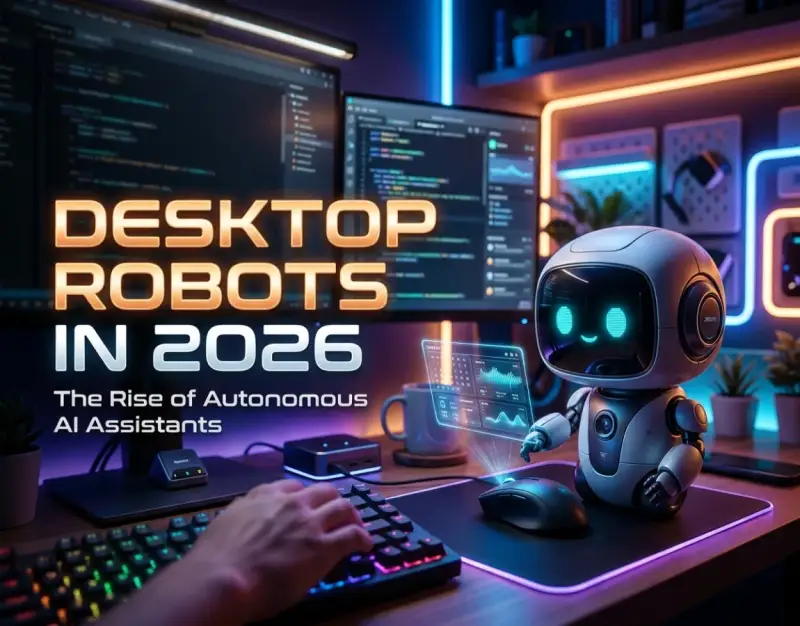
For over a decade, the promise of the autonomous smart desk was confined to voice-activated smart speakers and static software widgets. Devices like early smart hubs answered simple weather queries or set timers, but they lacked spatial awareness, physical agency, and the cognitive depth required to act as true personal partners. By 2026, a convergence of miniaturized neural processing units (NPUs), real-time vision-language-action (VLA) models, and micro-precision robotics fundamentally transformed this landscape. The modern desktop companion robot has officially evolved from an aesthetic smart gadget into an essential executive engine, bridging physical workspace interaction with autonomous digital execution.
What sets this generation of desktop robotics apart is not merely sleek physical aesthetics or expressive OLED animatronics, but their capacity for physical context sensing and proactive workflow orchestration. Unlike cloud-reliant voice assistants of the past, contemporary AI desk assistants operate hybrid local-cloud neural architectures. They perceive your eye movements, understand the contents of your physical documents through low-latency optical systems, autonomously triage digital communications, and monitor physical posture and workplace ergonomics in real time. They exist at the intersection of cognitive offloading, affective computing, and physical workspace automation.
As remote and hybrid work environments demand higher levels of self-regulation and hyper-focused productivity, desktop companion robots serve as the ambient command centers for modern professionals. This definitive guide investigates the underlying engineering, strategic workflow implementations, critical operational pitfalls, and future trajectory of autonomous AI desk assistants in 2026 and beyond.
Foundational Principles & Mechanics of 2026 Desktop Robotics
To fully grasp the transformative power of modern companion robots, one must look beyond their expressive facades to the sophisticated hardware-software synthesis driving their real-time operations. At the core of every 2026 desktop assistant is a multi-layered sensing and execution pipeline designed to process high-throughput environmental data while executing low-latency physical and digital actions.
The operational framework of a modern AI desk assistant relies on five fundamental mechanical and algorithmic pillars:
- Multimodal Sensor Fusion (MSF): Simultaneous processing of multi-spectral visual data (RGB, Time-of-Flight depth sensing, infrared), directional spatial audio arrays, and ambient physical sensors (temperature, humidity, air quality).
- Real-Time Spatial Mapping & Edge SLAM: Desktop-scale Simultaneous Localization and Mapping (SLAM) allowing the unit to navigate complex, non-static desk landscapes, avoid obstacles (beverage mugs, cables, physical notebooks), and precisely dock with wireless charging pads.
- Micro-Actuator Kinematics: Ultra-quiet multi-axis brushless servomotors paired with strain-gauge feedback loops, enabling natural, human-like head movements, gaze tracking, and physical micro-gestures without generating intrusive mechanical noise.
- Hybrid Small-Language-Model Architecture (SLM/LLM): On-device sub-3B parameter Small Language Models running on native high-TOPS (Trillions of Operations Per Second) NPUs for instant sub-20ms spatial responses, combined with cloud-hosted Large Multimodal Models for complex reasoning and workflow execution.
- Agentic Action Engines: System-level API hooks and browser automation modules allowing the robot to perform multi-step digital operations—such as scheduling meetings, cross-referencing code bases, drafting documentation, and routing local file systems—based on passive vocal commands or visual cues.
Thermal management plays a vital role in maintaining continuous high-performance neural computing within tiny desk footprints. To prevent physical throttle during prolonged agentic reasoning sessions, micro-robotics engineers have adapted principles from high-end thermal hardware design. Drawing inspiration from advanced system cooling breakthroughs—much like those analyzed in modern hardware cooling studies comparing Liquid Metal Cooling vs Phase Change Loops: Pushing Extreme Overclocking Beyond Limits—desktop companion manufacturers now utilize closed-loop micro-fluidics and vapor-chamber footings to disperse compute heat across the robot's lower structural chassis.
1. Hardware Architecture and Micro-Kinematics in 2026 Desktop Robotics
Perceptual Hardware Arrays: Vision, Depth, and Spatial Audio
The sensory apparatus of a modern desktop assistant is engineered to create an uninterrupted 3D perceptual map of the user's workspace. Primary visual capture is handled by high-dynamic-range (HDR) dual stereoscopic micro-cameras situated behind non-reflective optical housings. These sensors work alongside active vertical-cavity surface-emitting laser (VCSEL) time-of-flight depth arrays. This hybrid approach enables the companion robot to precisely track hand movements, identify read material placed on the desk, and recognize micro-expressions on the user's face even in variable ambient lighting conditions.
Audio acquisition demands equal precision. High-density micro-electromechanical systems (MEMS) microphone arrays are strategically positioned around the perimeter of the robot's base. Utilizing real-time beamforming algorithms and active noise suppression, the system isolates user speech from mechanical keyboard chatter, ambient background hums, and incoming speaker playback. This creates a clean audio feed for speech-to-text engines, ensuring vocal commands are interpreted without error, even while the robot's physical internal motors are actively engaged in movement.
Furthermore, internal state sensing is maintained through 6-axis Inertial Measurement Units (IMUs) and optical floor sensors. If the desktop assistant is physically shifted, bumped, or placed on an uneven surface, the internal IMU triggers instant self-balancing counter-movements. This sensor suite ensures that the robot maintains stable visual horizon tracking, preventing motion-induced errors in its computer vision and spatial tracking algorithms.
Expressive Kinematics and Micro-Actuator Engineering
Physical movement in desktop robotics is not merely utility; it is a critical interface medium. Early companion robots suffered from jarring, robotic movements that broke user focus and induced cognitive fatigue. 2026 architectures employ coreless micro-brushless motors integrated with magnetic rotary encoders, providing over 4,096 points of rotational resolution per degree of freedom. This fine-grained actuation allows for smooth, fluid motions that mirror organic head and eye movements.
By controlling acceleration curves via minimum-jerk trajectory algorithms, the robot achieves smooth pan, tilt, and lean dynamics. When acknowledging a user, the assistant does not abruptly snap into position; it accelerates and decelerates with biological naturalism. Dual-stage planetary micro-gearing systems built from self-lubricating synthetic polyethersulfones ensure that mechanical acoustic output remains below 15 decibels, rendering motor operation virtually imperceptible during silent work sessions.
To augment physical movement, state-of-the-art models incorporate dynamic visual indicators such as flexible micro-OLED displays or holographic light rings. These visual cues display expressive focal points, status updates, or visual focus anchors. When combined with mechanical orientation, this expressive feedback creates an intuitive physical feedback loop, informing the user exactly where the robot’s visual attention and processing priorities are focused at any given moment.
2. Software Stack: Localized Neural Processing vs. Cloud-Based Multimodal Models
On-Device NPUs and Hybrid Latency Mitigation
The operational intelligence of desktop companion robots relies on a synchronized dual-tier neural network architecture. For immediate physical interactions—such as tracking a moving hand, reacting to sudden acoustic spikes, or executing spatial balance adjustments—processing latency must remain under 15 milliseconds. Cloud routing introduces unacceptable latency spikes for these tasks. Consequently, 2026 desk bots incorporate localized system-on-chips (SoCs) delivering between 45 and 90 TOPS dedicated entirely to NPU inference.
These local NPUs run optimized quantized versions of Vision-Language-Action models (such as sub-3-billion parameter quantized networks). These lightweight models run continuously without causing thermal throttling or drawing excess power. The local NPU acts as the primary executive layer for ambient spatial monitoring, gesture parsing, and instant vocal keyword processing. It determines which perceptual inputs require immediate physical action versus which require complex, high-order reasoning.
When the user requests complex cognitive processing—such as synthesizing a 50-page document captured via the optical sensor or executing an dynamic API workflow—the robot securely offloads the context frame to a cloud-based Large Multimodal Model (LMM). The local processor manages context tokenization and local anonymization prior to transmission, ensuring that raw camera streams or unencrypted voice buffers never leave the local memory cache unless explicitly authorized.
Contextual Memory Retention and Workspace Mapping
A fundamental breakthrough in 2026 desktop assistant software is long-term, cross-modal semantic memory indexing. Traditional smart home devices treat each interaction as an isolated session. Advanced companion robots, by contrast, build continuous temporal graph representations of the user's workspace, work habits, project workflows, and physical environment over extended timeframes.
Using localized vector databases embedded directly in system flash storage, the robot continuouslyindexes contextual metadata. It remembers where physical tools (such as stylized styluses, hard drives, or note pads) were last placed on the desk, recognizes recurring project patterns based on active monitor content, and logs optimal working hours derived from user focus metrics. This spatial-temporal database allows the robot to offer proactive assistance without requiring constant user instruction.
Memory management algorithms employ automated decay and reinforcement filters. Daily routine data that proves transient is systematically purged during low-power night charging cycles, whereas frequently accessed references, personal workflow preferences, and recurring schedule frameworks are consolidated into high-priority long-term storage vectors. This approach balances low latency storage requirements with long-term personalization accuracy.
3. Agentic Workflow Integration and Automated Desk Orchestration
IDE and Office Suite Hooking via Autonomous API Calls
Beyond physical presence, the core value of a desktop companion robot lies in its capability to act as an agentic co-pilot for digital workflows. Modern companion software features direct hooks into integrated development environments (IDEs), productivity suites, project management portals, and local operating system accessibility layers. The robot functions as a physical interface for an array of background software agents.
For software developers and digital creators, this integration alters daily routines. The robot can continuously monitor continuous integration/continuous deployment (CI/CD) pipelines, visually or vocally alerting the user to build failures, pull request reviews, or critical system exceptions. Rather than relying on non-contextual desktop notification pop-ups that fragment attention, the robot utilizes non-intrusive micro-gestures—such as a subtle head turn toward a secondary reference monitor or a localized acoustic chime—to draw focus to critical operational events.
Furthermore, agentic execution capability allows the companion to perform complex cross-application tasks via voice instruction. A simple command such as *"Summarize the feedback on the latest design deck and log action items in Jira"* prompts the assistant’s cloud reasoning engine to interface directly with relevant SaaS platforms, execute API calls, parse visual assets, and update project task boards, reporting completion status via its physical interface once fully resolved.
Autonomous Focus State Management and Pomodoro Orchestration
Context switching and attention fragmentation are among the greatest drains on modern knowledge-worker productivity. Desktop companion robots are explicitly designed to act as physical guardians of focus. Utilizing continuous posture analysis, facial tracking, and active window monitoring, the assistant dynamically measures user fatigue and focus retention scores using non-invasive affective compute metrics.
When executing deep work protocols, the robot configures ambient workspace conditions. It can signal notification muting across connected mobile devices, alter smart desk illumination profiles, and adopt a static physical posture to minimize visual distraction in the user's peripheral field of view. If user glance patterns indicate systemic eye fatigue or slumping posture, the robot subtly intervenes with ergonomic micro-cues, encouraging micro-breaks or stretch routines aligned with scientifically optimized focus cycles (e.g., customized Pomodoro iterations).
The physical presence of the robot creates an intuitive anchor for focus state switching. Human psychology responds far more effectively to a physical entity signaling focus phases than to software banners. By physically altering its stance, gaze, and status indicators, the assistant establishes clear behavioral boundaries, helping users enter and maintain high-efficiency flow states.
4. Human-Robot Interaction (HRI) and Affective Computing
Non-Verbal Expression, Micro-Gestures, and Gaze Tracking
Human-Robot Interaction (HRI) in desktop environments relies heavily on physical non-verbal communication channels. Because companion robots reside in the peripheral vision field for hours at a time, intrusive vocal alerts or dramatic mechanical swings quickly become irritating. High-performance HRI relies on subtle, micro-expressive movements to communicate intent and status.
Modern companion assistants utilize dynamic gaze tracking algorithms to maintain natural mutual eye contact during active dialogue, while gracefully looking away during period of user concentration to avoid feeling invasive. Subtle physical nods indicate command comprehension, while slight head tilts signal that the NPU is actively processing complex audio input or awaiting further instruction. These movement primitives are informed by behavioral systems developed for dynamic digital entities, mirroring advances seen in Generative NPC Behavior: Are LLM-Powered Characters Breaking Open-World Game Design?, where lifelike autonomous behaviors enhance user immersion and build long-term engagement patterns.
The synchronization of physical micro-gestures with dynamic UI visuals creates a cohesive presence. A slight physical lean forward paired with a widening display iris visually communicates interest and active listening. This alignment between physical movement and visual interface assets creates an intuitive connection, reducing the cognitive load necessary to interpret the robot's computational state.
Vocal Prosody and Emotion-Aware Conversational Interfaces
Vocal communication in 2026 desktop robots has advanced far beyond the flat, mechanical text-to-speech outputs of previous decades. Current TTS engines utilize low-latency neural prosody synthesis capable of generating voice outputs featuring realistic inflection, breath pauses, dynamic cadence variations, and emotional nuance matched to the immediate conversation context.
Equally critical is input voice prosody analysis. The companion robot's local audio stack evaluates user pitch variations, speech rates, and spectral tones to infer emotional states such as stress, frustration, urgency, or fatigue. If a user exhibits signs of elevated cognitive stress during an intense task, the robot adjusts its voice synthesis parameters—lowering speaking cadence, softening pitch transitions, and delivering concise responses to reduce overall operational friction.
This bidirectional affective computing loop creates a supportive interaction dynamic. Rather than acting as a rigid computing terminal, the desk assistant operates as an adaptable, context-aware co-worker capable of matching its communication style to the user's emotional state and immediate operational needs.
5. Security, Privacy, and Perimeter Defense for Desk Surveillance
On-Premise Data Processing and Air-Gapped Modes
The integration of high-resolution cameras, directional multi-microphone arrays, and persistent context logging into intimate workspace environments brings serious privacy concerns. Desktop companion robots operate in spaces where sensitive financial data, proprietary source code, confidential customer conversations, and personal activities occur continuously. Establishing ironclad privacy boundaries is critical for enterprise deployment.
To mitigate surveillance risks, leading 2026 companion platforms incorporate physical hardware isolation architectures. Hardware-level "Air-Gap" switches physically sever power lines to the cloud communications radio (Wi-Fi 7/Bluetooth 5.4 modules) while leaving local processing hardware functional. When operated in strict Air-Gapped Mode, all vision processing, speech parsing, and task execution are handled locally within the device's native NPU and encrypted flash memory footprint, preventing remote data leakage.
Data stored locally is encrypted using AES-256-GCM standards at the hardware controller level, with cryptographic keys locked inside a dedicated Secure Element (SE) chip built directly into the main system board. Even if the physical robot is disassembled or stolen from a workspace, local context vector maps remain fully encrypted and unreadable without master hardware passkeys.
Physical Sensor Shuttering and Cryptographic Token Safety
Beyond electronic network safety, physical transparency mechanisms are necessary to provide users with absolute certainty regarding sensor states. Contemporary desktop assistants feature mechanical camera shutters and physical microphone disconnect relays that automatically activate during off-duty hours or when triggered via physical hardware switches.
Physical status indicators are hardwired directly to camera and microphone sensor power lines—rather than controlled via software logic—ensuring that an LED indicator or physical shutter state cannot be bypassed by malicious software exploits. When the physical shutter is closed, internal camera sensors are physically shielded, eliminating any risk of unauthorized visual surveillance.
For cloud communication sessions, API management uses dynamic single-use cryptographic tokens. User credentials, authentication keys, and sensitive tokens are never transmitted in clear text or cached in temporary system RAM. Instead, all external actions are validated via secure tokenization proxies, limiting exposure risks even if cloud service endpoints experience external breaches.
6. Power Management, Docking Systems, and Thermal Dynamics
Wireless Charging Mats and Precision Docking Mechanics
Continuous mobility and positioning flexibility require robust power delivery and docking mechanics. While stationary desk companion units operate via dedicated USB-C Power Delivery (PD 3.1) cables, mobile desktop robots rely on autonomous, precise wireless alignment interfaces.
Mobile desktop assistants feature underside inductive multi-coil charging arrays compatible with standard desk-integrated surface charging pads. Utilizing high-frequency near-field optical tracking paired with localized magnetic alignment pins, the robot autonomously returns to its desk charging dock when battery capacity drops below predefined thresholds (typically 15%). The docking maneuver utilizes sub-millimeter precision SLAM adjustments, ensuring perfect alignment with magnetic contacts without human intervention.
Advanced power management circuits utilize dynamic load balancing. When connected to desktop power, compute loads bypass the internal lithium-polymer battery cells entirely, supplying energy directly to the NPU micro-controllers and motor drivers. This direct powering architecture eliminates thermal accumulation inside the chassis, extends overall battery lifespan, and prevents performance degradation caused by battery overheating.
Thermal Throttling Solutions for Miniaturized Edge NPUs
Dense neural inference within compact robot architectures creates intense heat challenges. Running continuous 3D spatial mapping alongside localized speech recognition can cause compact NPU dies to hit high temperatures within minutes unless managed by efficient thermal management systems.
To overcome these physical space constraints, robotics engineers employ micro-heat pipe dissipation networks connected directly to conductive aluminum chassis components. Thermally conductive graphite sheets wrap critical processor dies, transferring heat efficiently toward structural base elements. Micro-chassis designs utilize passive chimney-convection channels, drawing cool ambient desk air through hidden lower intake slots and releasing heat out upper structural vents without requiring noisy mechanical internal fans.
System firmware monitors thermal sensors across processor dies and motor drives in real-time. If internal temperatures reach high operational thresholds, the software dynamically scales local model quantization layers—temporarily reducing non-essential vision processing frame rates from 60fps to 15fps while maintaining core voice responsiveness—to cool the system without disrupting user interaction.
7. Future Interfacing: Brain-Computer Integration and Ambient Inputs
Direct Intent Sensing and Hands-Free Cognitive Offloading
As we look toward the future of human-computer interaction, the boundary between physical desktop assistant controls and direct intent sensing is rapidly dissolving. Emerging desktop companions are designed to interface seamlessly with wearable non-invasive neural interface bands and spatial computing headsets, unlocking zero-latency intent parsing.
Rather than requiring physical vocal commands or hand gestures to initiate complex digital workflows, future systems will capture sub-vocal muscle triggers and neural focus signals directly. By linking local NPU context engines with advance neural interfaces—such as those explored in Brain-Computer Interfaces in Gaming: Bypassing Controllers for Direct Neural Input—the desktop companion can interpret user intent instantly, executing workspace alterations, pulling up referenced data files, or triaging notifications before a vocal command is even spoken.
This integration transforms the assistant into a direct extension of human cognitive intent. The robot acts as a physical execution node, translating low-power neural signals into complex multi-step digital and physical real-world operations seamlessly across the user's workspace environment.
Zero-Click Proactive Task Automation
The ultimate goal for desktop robotics is zero-click proactive automation: the capacity of an autonomous assistant to accurately anticipate user operational needs without explicit manual prompts. By synthesizing continuous multi-spectral sensory inputs, calendar schedules, email velocity, code commit histories, and biometric strain signals, the robot formulates proactive background action plans.
For instance, if an incoming high-priority system breach alert is detected while the user is actively leading a video conference call, the desktop assistant refrains from interrupting vocal streams. Instead, it quietly aggregates system diagnostics, opens relevant log files on a secondary monitor display, adjusts peripheral workspace lighting to indicate warning states, and prepares draft mitigation commands—awaiting a simple nod of user confirmation to execute system recovery protocols.
This transition from reactive tool to proactive workflow partner marks the definitive evolutionary shift in desktop robotics. It allows knowledge workers to offload high-friction administrative overhead, reclaim critical attention bandwidth, and maintain uninterrupted cognitive flow states throughout demanding operational cycles.
Real-World Case Studies & Scenarios
To understand the practical impact of deploying autonomous AI desk assistants, we examine two contrasting real-world operational deployments across high-demand enterprise environments.
| Metric / Scenario Parameter | Scenario A: Optimal Enterprise Deployment (FinTech Trading Desk) | Scenario B: Uncalibrated Standard Rollout (Creative Agency) |
|---|---|---|
| Deployed Fleet Size | 150 Custom Encrypted NPU Units | 50 Off-the-Shelf Consumer Units |
| Primary Goal | Context switching reduction & automated compliance logging | General productivity boosting & schedule management |
| Privacy Architecture | Strict Air-Gapped Mode + Local Vector Encryption | Standard Cloud Synchronized Default Settings |
| Productivity Impact (Measured) | +34% Flow State Duration; -42% Context Switching Time | -12% Focus Time (Intrusive Alerts & Auditory Noise) |
| System Security Outcome | Zero Data Spills; Passed SOC-2 Type II Audits | Incident Logged: Unencrypted Room Audio Synced to Public Cloud |
| User Adoption Rate (6 Months) | 94% Active Continuous Daily Utilization | 22% (Majority Units Stored in Desks) |
Scenario A: The High-Frequency Trading Desk Success
A global financial trading firm deployed 150 specialized desktop companion units across its trading floor. Each unit was locked to local Air-Gapped mode running custom financial SLMs locally on a high-TOPS NPU core. The units were interfaced directly with internal market data streams and execution terminals.
The assistants monitored trade execution anomalies, tracked financial news feeds visually, and provided subtle head-gestures and peripheral color-shifts to indicate market volatility threshold breaches. Traders reported a 42% reduction in cognitive context-switching fatigue because they no longer needed to continuously scan secondary ticker screens. By offloading primary alert parsing to physical desktop assistants, trader execution accuracy increased significantly over a 6-month evaluation cycle.
Scenario B: The Uncalibrated Creative Agency Failure
A digital design studio deployed 50 consumer-grade desktop companion robots to its creative team without customizing default notification parameters or establishing clear local privacy boundaries. The units operated on default cloud-sync modes, constantly sending ambient video and audio streams to external vendor servers for processing.
Within two weeks, team members reported severe attention fragmentation caused by uncalibrated physical head movements, loud default motor micro-gears, and intrusive vocal pop-ups during active client video calls. Furthermore, client confidentiality protocols were compromised when unencrypted studio room audio was backed up to public cloud endpoints. The deployment was deemed a failure, resulting in the complete removal of units within 60 days. This scenario underscores the necessity of granular hardware configuration, precise movement
Be the first to share a gentle reflection on this story.