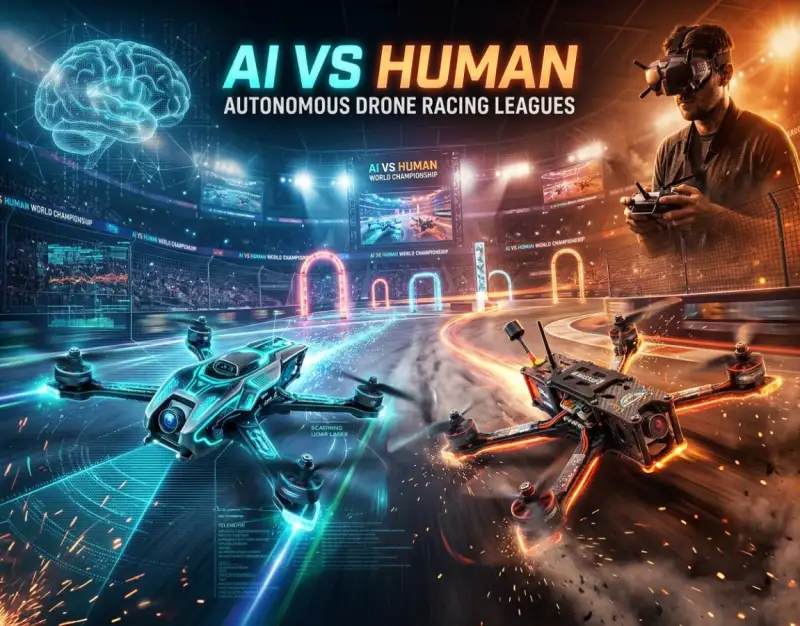
The concrete raceway inside a decommissioned industrial hangar echoes with an ear-splitting, 35,000-RPM scream. A high-voltage, custom-built first-person view (FPV) racing quadcopter blitzes through a three-meter gate at 140 kilometers per hour, pulling an instantaneous lateral turn at nearly 5G. Inside the pilot enclosure sits a seasoned world champion, goggles clamped tight, palms sweating over sensitive hall-effect gimbals, twitching muscle fibers with sub-second intuition honed over thousands of hours of high-stakes competition. Next to the human pit, however, there is no pilot chair—only an edge-computing ground station monitoring an onboard neural network running directly on an autonomous quadcopter.
For nearly a decade, human pilots ruled the skies. Flying high-power FPV quadcopters through intricate 3D gates requires an astonishing fusion of visual processing, instinctual spatial awareness, split-second predictive aerodynamics, and fine-motor neuromuscular control. While chess, Go, and StarCraft fell to artificial intelligence years ago, drone racing remained the final physical bastion of human superiority. Unlike digital games governed by clear, discrete rules, physical flight exists within a hostile, non-linear universe plagued by turbulence, ground effect, mechanical degradation, sensor noise, optical occlusions, and fluctuating battery voltage.
That barrier has decisively collapsed. The arrival of an elite autonomous racing league pitting state-of-the-art AI drone pilots against human world champions marks a watershed moment in robotics, aerospace, and machine learning. Autonomous systems are no longer merely matching human flight paths; they are redefining what is aerodynamically possible by calculating time-optimal trajectories down to the millisecond. This transition changes drone racing from an eccentric subculture into a hyper-accelerated crucible for next-generation aerial autonomy, sensor fusion, and micro-edge artificial intelligence.
Foundational Principles: The Anatomy of Ultra-High-Speed Autonomy
To grasp the scale of the engineering challenge, one must understand that standard industrial drones (such as aerial survey copters or delivery multirotors) prioritize passive stability, hover consistency, and redundant safety margins. In contrast, an FPV racing quadcopter is an aerodynamically unstable platform designed to convert raw battery wattage into instant kinetic thrust. Operating with power-to-weight ratios often exceeding 10:1, these quads cannot rely on satellite-based positioning. GPS updates at 5 to 10 Hz with an error margin measured in meters—a latency profile that would cause an instantaneous crash into a reinforced carbon-fiber gate within fractions of a second.
Autonomous racing leagues require a fundamentally distinct technology stack known as Visual-Inertial Odometry (VIO) coupled with dynamic trajectory generation and deep reinforcement learning (RL) policies. The autonomous system must resolve the classical state estimation problem: calculating its precise position, orientation, linear velocity, angular rate, and acceleration within a continuous, time-varying coordinate space. This must be executed while pulling high-G maneuvers where the camera feeds suffer from severe motion blur, light strobing, and propeller wash.
Where a human pilot processes video through standard analog or digital FPV goggles with an end-to-end biological latency of roughly 150 to 220 milliseconds (from optical stimulus to muscle actuation), an autonomous flight computer operating at 1,000 Hz can assess telemetry and execute motor speed adjustments every single millisecond. However, raw clock speed means nothing without an algorithmic model that accounts for the non-linear dynamics of multirotor thrust, aerodynamic drag, battery voltage sag, and the complex atmospheric wake left by preceding drones.
1. The Sensor Suite & Neuromorphic Vision Stack
Global Shutter vs. Neuromorphic Event-Based Cameras
Traditional autonomous multirotors utilize rolling shutter or standard global shutter CMOS sensors running at 60 to 120 frames per second. In a high-speed racing environment, these sensors introduce devastating trade-offs. Rolling shutters warp high-speed geometry, creating catastrophic errors in gate-corner detection algorithms. Global shutter sensors eliminate this spatial distortion, but they remain limited by fixed frame rates and poor performance across rapid light-to-dark transitions—a frequent occurrence when quads dive from illuminated arena ceilings into dark ground-level tunnels.
To overcome this bottleneck, leading research teams have deployed bio-inspired neuromorphic event cameras alongside high-speed global shutter optics. Rather than capturing full image frames at fixed temporal intervals, event cameras possess independent pixels that trigger asynchronously only when they detect a change in logarithmic light intensity. This architecture yields a microsecond-level temporal resolution, zero motion blur, and a dynamic range exceeding 120 dB. By combining an event camera with an IMU, autonomous flight controllers can track gate edges and structural boundaries during catastrophic rotational flips that would entirely blind both human pilots and conventional CMOS sensors.
Sub-Millisecond IMU Fusion and Extended Kalman Filtering
Vision alone cannot deliver the low-latency state updates demanded by extreme high-speed flight. The cornerstone of onboard state estimation is the tightly coupled Visual-Inertial Odometry pipeline, driven by an Error-State Extended Kalman Filter (ES-EKF) or an optimization-based sliding-window factor graph. The quad's Inertial Measurement Unit (IMU)—consisting of 3-axis gyroscopes and 3-axis accelerometers—samples raw inertial data at rates up to 4 kHz to 8 kHz.
Because low-cost micro-electromechanical (MEMS) sensors suffer from thermal drift and high-frequency vibrational noise caused by spinning motors, raw IMU integration quickly diverges into exponential position error. The autonomous pipeline uses visual gate detections and optical flow features to continuously estimate and correct sensor bias. The resulting state estimate feeds directly into the inner control loops, ensuring the quad retains its millimeter-accurate orientation even when traveling along non-linear vectors at highway speeds.
2. Edge Computing Architecture: Balancing SWaP-C Constraints
On-Board Tensor Cores and Heterogeneous SoC Design
The ultimate physical constraint in drone racing is SWaP-C: Size, Weight, Power, and Cooling. Every additional gram of silicon or battery payload degrades the drone's power-to-weight ratio, dampens rotational responsiveness, and increases battery discharge rates. Autonomous drone racing prohibits offloading compute to offboard ground stations via low-latency radio links due to RF packet loss, interference, and transmission latency. All visual processing, state estimation, and policy execution must happen entirely on board.
Engineering teams deploy specialized heterogeneous System-on-Chips (SoCs), such as Nvidia Jetson Orin Nano modules or Hailo-8 AI acceleration processors, paired with dedicated microcontroller units (MCUs) running real-time operating systems (RTOS). The SoC handles heavy convolutional operations and neural policy evaluation, while the MCU handles the mission-critical, hard real-time PID motor-mixing loops. By applying INT8 quantization, weight pruning, and TensorRT optimization to the vision pipeline, teams can compress multi-megabyte perception models into ultra-lean networks that execute in under 3 milliseconds.
Thermal Dissipation in Ultra-Dense Carbon Frames
An edge-AI computing module drawing 15 to 25 watts enclosed within a minimal carbon-fiber frame faces immediate thermal throttling. When an autonomous quad sits on the launch grid waiting for the start signal, there is zero propwash to cool the compute package. If the chip throttles from 1.5 GHz down to 400 MHz to preserve its silicon, inference latency spikes from 3 milliseconds to 15 milliseconds, causing the craft to miss its initial trajectory gate.
Advanced racing teams have turned to bespoke thermal solutions originally engineered for ultra-dense computing environments. For high-density compute stacks where traditional copper heatsinks add intolerable weight, exploring Nanocarbon Liquid Metal Cooling: Solving Extreme Thermal Throttling in Small Form Factor Rigs provides an exceptional look at managing severe thermal dissipation in lightweight, highly stressed electronics without penalizing structural balance.
In high-speed flight, ducting the propwash of the inward-spinning props directly across a thermal cold plate maintains peak processing clocks without relying on heavy passive heatsinks, ensuring continuous real-time neural inference throughout the heat.
3. Sim-to-Real Policy Transfer and Photorealistic Training
Aerodynamic Non-Linearities, Rotor Drag, and Propwash Modeling
Training an autonomous agent to pilot an FPV quadcopter directly in the real world through physical trial and error is economically impossible. Smashing dozens of multi-thousand-dollar carbon-and-silicon prototypes into solid gates every afternoon is a non-viable development loop. Instead, the breakthrough that allowed AI drone pilots to surpass human champions lies in Deep Reinforcement Learning (DRL) executed within hyper-accurate, high-throughput physics simulators.
The core computational bottleneck in this approach has always been the "sim-to-real gap." Simple blade-element theory and rigid-body mechanics fail to capture the complex aerodynamic chaos of high-speed multirotor dynamics. In real airspaces, quads encounter rotor downwash, asymmetric blade stall, ground effect during low floor-skimming sweeps, and blade-flapping drag at high advance ratios. Contemporary simulators model these non-linearities using data-driven residual physics networks—small machine learning models trained on real flight telemetry that correct the simulator’s idealized physics engine in real time.
Synthetic Data Pipelines and Photorealistic Gate Perception
Beyond aerodynamics, the vision model must seamlessly transfer from pristine digital simulations to the gritty, dust-filled visual landscape of physical arenas. If an AI policy is trained exclusively in sterile, uniformly lit digital rooms, it will misinterpret arena reflections, LED gate strobing, or crowd motion, resulting in fatal control commands.
Modern engineering workflows leverage highly optimized procedural graphics pipelines capable of randomizing textures, lighting vectors, specular reflections, and lens flares across millions of parallel iterations. To understand the sophisticated methods used to generate high-fidelity, computationally dense spatial environments, reading through Procedural City Generation in Unreal Engine 5.5: Nanite Mega-Meshes vs Traditional Assets reveals how the latest rendering architectures stream high-complexity geometry—principles identical to those used in training perception algorithms for sub-millimeter aerial navigation.
By coupling procedural visual randomization with massive parallel simulation frameworks like Isaac Gym or Flightmare, AI agents log the equivalent of hundreds of years of uninterrupted flight experience within a few real-world compute days.
4. Trajectory Generation: Time-Optimal Control vs. Reflexive Deep RL
Minimum-Snap Polynomials and Model Predictive Contouring Control
Historically, autonomous flight control relied on analytical trajectory generation. Engineers pre-computed smooth geometric curves—often using minimum-snap polynomial splines—that respected the physical constraints of the motors and frame. A Model Predictive Controller (MPC) or Model Predictive Contouring Control (MPCC) was then deployed to track the generated reference line by continuously solving a constrained optimization problem over a receding time horizon.
While MPC methods deliver mathematical safety guarantees and exceptional tracking along known paths, they struggle at the absolute physical limits of the vehicle. When a quad flies at maximum thrust, minor aerodynamic disturbances or voltage drops push the motors into saturation. If the optimization solver cannot converge within its allocated time budget (typically 10 milliseconds), the control loop degrades, triggering oscillations or catastrophic trajectory drift.
End-to-End Neural Control Policies
To defeat human world champions, researchers at institutions like the University of Zurich (with their pioneering "Swift" platform) pivoted away from traditional trajectory tracking toward end-to-end and hybrid Deep Reinforcement Learning policies. Instead of splitting the task into a rigid path planner and an underlying controller, an RL agent is trained to map the state estimate directly to raw actuator commands—specifically, collective thrust and body rates, or even individual motor pulse-width modulation (PWM) signals.
The neural policy does not follow a predefined geometrical curve. Instead, it learns a time-optimal policy through trial and reward: pass through every gate in the designated sequence in the minimum absolute time without crashing. Through this reward framing, the AI discovers flight lines that defy traditional human racing logic. The neural pilot will deliberately drift laterally into what appears to be an inefficient vector, using aerodynamic drag to decelerate rapidly while rotating its thrust vector backward, pointing the nose precisely toward the subsequent gate apex before the turn is even halfway complete.
5. Spectator Technology: Visualizing Sub-Millimeter Lines in Real Time
Mixed-Reality Flight Telemetry and Virtual Stadium Overlays
As autonomous drone racing leagues mature into premier sporting events, spectator engagement has become a major technical frontier. Watching two carbon-fiber quads blur past at 140 km/h is exciting for a few laps, but the human eye cannot discern the millimeter-level line choices, micro-braking inputs, and dynamic G-forces that separate human intuition from algorithmic optimization.
High-speed telemetry suites broadcast full-state estimation logs from the drones to arena media servers via ultra-low-latency 5.8 GHz and Wi-Fi 6E links. Real-time broadcast engines project graphical "ghost lines" onto live video streams, highlighting the exact predicted trajectories of the AI versus the reactionary inputs of the human pilot. Spectators can see the precise point where an AI agent decides to execute a high-G apex cut, complete with vector arrows displaying thrust distributions and instantaneous battery wattage consumption.
Volumetric Arena Displays and Spatial Tracking
The ultimate vision for stadium-scale drone racing involves moving beyond 2D digital overlays entirely. As these competitions move into modern public arenas, structural integration with spatial display hardware transforms how crowds consume physical robotics.
Emerging stadium concepts leverage ambient spatial projections that cast three-dimensional gate coordinates and performance telemetry directly into the airspace. Those interested in the underlying hardware driving these glasses-free volumetric media platforms will appreciate the deep technical breakdowns in Sub-Surface Holographic Projections: Creating True 3D Displays Without Glasses, which outlines how volumetric light fields are deployed to reconstruct real-time 3D flight paths for audiences in physical attendance.
By projecting the autonomous drone’s spatial "mind map" directly into the stadium air, fans gain unprecedented insight into how artificial intelligence navigates the physical world.
Real-World Case Studies: The Turning Point of Autonomous Flight
Case Study 1: The Human Champion vs. Autonomous System Shootout
The historic inflection point for autonomous drone racing arrived when the University of Zurich’s autonomous platform, Swift, went head-to-head against three world-class FPV human champions: Alex Vanover (Drone Racing League World Champion), Thomas Bitmatta (MultiGP Champion), and Marvin Schäpper. The quads flew on an identical, meticulously mapped indoor track featuring complex vertical climbs, high-speed split-S maneuvers, and tight hairpins.
The results decisively rewrote aerospace benchmarks:
- The Lap Record: The autonomous system secured the outright fastest lap time ever recorded on the course, clearing the circuit in 5.30 seconds—a full half-second faster than the best time achieved by any human world champion on the same track.
- Consistency Metrics: Across consecutive laps, the AI's trajectory deviation remained under 2.5 centimeters at every single gate entry. Human world champions, while remarkably skilled, exhibited a spatial variance of 15 to 40 centimeters depending on fatigue, adrenaline, and optical goggle resolution.
- G-Force Extremes: The AI routinely pulled lateral accelerations of up to 5.2G without exhibiting the micro-corrections typical of human piloting, preserving precious kinetic energy along the exit vectors.
Case Study 2: The Physical Anomaly Failure Mode
Despite its historic victory, the shootout exposed the inherent fragility of current-generation autonomous flight stacks. During a head-to-head heat, a minor physical disturbance occurred: the human pilot’s quad brushed past the AI’s slipstream, creating an unexpected pocket of low-pressure turbulent air. Simultaneously, ambient lighting inside the venue shifted as secondary studio illumination was powered on for television broadcast.
The human champion felt the mechanical wash through the quad's visual attitude, instantly dropped throttle by 5%, counter-rolled across the disturbance, and kept flying. The AI platform, however, suffered a transient state estimation error. The dynamic lighting shift caused its vision module to drop gate-edge tracking for roughly 40 milliseconds, while the turbulent aerodynamic wash introduced acceleration values that fell outside its policy's standard distribution. The neural controller attempted an over-corrective snap maneuver, violently saturating the rear-left motor and clipping the inner carbon-fiber upright of the gate at 100 km/h. This event revealed the core dichotomy of modern drone racing: AI possesses superior time-optimal precision within known operating envelopes, but the human nervous system remains extraordinarily resilient to real-world edge cases.
Critical Mistakes in Autonomous Drone Racing & Countermeasures
Teams attempting to transition from theoretical computer vision into high-speed physical autonomous racing consistently encounter predictable engineering pitfalls. Below are the five most catastrophic mistakes and their exact technical countermeasures.
-
Ignoring Sim-to-Real Battery Voltage Sag Dynamics
The Mistake: Simulating multirotor dynamics using a constant, nominal voltage source. In physical flight, punching the throttle on a 6S LiPo pack draws over 120 Amps, causing instantaneous voltage sag from 25.2V down to 18.5V. This radically reduces maximum available motor torque mid-maneuver.
The Countermeasure: Integrate a non-linear internal-resistance battery model into the simulation loop. Train the reinforcement learning policy with dynamic voltage inputs, allowing the network to modulate body-rate aggression based on real-time voltage and current telemetry.
-
Relying Exclusively on Global Frame Optimization
The Mistake: Generating a fixed global trajectory map before launch and relying entirely on dead reckoning and global coordinates. Any physical gate that shifts by even two inches due to a high-speed collision will cause the autonomous quad to crash.
The Countermeasure: Implement a gate-relative perception pipeline. The AI must compute its navigation vectors relative to visual gate detections in its immediate line of sight, dynamically updating the trajectory model even if gates drift mechanically throughout the event.
-
Failing to Account for Optical Sensor Latency Jitter
The Mistake: Treating image processing times as constant. Real-world edge computers exhibit processing latency jitter; an exposure might take 4 ms on one frame and 9 ms on the next due to operating system scheduling or thermal constraints, causing the Kalman filter to desynchronize.
The Countermeasure: Deploy high-precision hardware timestamps directly synchronized via hardware triggers between the camera shutter and the IMU clock. Use time-delayed state estimation in the Extended Kalman Filter to fuse visual detections precisely into the historical state at the moment the photons hit the sensor.
-
Overfitting Visual Gate Detectors to Pristine Environments
The Mistake: Training gate-detection convolutional neural networks (CNNs) on clean, well-lit photographs of gates against solid backdrops. Real racing arenas feature complex lighting, shadows, spectators, flags, and debris.
The Countermeasure: Apply aggressive visual data augmentation during perception model training. Randomize hue, saturation, motion blur, cutouts, contrast, and specular glare. Inject synthetic background noise to force the model to identify the geometric structural corners of the gate rather than relying on color or uniform illumination.
-
Directly Outputting Low-Level PWM Signals from Deep Reinforcement Learning
The Mistake: Training an end-to-end neural policy to command raw motor voltages or direct PWM signals. If the model encounters an out-of-distribution state, it will output chaotic, high-frequency oscillations that burn out motor windings or snap carbon arms within milliseconds.
The Countermeasure: Employ a hierarchical control architecture. Train the high-level neural policy to output normalized body rates and collective thrust commands. Hand these target references to a deterministic, highly tuned inner PID control loop running at 1 kHz to 4 kHz on an RTOS microcontroller, preserving vehicle safety margins.
Comprehensive Comparison: Human World Champions vs. AI Drone Pilots
The table below provides a detailed side-by-side engineering breakdown across the key parameters defining competitive human FPV racing versus fully autonomous robotic quads.
| Performance Metric | Human World Champion | Autonomous Drone Racing AI | Technical Analysis & Competitive Advantage |
|---|---|---|---|
| End-to-End Control Latency | 150 ms – 220 ms | 5 ms – 12 ms | Massive AI Advantage: The human neuromuscular pathway cannot compete with 1,000 Hz onboard VIO and real-time state estimation loops. |
| Trajectory Consistency | Variance: 15 cm – 40 cm | Variance: < 2.5 cm | Decisive AI Advantage: Neural time-optimal control repeats the exact spatial apex across 100 consecutive laps without micro-tremor degradation. |
| Edge-Case Adaptation | Exceptional; instantaneous intuitive recovery | Moderate to Poor; brittle outside training distribution | Decisive Human Advantage: Humans extrapolate real-world physics intuitively when handling mid-air collisions, prop wash, and sudden illumination shifts. |
| Vehicle Weight (SWaP Penalty) | Zero onboard compute penalty (700g quad) | High onboard compute penalty (850g – 950g quad) | Human Advantage: Human-piloted quads carry only an analog/digital video transmitter, saving weight and increasing total thrust-to-weight ratios. |
| G-Force Tolerance | Physically decoupled (seated pilot) | Limited only by carbon-fiber tensile strength (> 6G) | AI Advantage: While human bodies feel no strain inside the cockpit, human reaction times degrade during rapid rotational flips; AI tracks continuously. |
| Line Discovery Strategy | Heuristic, learned via muscle memory | Global optimization via trial-and-error DRL | AI Advantage: Reinforcement learning discovers counter-intuitive, multi-axis drift paths that human intuition naturally dismisses as unstable. |
| Environmental Scalability | Zero mapping required; walks the track once | Requires photorealistic simulation and prior gate mapping | Human Advantage: A human can inspect a brand-new arena for five minutes and pilot at 90% capacity immediately. AI requires training pipelines. |
Frequently Asked Questions (FAQ)
Can an autonomous drone racing league use offboard computing over 5G or Wi-Fi 7 to save weight?
While theoretical architectures frequently propose offloading heavy neural computing to a trackside server over high-speed wireless links, real-world racing makes this practically impossible. Even under ideal conditions, 5G and Wi-Fi networks suffer from non-deterministic latency spikes, radio-frequency shadowing caused by metal arena trusses, and packet loss.
At 140 km/h, a drone travels nearly 4 centimeters every millisecond. A single 30-millisecond latency spike or dropped packet bundle leaves the quad flying blind over a distance of more than a meter. Because racing quads operate in an aerodynamically unstable state, an unexpected drop in control inputs results in instantaneous structural failure. True competitive autonomy requires all perception, estimation, and actuation loops to remain strictly on board the physical chassis.
Do AI drone pilots rely on motion capture systems like OptiTrack or Vicon to win races?
Early laboratory experiments in the mid-2010s relied heavily on external motion-capture camera rigs mounted throughout the ceiling to stream millimeter-accurate ground-truth positions to the quadcopter over radio links. While this yielded spectacular scientific demonstrations, it did not reflect real-world racing autonomy.
Modern autonomous racing leagues completely prohibit external positioning systems. Current-generation AI racing quads are fully self-contained. They utilize only their onboard forward-facing cameras, neuromorphic sensors, and IMUs to perceive the world and estimate their state in real time, making them genuinely autonomous robotic entities competing under the same spatial constraints as human pilots.
Why are human pilots still competitive if AI reaction latency is so much faster?
Human pilots retain a critical advantage in overall weight-to-power dynamics and biological general intelligence. Because a human pilot's "computer" stays seated safely in a chair, their quadcopter does not carry an expensive, heavy edge-AI System-on-Chip, active thermal dissipation plates, or complex camera arrays. A human-piloted racing quad weighs significantly less, granting superior instantaneous acceleration and agility.
Furthermore, human pilots possess remarkable adaptive reasoning. If a propeller chips, if another drone clips their wing, or if the arena fills with smoke from an electrical failure, a human pilot effortlessly re-calibrates their flight inputs within milliseconds. Today's AI models, by contrast, can fail catastrophically when encountering physical phenomena that fall outside their simulation training data.
How does propwash affect an AI pilot compared to a human pilot?
Propwash is the turbulent, dirty air generated by the multirotor’s own spinning propellers, particularly when executing tight 180-degree hairpin turns or descending vertically through its own exhaust column. For human pilots, propwash feels like an aggressive, unpredictable wobble that demands intuitive throttle blips and counter-steering to fly through smoothly.
For an AI system, propwash introduces non-linear aerodynamics that can cause standard state-estimation models to diverge. However, when an autonomous system is trained using deep reinforcement learning that incorporates residual physics models, the AI learns to exploit the propwash. It calculates the exact aerodynamic boundary layers, using the dirty air to initiate snap rotations that would induce vertigo or loss of orientation in a human pilot.
What motor and battery configurations power these autonomous quads?
Modern autonomous racing quads typically run on 6S (6-cell, 22.2V to 25.2V) lithium-polymer (LiPo) or high-voltage LiPo (LiHV) batteries with capacities ranging from 1,300 to 1,800 mAh, capable of continuous 120C to 150C discharge rates. These batteries supply power to high-efficiency, high-torque brushless DC motors—typically 2207- or 2306-sized stators wound to 1,950 to 2,550 KV.
The motors drive rigid 5-inch tri-blade propellers engineered from polycarbonate blends designed to minimize blade deflection under heavy aerodynamic loading. The raw electronics stack utilizes custom 4-in-1 Electronic Speed Controllers (ESCs) flashing open-source BLHeli_32 or AM32 firmware, capable of executing bidirectional DShot protocols at speeds up to DShot1200 to ensure sub-millisecond digital motor communication.
Strategic Roadmap & Final Takeaway: The Next 2 to 5 Years
The convergence of high-speed robotics, deep reinforcement learning, and micro-edge compute has permanently transformed aerial sports. The milestone of AI defeating human
Be the first to share a gentle reflection on this story.