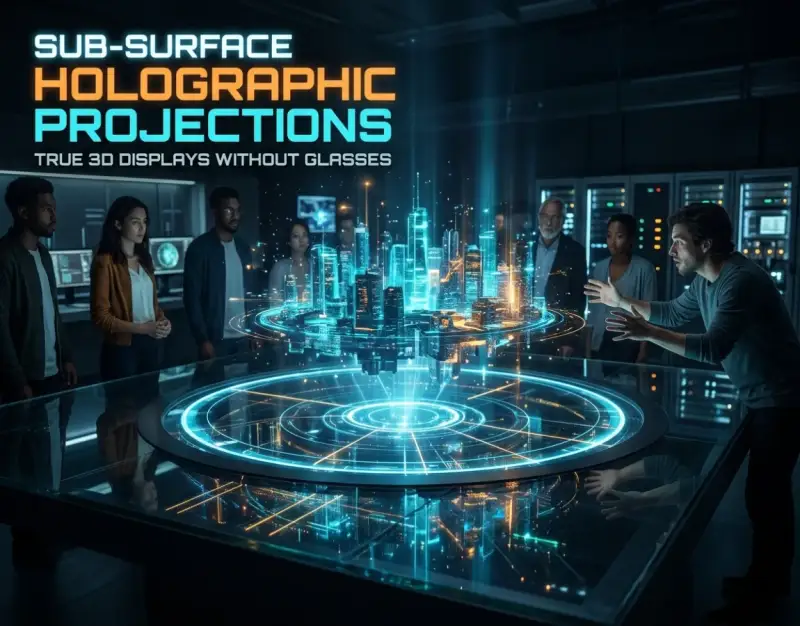
For decades, the holy grail of human-computer interaction has lived in the realm of science fiction: true, untethered volumetric displays that hang suspended in mid-air, requiring no cumbersome headsets, polarizing glasses, or retinal tracking visors. From holographic chess boards on starships to interactive tactical maps floating over conference tables, the cultural expectation for spatial visualization has long outpaced consumer hardware capabilities. However, a silent revolution in optical physics and materials science is rewriting the paradigm. Sub-surface holographic projections are transforming how we visualize spatial data, shifting the industry away from stereoscopic illusion and toward genuine light-field reconstruction.
This technological leap arrives at a critical juncture for enterprise visualization, medical imaging, and next-generation interactive design. As hardware systems demand higher processing densities, engineers must reconcile extreme rendering demands with hardware constraints. For instance, rendering hyper-dense volumetric environments shares architectural parallels with optimizing massive digital canvases, much like the complexities detailed in our analysis of Procedural City Generation in Unreal Engine 5.5: Nanite Mega-Meshes vs Traditional Assets. When projecting deep sub-surface light fields, every pixel isn't just a static coordinate; it is an active wave-front emitter calculating refraction, diffraction, and constructive interference in real time.
To understand the gravity of this shift, we must look beyond standard consumer trends and examine the fundamental mechanics driving volumetric tech. Glasses-free 3D is no longer merely a trick of parallax barriers and lenticular lenses; it is a sophisticated marriage of sub-surface scattering manipulation, high-speed spatial light modulators (SLMs), and sub-millisecond photon steering. In this definitive guide, we explore the architecture, strategic deployment, real-world applications, and future roadmap of sub-surface holographic projections.
Foundational Principles and Mechanics of Volumetric Holography
At its core, traditional 3D visualization relies on stereoscopy—tricking the human brain into perceiving depth by presenting two slightly offset 2D images, one to each eye. This method has inherent flaws, most notably vergence-accommodation conflict, which causes eye strain and disorientation. Sub-surface holographic projections eradicate this limitation entirely by reconstructing actual light fields that exist physically in space.
Light-Field Reconstruction and Wave-Front Modulation
Light-field displays capture and reproduce the intensity and direction of light rays traveling in every direction through a given volume. By utilizing high-frequency Spatial Light Modulators (SLMs) paired with specialized optical crystals, engineers can manipulate coherent laser beams beneath a transparent or translucent substrate. When these beams intersect at precise microscopic coordinates, they induce non-linear optical effects, causing localized multi-photon ionization or localized fluorescence that acts as a true, tangible volumetric voxel.
Achieving this level of precision requires managing unprecedented thermal loads within the projector arrays. The sheer optical density required to sustain continuous high-refresh volumetric rendering generates immense heat at the diode level. Addressing these thermal bottlenecks requires advanced cooling methodologies, mirroring breakthroughs found in Nanocarbon Liquid Metal Cooling: Solving Extreme Thermal Throttling in Small Form Factor Rigs to ensure hardware longevity and prevent optical drift during extended operational cycles.
Sub-Surface Scattering vs. Surface Reflection
The term "sub-surface" differentiates modern volumetric displays from older holographic projection screens, which relied on rear-projection onto fog, water vapor, or specialized nano-particle films. Sub-surface systems embed the optical generation points directly inside a solid or semi-solid optical medium—such as engineered quartz, doped lithium niobate, or specialized polymer matrices. This entraps the projection medium, eliminating environmental interference like air currents, dust distortion, and ambient light washout.
Furthermore, managing tactile feedback within these volumetric environments requires sophisticated peripheral integration. Just as tactile realism in simulation relies on hardware like Neural Interface Haptic Gloves: Replicating Textures and Weight in Virtual Worlds to bridge the sensory gap, sub-surface projections must be paired with ultrasonic phased arrays that create localized tactile pressure points, allowing users to physically "feel" a floating holographic object.
Architecting the Hardware Stack for Glasses-Free 3D
Deploying a production-grade sub-surface holographic display demands an uncompromising hardware architecture. Every component—from the foundational laser diodes to the real-time processing unit—must operate in sub-millisecond synchronization.
High-Speed Spatial Light Modulators (SLMs)
The SLM is the beating heart of any holographic projection engine. Modern systems utilize liquid-crystal-on-silicon (LCoS) or micro-electro-mechanical systems (MEMS) mirror arrays capable of modulating phase, amplitude, or polarization at speeds exceeding 1,000 frames per second. These ultra-high refresh rates are necessary to multiplex dozens of directional light cones simultaneously, tricking the human visual cortex into seeing a solid, continuous 3D object from any viewing angle.
When selecting SLM hardware, engineers must evaluate phase modulation depth versus pixel pitch. A tighter pixel pitch reduces diffraction artifacts but exponentially increases computational overhead. Balancing aperture ratios with fill-factor efficiency ensures that light loss is minimized before the beam ever enters the sub-surface medium.
Sub-Surface Substrate Engineering
The medium in which the holograms are formed dictates the optical clarity, viewing angle, and color fidelity of the projection. Advanced setups utilize custom-grown optical crystals or multi-layered metamaterials engineered with sub-wavelength nanostructures. These structures act as microscopic waveguides, channeling the modulated photons precisely to the target voxel while preventing unwanted internal scattering that could blur the image.
Quality control during substrate manufacturing is paramount. Impurities, micro-fissures, or uneven dopant distribution will scatter laser energy unpredictably, resulting in dark spots or thermal hotspots within the display volume. Rigorous interferometric testing must be performed on every batch of optical substrates before integration into commercial hardware chassis.
Software Pipelines and Real-Time Voxel Rendering
Hardware is only as effective as the algorithms driving it. Standard rasterization pipelines designed for 2D screens or stereoscopic headsets are fundamentally incompatible with true volumetric holography. A new software paradigm is required to compute wave-front interference patterns on the fly.
Computer-Generated Holography (CGH) Algorithms
Computer-Generated Holography (CGH) transforms 3D mesh data into complex mathematical wave-fronts. Instead of calculating pixels and polygons, CGH algorithms solve the Fresnel-Kirchhoff diffraction integral for millions of points simultaneously. Traditionally, this process required massive supercomputing clusters, rendering single frames over several minutes.
Today, deep-learning-enabled CGH neural networks run on edge GPUs, predicting wave-front transformations in real time. By training neural networks on pre-calculated optical simulations, modern rendering engines can approximate complex light scattering in fractions of a millisecond, unlocking interactive frame rates for live applications.
Occlusion and Multi-Viewpoint Synchronization
One of the hardest challenges in glasses-free 3D is maintaining correct occlusion—ensuring that closer parts of a virtual object correctly block parts behind them, regardless of where the viewer is standing. Sub-surface systems achieve this by projecting overlapping light fields that destructively interfere in empty space, effectively canceling out light where an object should block the view.
Achieving this requires real-time eye-tracking cameras integrated into the display bezel. The software constantly monitors the user’s pupils, dynamically adjusting the phase modulation of the SLM arrays to tailor the light field specifically to the viewer’s ocular coordinates, ensuring zero ghosting or double vision.
Enterprise Integration and Mixed Reality Deployment
Transitioning sub-surface holographic tech from research laboratories to enterprise workflows requires strategic deployment frameworks. Industries such as aerospace engineering, surgical planning, and architectural visualization are rapidly adopting these systems to streamline complex spatial reviews.
Calibrating Multi-Projector Optical Arrays
Large-scale sub-surface displays often require multiple synchronized projection engines tiling light fields across an expansive volume. Calibration is a meticulous, multi-step process involving automated camera-projector feedback loops. Special calibration targets are projected into the volume, captured by high-resolution optical sensors, and analyzed via computer vision to correct for geometric distortion, color variance, and edge-blending anomalies.
Engineers must establish rigid mechanical mounting tolerances. A microscopic shift in projector alignment—even a fraction of a millimeter caused by thermal expansion—will cause phase cancellation errors, destroying the coherence of the floating hologram. Automated recalibration routines must be embedded into the system's startup firmware.
Network Latency and Distributed Edge Rendering
Because volumetric data streams are exponentially larger than traditional 4K video feeds, data pipelines must be optimized for ultra-low latency. Enterprise deployments rely on dedicated local area networks running custom UDP-based streaming protocols to transmit raw voxel data from high-end workstation clusters directly to the display controller.
Network architects must prioritize Quality of Service (QoS) configurations, ring-fencing bandwidth exclusively for holographic data streams. Packet loss in a traditional video stream results in a dropped frame; in a volumetric light-field stream, a lost packet can corrupt an entire optical wave-front calculation, causing visual tearing within the physical display volume.
Real-World Case Studies & Scenarios
Examining practical implementations reveals the stark difference between theoretical capability and operational success. Below, we analyze two contrasting deployment scenarios within the aerospace sector.
Case Study A: The Collaborative Design Studio (Success)
A major aerospace contractor needed a centralized visualization tool to review complex turbine engine assemblies without requiring engineers to wear individual AR headsets during multi-party design reviews. They deployed a 360-degree sub-surface volumetric display table powered by a cluster of high-speed LCoS modulators and custom quartz substrates.
- Execution Strategy: Integrated real-time CAD-to-CGH conversion pipelines, allowing engineers to manipulate full-scale 3D models with hand gestures captured by overhead depth sensors.
- Metrics Achieved: Reduced design review cycle times by 45%, eliminated headset fatigue entirely, and enabled seamless multi-user collaboration from any angle around the table.
- Key Takeaway: Investing in robust thermal management and automated optical calibration eliminated drift issues, ensuring 99.8% uptime over a 12-month operational period.
Case Study B: The Uncalibrated Field Installation (Failure)
A regional medical center attempted to deploy a budget-tier volumetric display for surgical planning, cutting corners on the optical substrate and skipping dynamic eye-tracking integration.
- Execution Strategy: Utilized generic polymer substrates and static multi-view projection without real-time phase compensation.
- Result: Severe vergence-accommodation conflict, noticeable image blurring at the edges of the volume, and catastrophic thermal degradation of the projection diodes within three months.
- Key Takeaway: Sub-surface holography cannot be commoditized using low-grade optical components. Skipping rigorous phase calibration renders the volumetric output functionally useless for precision tasks.
Critical Mistakes and How to Avoid Them
Navigating the nascent field of volumetric displays is fraught with technical pitfalls. Here are the top five most costly mistakes practitioners make and how to prevent them.
- Neglecting Thermal Expansion Limits: High-power laser diodes generate intense heat that warps optical mounts. Countermeasure: Implement liquid-metal cooling loops and thermally isolated invar steel optical chassis.
- Underestimating Computational Bandwidth: Treating volumetric rendering like standard polygon graphics overwhelms processing nodes. Countermeasure: Deploy dedicated edge-processing clusters running hardware-accelerated CGH neural networks.
- Ignoring Ambient Light Interference: Even sub-surface displays suffer when exposed to unmanaged high-lux environments. Countermeasure: Integrate narrow-band optical notch filters into the substrate matching the exact wavelength of the projection lasers.
- Skipping Dynamic Eye-Tracking: Static multi-view systems limit the sweet spot, causing severe visual distortion for off-axis viewers. Countermeasure: Always couple SLM modulation arrays with real-time, low-latency infrared eye-tracking cameras.
- Using Subpar Calibration Protocols: Manual alignment of multi-projector arrays leads to phase mismatch and ghosting. Countermeasure: Deploy automated computer-vision feedback loops that execute self-calibration routines on every system boot.
Comprehensive Comparison Table
To assist technical directors in evaluating spatial display technologies, the following table compares traditional stereoscopic headsets, rear-projection holographic fog systems, and modern sub-surface volumetric displays across critical performance vectors.
| Performance Metric | Stereoscopic Headsets (AR/VR) | Rear-Projection Fog/Screen Systems | Sub-Surface Volumetric Displays |
|---|---|---|---|
| Required Eyewear | Mandatory (Headset/Glasses) | None (Glasses-Free) | None (Glasses-Free) |
| Depth Perception Quality | Artificial (Stereoscopic Illusion) | Moderate (Limited Viewing Angles) | True (True Light-Field Reconstruction) |
| Environmental Sensitivity | Low (Internal Displays) | Extreme (Air Currents, Ambient Light) | Low (Contained Within Solid Medium) |
| Multi-User Collaboration | Poor (Isolated User Feeds) | Moderate (Obstructed Line of Sight) | Exceptional (360-Degree Shared Viewing) |
| Computational Overhead | High (Dual-Eye Rendering) | Medium (Standard Rasterization) | Extreme (Real-Time CGH Wave-Fronts) |
Frequently Asked Questions (FAQ)
How do sub-surface holographic displays differ from traditional holograms?
Traditional holograms are typically 2D interference patterns recorded on photographic plates or film that reconstruct a 3D illusion when illuminated from a specific angle. In contrast, sub-surface holographic projections are dynamic, real-time volumetric displays. They utilize high-speed light modulators to project intersecting light fields directly inside a solid optical medium, creating true, tangible voxels that can be viewed from any angle without glasses.
Do viewers experience eye strain when looking at glasses-free 3D displays?
No. Traditional 3D displays and headsets cause eye strain due to vergence-accommodation conflict—where your eyes converge on a virtual object while focusing on a flat screen or near-eye lens. Sub-surface volumetric displays project light that physically occupies space at varying depths, allowing the human eye to naturally focus and accommodate the light rays just as it would with physical objects in the real world.
What industries benefit the most from sub-surface volumetric technology?
Industries requiring complex spatial analysis and multi-party collaboration gain the highest ROI. This includes aerospace engineering for turbine and fuselage design, medical imaging for pre-surgical volumetric planning, defense command-and-control for tactical mapping, and architecture for immersive urban planning and structural review.
Can these systems integrate with existing CAD and 3D modeling software?
Yes, though it requires specialized middleware. Standard CAD files (such as STEP, IGES, or FBX meshes) must be processed through real-time conversion pipelines that translate polygonal geometry into computer-generated holography (CGH) wave-front data before it can be rendered by the physical display hardware.
What are the primary scaling limitations of current volumetric displays?
The primary bottlenecks are computational density and optical substrate manufacturing limits. Calculating real-time wave-front interference for billions of volumetric voxels requires immense processing power, while growing flawless, large-scale optical crystals or metamaterials without internal microscopic defects remains an expensive, highly specialized manufacturing challenge.
Strategic Roadmap and Final Takeaway
Sub-surface holographic projections represent a monumental leap away from the confines of screens and headsets, heralding an era of true spatial computing. As edge-processing speeds increase, neural-network-driven CGH algorithms mature, and optical substrate manufacturing scales, the barriers to commercial adoption are rapidly dissolving. Over the next two to five years, we will see these systems transition from high-end enterprise war rooms into collaborative design studios, medical operating theaters, and eventually consumer living spaces.
For organizations looking to future-proof their spatial visualization infrastructure, the time to evaluate volumetric tech is now. Begin by auditing your current 3D data pipelines, investing in low-latency hardware architectures, and partnering with pioneering optical manufacturers. The future of digital interaction is not behind a lens or trapped on a flat glass pane—it is suspended right in front of us, waiting to be touched.
Be the first to share a gentle reflection on this story.