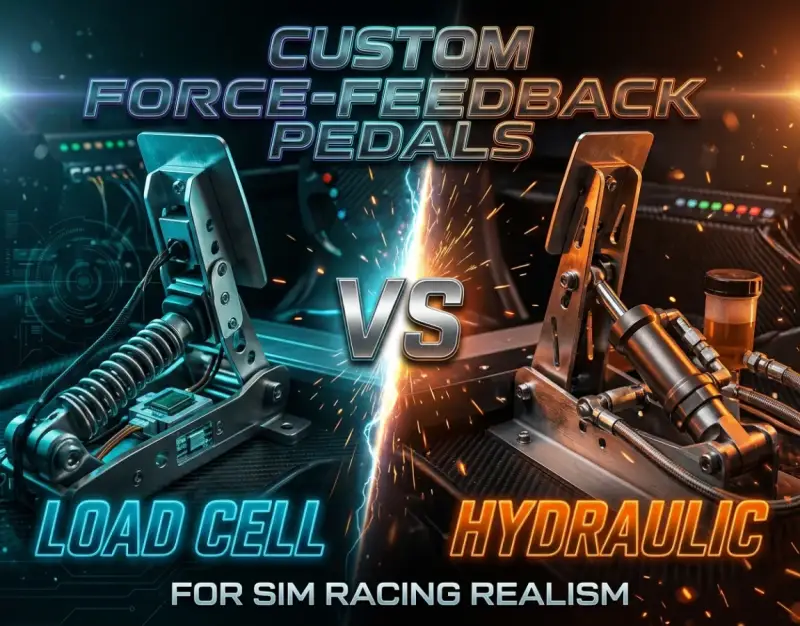
The evolution of simulation gaming has long transcended simple entertainment, pushing steadily into the territory of absolute kinetic mimicry. Nowhere is this pursuit of hyper-realism more palpable than in the rigorous domain of high-end force feedback hardware. For decades, sim racers relied on potentiometers and simple spring-loaded pedals that registered foot travel rather than actual pressure, stripping away the nuanced tactile feedback that defines real-world motorsport. Today, the conversation around securing a definitive racing simulator upgrade has narrowed to a fierce debate between two dominant engineering philosophies: load cell sensors and hydraulic cylinder systems. Understanding this hardware divide is no longer just for professional esports athletes; it is essential for anyone seeking an authentic connection to the asphalt.
As modern physics engines grow exponentially more complex, the hardware feeding data back into our nervous systems must match that fidelity. Just as enthusiasts explore advanced immersion techniques—such as examining Zero-Latency Wireless VR: Wi-Fi 7 vs Dedicated 6GHz Air Transmitters Tested to dissolve the boundary between user and virtual space—sim racers are demanding pedal sets that replicate the microscopic shifts in brake fluid pressure and high-frequency chassis vibration. The shift away from archaic linear potentiometers toward force-sensing resistors and closed-loop hydraulic circuits marks a watershed moment in digital simulation history. It is a technological leap driven by a singular objective: translating human biomechanics into digital telemetry without translation loss.
This exhaustive investigation dives deep into the engineering mechanics, performance tradeoffs, software integrations, and long-term durability of both load cell and hydraulic systems. Whether you are building a dedicated GT3 endurance rig or an open-wheel formula cockpit, navigating the complexities of sim racing pedals requires more than skimming specification sheets. By examining real-world deployment data, common installation pitfalls, and expert calibration strategies, this guide provides the definitive blueprint for mastering force feedback hardware and transforming your virtual driving experience forever.
Understanding the Anatomy of Sim Racing Resistance
The Physics of Human Braking and Muscle Memory
In a real-world racing car, particularly high-downforce open-wheelers or GT3 machines, braking is almost entirely a function of pressure, not travel. Human biomechanics rely heavily on proprioception—the body's ability to sense muscle tension and joint positioning—rather than visual cues when modulating deceleration. When a driver stomps on a brake pedal at 200 kilometers per hour, the brake pedal might only depress by a centimeter or two, but the resistance experienced by the foot scales exponentially with pressure. Replicating this phenomenon digitally requires hardware that measures force in kilograms or pounds, rather than degrees of rotation.
Traditional potentiometer-based pedals fail this biomechanical test because they measure physical distance. If your foot moves the pedal halfway, the game registers fifty percent input, regardless of how hard you are pressing. This disconnect forces drivers to memorize leg positions instead of muscle pressures, leading to inconsistent trail-braking and frequent lock-ups. Modern force feedback hardware eliminates this issue by anchoring input to physical force, training the nervous system to react to resistance curves that mimic actual brake calipers clamping down on carbon-ceramic discs.
The Evolution from Potentiometers to Strain Gauges
The journey of pedal telemetry improvement began with the abandonment of sweeping electrical wipers in favor of contactless magnetic hall-effect sensors for throttle and clutch axes. However, the brake pedal demanded an entirely different technological approach. Enter the strain gauge, the foundational component of load cell technology. A load cell is a transducer that creates an electrical signal whose magnitude is directly proportional to the force applied to it. When pressure is exerted on the pedal arm, a bonded metallic foil strain gauge deforms microscopically, altering its electrical resistance and sending a precise telemetry stream to the game engine.
This transition revolutionized the mid-tier and high-end market, democratizing precise braking control that was previously locked behind multi-thousand-dollar professional motion simulators. By measuring force instead of position, load cells allow drivers to threshold brake instinctively. They can feel the exact moment the front tires begin to scrub speed without locking, drastically lowering lap times and increasing consistency across long stint races. Yet, as brilliant as load cells are, engineering teams continually pushed further, asking whether electronic strain gauges could truly match the organic compressibility of genuine hydraulic fluid.
Load Cell Sim Racing Pedals: Engineering, Pros, and Cons
How Load Cell Sensors Operate Under Extreme Pressure
At the heart of every load cell pedal set is a robust steel or aluminum load cell block—often rated for 50kg, 100kg, or even 200kg of force. When the user depresses the brake pedal, the mechanical force travels through a linkage system and compresses an elastomer stack, polyurethane springs, or steel coil springs before pressing directly against the load cell sensor. The sensor measures this mechanical deformation via a Wheatstone bridge circuit, converting micro-voltages into clean USB digital signals via an onboard 16-bit analog-to-digital converter (ADC).
The beauty of the load cell architecture lies in its simplicity and reliability. Because there are no fluid reservoirs, seals, or master cylinders to bleed, load cell pedals require virtually zero hydraulic maintenance. They offer an exceptional balance of customization, allowing users to swap out elastomer durometers (hardness ratings) to tailor the initial soft bite and final stiff wall of the brake pedal feel. This modularity makes load cells the most popular racing simulator upgrade for enthusiasts transitioning from entry-level gear.
Advantages: Durability, Cost-Efficiency, and Tuning Modularity
The primary advantage of load cell technology is its incredible durability combined with a relatively accessible price point. Unlike hydraulic systems, which rely on delicate rubber O-rings and master cylinder seals that can degrade or leak over time, load cells feature solid-state electrical components with minimal moving wear parts. They are built to withstand hundreds of thousands of aggressive, high-pressure stomps without losing calibration fidelity or developing fluid leaks.
Furthermore, tuning load cell pedals is exceptionally straightforward. Most manufacturers ship their pedal sets with an assortment of interchangeable elastomers and springs of varying densities. If a driver prefers a long, progressive pedal travel with a firm lockout, or a short, stiff Formula 1-style pedal with almost zero travel, they can achieve this in minutes using basic hand tools. This adaptability ensures that the hardware grows alongside the driver's skill level and cockpit ergonomics.
Limitations: Electronic Noise and Linear Compression Reality
Despite their dominance, load cells are not entirely without flaws. Because they rely on electronic amplification of microscopic voltage changes, poorly shielded wiring or electromagnetic interference (EMI) from nearby high-torque Direct Drive wheelbases can sometimes introduce signal noise, leading to phantom brake inputs. While easily mitigated with ferrite cores and proper grounding, it remains a consideration for densely packed home cockpits.
Additionally, while elastomers and springs do a commendable job simulating brake resistance, they fundamentally lack the thermodynamic and fluid-dynamic properties of actual hydraulic brake fluid. Elastomers can heat up and slightly change their durometer rating during a grueling 24-hour endurance race, altering the pedal feel subtly over time. For casual to hardcore competitive sim racers, this is rarely a dealbreaker, but absolute purists often look toward hydraulic alternatives for the ultimate tactile experience.
Hydraulic Cylinder Sim Racing Systems: The Pinnacle of Fluid Realism
The Mechanics of Master and Slave Cylinders in Sim Rigs
Hydraulic sim racing pedals take mechanical realism to its absolute zenith by mimicking the exact hydraulic architecture found in real race cars. Instead of relying purely on a solid-state strain gauge, depressing the brake pedal physically pushes a plunger into a master cylinder filled with automotive brake fluid or high-viscosity mineral oil. This fluid is forced through flexible braided lines or rigid steel tubing toward a slave cylinder or a secondary resistance block equipped with a secondary pressure transducer.
This closed-loop fluid dynamic creates an entirely different tactile sensation. Fluids are virtually incompressible, meaning the resistance experienced by the driver's foot is a direct, instantaneous result of fluid displacement and counter-pressure. When paired with high-precision pressure sensors (transducers) that read the hydraulic pressure within the line, these systems deliver an uncompromised, buttery-smooth resistance curve that is mathematically and physically identical to a real motorsport braking system.
Advantages: Unmatched Pedal Modulation and True Fluid Feedback
The primary selling point of hydraulic pedals is their peerless pedal modulation. The way hydraulic fluid compresses slightly under extreme loads, combined with the subtle feedback pulses transmitted back through the pedal arm when ABS engages or tires lock, creates an immersive loop that elastomer stacks simply cannot replicate. For drivers training for real-world track days in GT4 or Formula cars, hydraulic pedals provide the exact muscle memory transfer required for seamless transition to actual metal.
Moreover, high-end hydraulic setups often feature independent adjustment for pedal throw, initial bite point, hydraulic leverage ratios, and damping coefficients. This allows elite drivers to fine-tune the hydraulic feedback to mirror specific racing series—from the heavy, long-travel pedal throw of a vintage sports car to the rock-hard, minimal-travel bite of a modern carbon-braked prototype. The fidelity of data read by the inline pressure sensors ensures linearity and repeatability that leaves zero room for telemetry ambiguity.
Disadvantages: Cost, Maintenance Complexity, and Fluid Management
Perfection, however, comes at a steep price. Hydraulic pedal systems represent the absolute ceiling of sim racing hardware pricing, often costing several thousand dollars for a complete three-pedal set. Beyond the initial financial investment, they require ongoing maintenance that can intimidate casual users. Master and slave cylinder seals can wear out, requiring periodic disassembly, cleaning, and replacement of rubber O-rings to prevent fluid leaks.
Furthermore, bleeding hydraulic lines to remove trapped air pockets is an essential maintenance task that mirrors real-world garage work. If air enters the system, the brake pedal will feel spongy, unpredictable, and unresponsive. For hobbyists who simply want to plug in their hardware and race without worrying about fluid viscosity, bleeding kits, and potential leaks, hydraulic systems can introduce unnecessary mechanical anxiety.
Head-to-Head Technical Comparison: Load Cell vs Hydraulic
| Performance Metric | Load Cell Pedals | Hydraulic Cylinder Pedals |
|---|---|---|
| Primary Resistance Mechanism | Strain gauge sensor combined with elastomer/spring stacks | Master/slave cylinders utilizing brake fluid or mineral oil |
| Price Point | Mid-range to High-end ($250 – $900 USD) | Ultra-premium to Professional ($1,000 – $3,500+ USD) |
| Maintenance Requirements | Very low; periodic elastomer inspection and cleaning | High; periodic fluid bleeding, seal replacement, and leak checks |
| Tactile Realism & Fidelity | High accuracy via pressure sensing; slight elastomer fatigue over long stints | Absolute benchmark realism; true fluid compressibility and feedback dynamics |
| Setup Complexity | Plug-and-play USB connection with software calibration | Rigid cockpit mounting, fluid filling, line bleeding, and transducer calibration |
| Durability & Longevity | Extremely robust solid-state components with minimal wear parts | High durability, though rubber seals and master cylinders require servicing |
Integration with Advanced Sim Cockpits and Software Calibration
Rig Rigidity and Mounting Requirements for High-Force Pedals
Whether you choose load cell or hydraulic pedals, upgrading your braking system demands a radical reassessment of your simulator chassis. When you apply 80 to 100 kilograms of pressure to a high-end brake pedal, any flex in your cockpit frame will absorb that force instead of translating it into the sensor. If your pedal deck flexes even a few millimeters, your braking input becomes inconsistent, destroying your muscle memory and rendering expensive hardware investments functionally obsolete.
Before installing high-performance force feedback pedals, ensure your rig is constructed from heavy-gauge extruded aluminum profile (such as 8020 framing) or heavy-duty structural steel. Lightweight folding wheel stands or tubular steel desks will buckle under high-load braking. Furthermore, bolting the pedal base directly to a reinforced pedal deck with heavy-grade steel bolts is mandatory. Securing your racing seat with heavy-duty brackets prevents your body from sliding backward during heavy braking zones, ensuring all force is isolated entirely within your legs and the pedal sensors.
Software Calibration, Deadzones, and Telemetry Mapping
Raw hardware is only as good as the software translating its signals into the game engine. Once your pedals are physically bolted down, mastering calibration software (such as DiRT, iRacing, Assetto Corsa Competizione, or dedicated manufacturer suites like Heusinkveld SmartControl or Simucube Link) is critical. You must establish proper minimum and maximum force thresholds so that resting foot weight does not trigger unintended brake drag, while ensuring 100% brake saturation requires comfortable maximum leg pressure.
Advanced software suites also allow users to non-linearly map their brake curves. While a 1:1 linear response is standard, many drivers prefer an exponential or logarithmic curve that
Be the first to share a gentle reflection on this story.