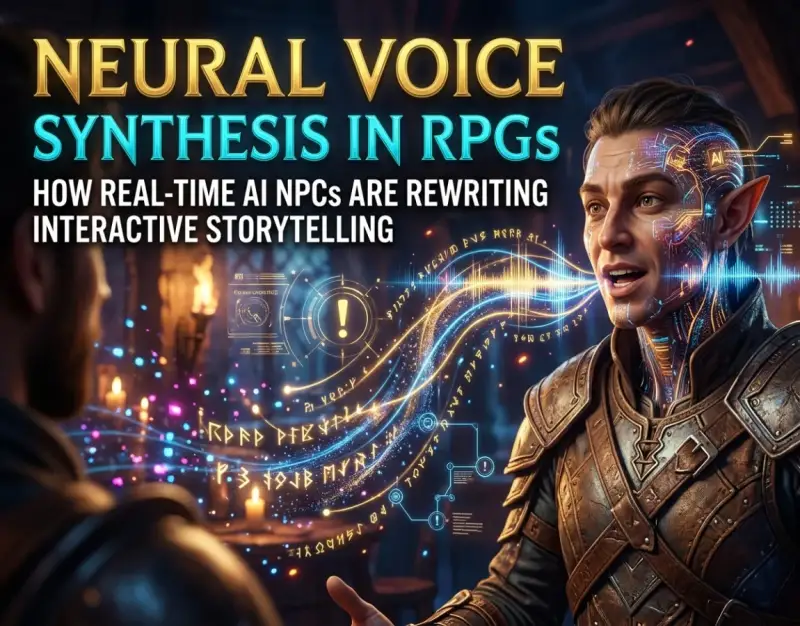
Imagine wandering into a dusty, dimly lit tavern in a digital frontier, walking up to a rugged barkeep, and asking a question that no developer ever anticipated, typed into a design doc, or recorded in a sound booth. In traditional role-playing games, the barkeep would stutter, repeat a canned line about local weather or recent goblin attacks, and break the immersive spell. Today, thanks to the explosive convergence of machine learning and game design, that same barkeep replies with contextual wit, remembers your name, references a side quest you completed three hours ago, and delivers the dialogue in a dynamically generated human-like voice complete with regional accents, emotional cadence, and real-time breaths. This is not the distant future of interactive entertainment; it is the unfolding reality of modern role-playing video games.
The integration of neural voice synthesis and advanced machine learning models is fundamentally restructuring the bedrock of digital storytelling. For decades, interactive narratives have been bounded by the iron triangles of budget, storage, and human labor. Recording thousands of lines of voice acting for multiple branches required millions of dollars and years of studio time, forcing writers to funnel players down narrow, deterministic narrative pipelines. The introduction of AI NPCs alongside advanced neural voice synthesis completely shatters these old constraints. By shifting dialogue generation from static pre-recorded assets to real-time generative models, developers are unlocking worlds where dynamic gaming lore is written on the fly and brought to life through hyper-realistic vocal engines, transforming passive players into active, co-authors of living virtual histories.
As we examine this seismic shift through the lens of modern computing, the implications stretch far beyond mere entertainment. Just as advanced autonomous systems are reshaping physical competition—much like we see explored in Autonomous Drone Racing Leagues: AI-Piloted Quads vs Human World Champions—machine intelligence in gaming is redefining the boundaries of what is possible when software reacts in real time to unpredictable human input. This comprehensive guide delves deep into the technological mechanics, strategic implementation frameworks, real-world case studies, and critical hurdles facing developers and audio engineers who are currently rewriting the rules of interactive storytelling.
Foundational Principles: Decoding Neural Audio and Generative Lore
To understand how modern role-playing games are transforming, we must first deconstruct the underlying technologies that make real-time intelligent non-player characters possible. At its core, the modern AI NPC architecture relies on three interconnected pillars: Large Language Models (LLMs) for reasoning and text generation, retrieval-augmented generation (RAG) for maintaining consistent world states, and advanced neural text-to-speech (TTS) engines for instantaneous voice conversion.
The Anatomy of Real-Time Text-to-Speech Architecture
Traditional audio synthesis relied on concatenative or formant synthesis, resulting in robotic, stilted speech that shattered immersion. Modern neural voice synthesis, however, utilizes deep neural networks trained on thousands of hours of diverse human speech. These models do not just stitch phonemes together; they analyze semantic intent, punctuation, emotional context, and syntactic structure to predict pitch, volume, and timing natively.
When an AI NPC generates a line of dialogue, the text token is passed instantly to the neural vocoder. The vocoder processes the text alongside emotional tags injected by the LLM—such as sarcasm, fear, or joy—rendering a high-fidelity audio waveform in milliseconds. This low-latency pipeline is what allows characters to converse with players in real-time, matching the conversational cadence of human-to-human interaction without noticeable stutter or lag.
Maintaining Narrative Integrity Through Retrieval-Augmented Generation
One of the greatest historical risks of generative AI in storytelling is "hallucination"—the tendency of language models to invent facts that contradict established lore. To combat this in RPGs, developers implement Retrieval-Augmented Generation (RAG) frameworks. Whenever a player speaks to an NPC, the query searches a localized vector database containing the game's lore bible, faction relationships, and the player's personal history.
This retrieved context is fed directly into the prompt alongside the NPC's persona profile. As a result, the generated text remains strictly anchored to the game world's rules. If a player asks a peasant about the fallen king, the NPC will not hallucinate modern technology; instead, they will draw upon the verified historical data of the realm, ensuring that generative storytelling enhances immersion rather than breaking it.
Step-by-Step Strategic Blueprint for Implementing AI NPCs
Integrating generative voices and dynamic characters into an existing or new game engine requires a rigorous, multi-tiered engineering and writing strategy. Below is the step-by-step blueprint used by pioneering studios to bring living worlds to life.
1. Establishing Character Profiles and Behavioral Guardrails
Before a single line of code is written, writers must construct hyper-detailed psychological profiles for every interactive entity in the game world. Unlike static scripts, an AI NPC needs a clear worldview, core motivations, a distinct lexicon, and behavioral boundaries.
Writers should define parameters such as education level, emotional volatility, prejudice, and loyalty to factions. These parameters act as system prompts that constrain the LLM, ensuring that a humble blacksmith never speaks like an Oxford scholar and that a villain maintains their sinister composure even when provoked by an erratic player.
2. Designing the Low-Latency Audio Pipeline
Latency is the silent killer of conversational immersion. If a player asks a question and must wait five seconds for a voice response, the illusion of a natural dialogue vanishes. Engineers must optimize local or cloud-based inference pipelines to achieve sub-second response times.
Implementing client-side caching for frequent conversational openers, streaming audio chunks as they are generated rather than waiting for the complete file, and utilizing lightweight quantized models ensure that the game engine maintains a stable frame rate while processing complex audio synthesis.
3. Crafting Dynamic Quest Hooks and Branching Lore
With traditional game design, branching quests are expensive and finite. With AI NPCs, quest lines can emerge organically based on player actions. For example, if a player steals an apple from a merchant, the merchant might mention it to a guard, updating the local security lore dynamically.
Designers must establish trigger events that cause NPCs to update their internal memory banks. When a significant world event occurs—such as a dragon attack or an economic depression—all AI NPCs in the affected region receive a prompt update, altering their default dialogue and emotional states across the board.
4. Fine-Tuning Voice Clones and Emotional Modulation
To avoid the uncanny valley of audio, neural voice synthesis must support dynamic emotional modulation. Voice actors are hired to record baseline reference audio, capturing various emotional states and vocal tonalities, which are then used to train custom voice models for key characters.
Audio directors must program the synthesis engine to inject specific paralinguistic cues—such as sighs, laughter, hesitations, and changes in breathing rate—into the generated audio stream. These subtle human imperfections are what trick the human brain into accepting synthesized audio as genuinely authentic performance art.
5. Implementing Content Moderation and Safety Filters
Because players can type or say anything into an open microphone or text box, generative AI opens the door for unintended, offensive, or game-breaking dialogue from NPCs. Robust guardrails are non-negotiable for commercial releases.
Developers must integrate real-time input and output moderation filters that screen both player prompts and generated NPC responses for hate speech, explicit content, and lore-breaking exploits. If an input violates safety parameters, the NPC can be programmed to respond with an in-character deflection, maintaining immersion while neutralizing inappropriate behavior.
Real-World Case Studies & Operational Scenarios
To truly grasp the impact of neural voice synthesis and real-time AI NPCs, we can analyze the trajectory of early industry experiments, contrasting successful design frameworks against common tactical failures.
Scenario A: The Immersive Living Settlement (Successful Execution)
In a recent beta test conducted by an indie RPG studio, developers replaced the standard dialogue trees of a small frontier village with fully generative, voice-synthesized AI NPCs. Each of the fifty villagers had a unique daily routine, a set of personal grievances, and access to a local lore database.
The Outcome: Players reported unprecedented levels of emotional attachment. One player spent two hours investigating a local theft by interviewing villagers, who cross-referenced alibis and contradicted each other organically. Because the neural voice synthesis matched the rustic tone of the setting, players engaged in open-ended conversations that lasted far longer than any pre-written script would have allowed, dramatically increasing player retention.
Scenario B: The Unfiltered Chaos Experiment (Common Failure)
Conversely, an experimental project that deployed unconstrained LLMs and fast TTS without robust safety filters or memory constraints resulted in catastrophic immersion collapse. Players quickly figured out how to trick NPCs into breaking character, discussing modern politics, or repeating offensive slang.
The Lesson Learned: Without strict prompt engineering, bounded memory vectors, and rigorous output filtering, generative systems will quickly devolve. Total freedom without structural guardrails destroys the suspension of disbelief faster than traditional linear storytelling ever could.
Critical Mistakes and How to Avoid Them
As studios rush to adopt neural voice synthesis, many fall into predictable traps. Here are the five most costly mistakes practitioners make and how to prevent them.
- Neglecting Vocal Diversity: Relying on a single generic voice model for multiple NPCs breaks immersion instantly. Countermeasure: Invest in a diverse library of base voice embeddings and utilize pitch-shifting and formant adjustments to ensure every character sounds distinct.
- Ignoring Hardware Limitations: Running massive LLMs and heavy neural vocoders locally can cripple frame rates. Countermeasure: Utilize hybrid architectures where heavy reasoning occurs on optimized cloud servers or leverage heavily quantized edge models designed specifically for gaming hardware.
- Failing to Manage Conversational Drift: Allowing NPCs to forget past interactions leads to repetitive and contradictory dialogue. Countermeasure: Implement robust vector memory databases that log every player interaction and weigh recent events more heavily in the prompt hierarchy.
- Overlooking Pacing and Interactivity: Letting NPCs ramble on for minutes without interruption frustrates players who want to get on with gameplay. Countermeasure: Program sentence-length limits and allow players to interrupt the NPC mid-sentence, causing the character to react naturally to being cut off.
- Underestimating Localization Challenges: Generating voice synthesis in English is only the first step; global markets require multi-lingual emotional nuance. Countermeasure: Partner with multilingual neural voice providers who support native accent training rather than relying on awkward post-hoc translation filters.
Comprehensive Comparison: Traditional Voice Acting vs. Neural Voice Synthesis
To evaluate the operational shift in game development, review the following semantic comparison table detailing the core differences between legacy studio recording and modern AI-driven synthesis:
| Metric / Feature | Traditional Voice Acting | Neural Voice Synthesis (AI NPCs) |
|---|---|---|
| Dialogue Volume | Finite (capped by budget and studio time, typically 10k-50k lines). | Infinite (unlimited conversational permutations on the fly). |
| Production Cost | Extremely high per recorded line; scales exponentially with branches. | High initial setup cost, but marginal cost per additional line is near zero. |
| Player Freedom | Strictly restricted to pre-scripted choices and branching paths. | Fully open-ended; players can type or speak anything. |
| Emotional Authenticity | Flawless human performance captured in controlled studio environments. | Highly convincing and continuously improving, supplemented by paralinguistic tags. |
| Lore Consistency | Guaranteed by human writers during initial script creation. | Maintained dynamically through RAG frameworks and strict prompt guardrails. |
Just as intelligent automation is transforming household and domestic tasks—as detailed in discussions on Swarm Robotics at Home: Coordinating Multi-Bot Cleaning and Surveillance Ecosystems—the shift from static assets to dynamic, responsive generation represents a permanent evolution in how we interact with computerized systems.
Frequently Asked Questions (FAQ)
Will AI NPCs completely replace human voice actors in video games?
No, human voice actors will not be replaced, but their role is evolving. High-impact cinematic moments, key protagonist performances, and critically important narrative set-pieces will still rely on the nuanced, emotional depth of human actors. In fact, professional voice actors are increasingly licensing their voices to train proprietary neural models, earning residuals and creating new revenue streams while enabling the infinite background dialogue required for expansive open-world RPGs.
How do developers prevent AI NPCs from saying offensive or inappropriate things?
Developers implement a multi-layered security architecture. This includes strict system prompts that define the character's moral boundaries, real-time input filters that screen player prompts before they reach the LLM, and output moderation layers that catch and rewrite any generative anomalies before the text is sent to the neural voice synthesizer. If an edge case slips through, fallback dialogue triggers automatically to preserve the game's rating and tone.
What kind of hardware is required to run real-time neural voice synthesis in games?
Hardware requirements depend on whether the processing is handled locally or via cloud APIs. Cloud-based inference offloads the heavy lifting to server farms, requiring only a stable internet connection and minimal local latency. For offline or local execution, modern gaming PCs and current-generation consoles utilize specialized neural processing units (NPUs) and optimized, quantized models that can render high-fidelity audio waveforms in milliseconds without compromising GPU rendering performance.
Can players use their own microphones to speak directly to AI NPCs?
Yes. Many cutting-edge RPG mods and upcoming commercial titles integrate automatic speech recognition (ASR) pipelines. Players speak naturally into their microphones, their voice is transcribed into text in real time, processed by the LLM, converted into voice via neural synthesis, and spoken back by the NPC. This creates a seamless, natural spoken-word conversation loop that eliminates menus entirely.
Does generative storytelling mean game writers are no longer needed?
On the contrary, the demand for skilled narrative designers and writers is higher than ever. Instead of writing linear dialogue trees, writers now act as world architects and lore masters. They design the overarching history, character motivations, faction rules, and behavioral boundaries that feed the AI models. Without expert human writers to craft the foundational lore, generative systems lack the cultural depth and thematic resonance required for a truly compelling RPG.
Strategic Roadmap and Future Takeaways
As we look toward the next two to five years, the convergence of neural voice synthesis and interactive role-playing games will move from experimental tech demos to industry-standard benchmarks. Developers who master the art of balancing generative freedom with tight narrative control will define the next era of digital entertainment. Players will no longer settle for wooden, repetitive NPCs; they will expect every character in a virtual world to listen, understand, and reply with the emotional richness and vocal authenticity of a living person.
For studios, the immediate next steps involve investing in robust RAG pipelines, training ethical voice-cloning partnerships, and mastering low-latency audio integration. The tools are ready, the technology is scaling rapidly, and the audience is eager. The script of interactive storytelling is being rewritten in real time—and the characters are finally ready to speak for themselves.
Be the first to share a gentle reflection on this story.