Visual and auditory immersion within virtual environments has reached near-photorealistic fidelity. Modern spatial computing displays render sub-millimeter spatial details, high-dynamic-range lighting, and pin-point binaural acoustics. Yet, despite these breakthroughs in optic and acoustic engineering, human interaction within digital domains has remained fundamentally detached. Users can see a virtual solid stone wall or a delicate crystal vase, but upon extending a hand, their fingers meet empty air or the uniform plastic grip of a handheld motion controller. The tactile dimension—the primary sensory channel through which humans manipulate, assess, and understand physical reality—has long been the ultimate missing link in immersive technology.
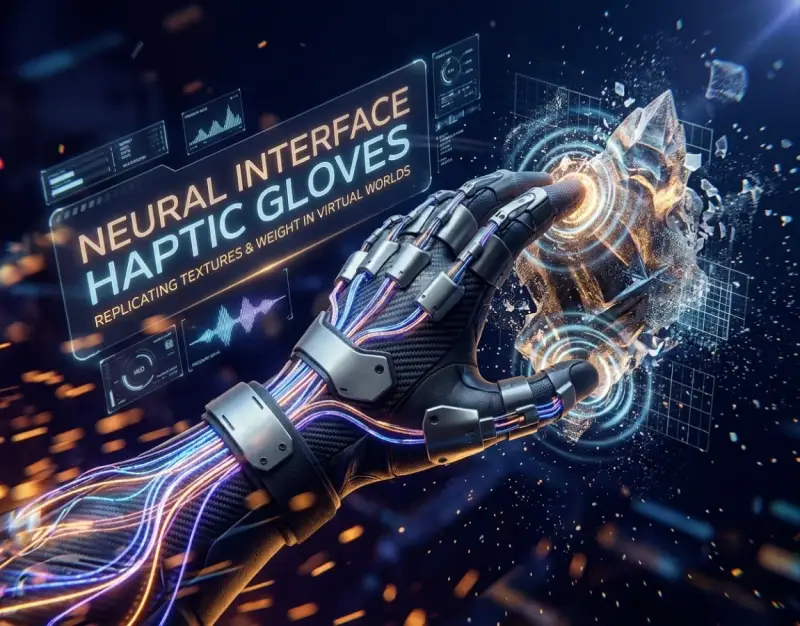
Neural interface haptic gloves represent a monumental paradigm shift in human-computer interaction (HCI). By integrating high-density surface electromyography (HD-sEMG), active biomechanical force feedback, microfluidic skin deformation arrays, and neural signal processing, modern spatial hardware can now bridge the gap between biological perception and synthetic simulation. These systems do not merely vibrate when an object is touched; they selectively stimulate the hand's mechanoreceptors and biomechanical structures to trick the central nervous system into processing digital matter as physically tangible, complete with mass, friction, compliance, and micro-surface texture.
This technological evolution is fundamentally altering industrial design, aerospace training, remote tele-robotic surgery, and next-generation interactive entertainment. As virtual spatial environments expand beyond primitive digital sandboxes into intricate, persistent worlds—a cultural and technological trajectory analyzed in our examination of Cyberpunk Dystopias in Gaming: Why Modern Sci-Fi Lore Obsesses Over Corporate Mega-Cities—the mandate for high-fidelity somatic feedback becomes paramount. This authoritative publication dissects the underlying mechanics, bio-neural interfaces, physics pipelines, and engineering blueprints that enable modern haptic gloves to synthesize weight and texture in virtual spatial computing.
Foundational Principles & Mechanoreceptor Neurobiology
To construct hardware capable of replicating physical touch, engineers must first interface with the biological architecture of human somatosensation. Human tactile perception is split into two primary modalities: kinesthetic feedback (the sensation of spatial position, joint angles, muscle tension, and structural resistance) and cutaneous feedback (the sensation of surface texture, thermal exchange, micro-vibrations, and local skin deformation). Replicating these sensations requires modulating four distinct classes of mechanoreceptors embedded within the dermal and epidermal layers of the hand:
- Meissner’s Corpuscles (FA-I): Fast-adapting type I receptors located in the papillary dermis. Highly sensitive to low-frequency vibrations (10–50 Hz) and skin slip, providing the primary neural feedback for detecting object slippage and gross surface textures.
- Pacinian Corpuscles (FA-II): Fast-adapting type II receptors situated deep within the dermis and subcutaneous tissue. Resonant at high frequencies (100–300 Hz), responding to subtle micro-textures, fine grain variations, and high-speed mechanical transients.
- Merkel Discs (SA-I): Slow-adapting type I receptors clustered in the basal epidermis. Extremely sensitive to sustained pressure, spatial form, and point-edge contours, transmitting structural shape information to the somatosensory cortex.
- Ruffini Endings (SA-II): Slow-adapting type II receptors located deep within dermal tissue. Sensitive to continuous lateral skin stretch and joint rotation, contributing directly to grip force perception and object shape sensation.
A simple rumble motor (such as an Eccentric Rotating Mass or basic Linear Resonant Actuator) stimulates Pacinian corpuscles indiscriminately, creating a generalized vibration across the palm. Neural interface haptic gloves, by contrast, coordinate micro-actuator arrays to target specific mechanoreceptor groups independently. By coordinating cutaneous skin deformation with active force feedback applied to the phalangeal joints, these devices present the brain with unified sensory inputs, eliminating the cognitive dissonance that typically breaks immersion in spatial computing environments.
1. Actuation Architecture: Bridging Kinesthetic Force and Cutaneous Texture
Exoskeleton Tendon Drives vs. Microfluidic Bladder Arrays
Modern high-fidelity haptic gloves utilize hybrid actuation architectures to address kinesthetic and cutaneous sensory channels simultaneously. Kinesthetic force feedback—stopping the user's fingers from closing through a solid virtual object—requires substantial mechanical resistance. Mechanical exoskeleton tendon drives employ high-tensile ultra-high-molecular-weight polyethylene (UHMWPE) cables routed along the dorsal surface of each finger. These cables connect to active servo motors or magnetic particle brakes mounted on the wrist. When a user grasps a virtual object, the system calculates the object's geometry and applies opposing mechanical tension to the tendon lines within milliseconds, locking the finger joints at the exact physical boundaries of the virtual volume.
Conversely, kinesthetic force alone cannot communicate whether an object is smooth glass, coarse sandpaper, or wet rubber. Cutaneous feedback requires localized micro-surface manipulation. Advanced gloves integrate microfluidic arrays—flexible palmar layers embedded with hundreds of microscopic pneumatic or hydraulic bladders per square centimeter. By pumping micro-volumes of fluid into individual bladders at variable pressures and frequencies, the glove mechanically deforms the user's skin at a sub-millimeter resolution, replicating micro-edges, point pressure, and local contour dynamics.
Active Braking Systems and Electro-Rheological Fluids
While continuous rotary motors can deliver powerful active resistance, they introduce significant bulk, weight, and thermal loads onto the user's forearm. To solve this, advanced spatial computing hardware leverages passive dynamic braking powered by Electro-Rheological (ER) or Magneto-Rheological (MR) fluids. ER fluids contain suspended micro-particles that transform from a free-flowing liquid to a semi-solid crystalline matrix within microseconds when exposed to an electric field.
By routing tendon cables through micro-clutches filled with ER fluid, the glove can apply up to 40 Newtons of stopping force per finger without requiring heavy electric motors. The system draws minimal power during sustained holds, preventing thermal throttling while delivering rigid, instant structural feedback when contacting hard virtual geometries like steel or stone.
Vibrotactile Resonator Arrays for High-Frequency Transients
To complement low-frequency pressure arrays, micro-piezoelectric actuators are strategically distributed across the distal phalanges (fingertips). Piezoelectric ceramics deform rapidly under electric voltage, operating at frequencies between 1 Hz and 1,000 Hz with sub-millisecond response times. These actuators reproduce dynamic transient events, such as the initial high-frequency click of a physical switch, the transient tick of a watch gear, or the subtle rasp of sliding a finger across unpolished marble.
2. Neural Interfacing and EMG Signal Decoding
High-Density Surface Electromyography (HD-sEMG)
Traditional VR tracking relies on optical cameras or inertial measurement units (IMUs) to measure finger movement. However, physical movement is the *end result* of a neurological chain. By the time an optical camera registers finger flexion, tens of milliseconds have elapsed. Neural interface haptic gloves bypass this physical latency by integrating High-Density Surface Electromyography (HD-sEMG) arrays into the glove's wrist cuff and forearm sleeve.
HD-sEMG sensors monitor Motor Unit Action Potentials (MUAPs)—the electrical currents generated by motor neurons conducting impulses across muscle fibers in the flexor digitorum profundus and extensor digitorum muscles. By reading these microvolt-level bio-electric signals directly through the skin, the glove detects motor intent at the neuro-muscular level before physical joint movement even begins.
Intent Prediction and Neuromuscular Machine Learning
Raw sEMG signals are notoriously noisy, subject to physiological variance, sweat accumulation, and motion artifacts. Modern haptic pipelines feed multi-channel sEMG streams into lightweight edge-convolutional neural networks (CNNs) running locally on the glove’s processing unit. These models decode the raw signal into real-time joint torque predictions and intended trajectory vectors.
This predictive capability enables "sub-zero latency tracking." By reading the neuromuscular impulse 15 to 30 milliseconds before the anatomical muscle fully contracts, the spatial physics engine can pre-load force-feedback states and position virtual hands in sync with actual physical movement. This eliminates the perceptual lag that disrupts physical immersion.
Closed-Loop Electro-Tactile Stimulation
Beyond passive neural reading, state-of-the-art research gloves implement non-invasive electro-tactile neural feedback. By placing low-current micro-electrode arrays directly against the epidermis, the glove delivers controlled electrical pulses to the cutaneous afferent nerve endings (specifically A-beta fibers). By adjusting pulse width, frequency, and current amplitude, system designers can directly induce sensations of tingling, pressure, temperature shifts, or sharpness without relying purely on mechanical movement. When paired with microfluidic bladders, electro-tactile feedback broadens the tactile dynamic range, delivering high-fidelity textures impossible to achieve through physical displacement alone.
3. Real-Time Physics Integration & Dynamic Weight Emulation
Volumetric Mass Simulation and Center-of-Gravity Kinematics
Simulating the weight of a virtual object presents a profound engineering challenge: a user holding an empty hand in mid-air does not feel real gravity acting on a non-existent virtual brick. True spatial weight perception, however, is largely a function of structural inertia, torque differential, and muscle resistance during acceleration. When a human lifts a heavy object, the brain estimates its mass by comparing expected joint torque against actual movement velocity, alongside skin deformation patterns across the finger pads.
Haptic glove physics engines model objects as multi-body volumetric meshes with detailed inertia tensors. When a user picks up a virtual iron hammer, the physics system calculates its center of mass relative to the grip point. As the user sweeps their hand through the air, the exoskeleton tendons apply proportional resistive force to the finger flexors and wrist actuators, resisting the movement vector in accordance with Newton's second law ($F = ma$). The hand meets true resistance during acceleration and braking, tricking the brain into perceiving real mass and dynamic inertia.
"Weight in virtual reality is not merely a static down-force; it is a dynamic neural calculation of inertia, momentum, friction, and kinesthetic resistance synthesized across real-time acceleration vectors."
Pseudo-Haptic Illusion Synthesis
Engineers maximize weight perception using "pseudo-haptic illusions"—exploiting visual dominance over tactile sensation. When a user lifts a heavy virtual crate, the physics engine intentionally introduces a tiny, controlled offset between the user's real physical hand (tracked via sEMG) and the visual virtual hand rendered in the headset display. The virtual hand moves slightly slower than the physical hand, visually exaggerating the object's mass.
Simultaneously, the haptic glove increases skin deformation pressure on the lower finger pads while engaging tendon brakes. The brain resolves the visual lag and physical skin compression as heavy physical mass. Through this neuro-cognitive alignment, a glove weighing only 300 grams can successfully simulate the illusion of lifting a 10-kilogram weight.
Procedural Micro-Texture and Surface Friction Modeling
Rendering convincing tactile surfaces requires moving beyond static, pre-recorded vibration clips. Advanced spatial engines execute real-time procedural haptic rendering, calculating surface friction using modified Coulomb friction equations and stick-slip dynamics. When a finger glides across a virtual surface, the engine samples the micro-geometry of the spatial asset.
Just as real-time graphical rendering has evolved through advanced upscaling and procedural neural synthesis—as explored in our technical breakdown of Neural Network Texture Upscaling: Real-Time Super-Resolution for Retro Game Emulation—haptic engines utilize neural spatial upscaling to generate sub-millimeter haptic bump maps from low-resolution graphical meshes. As the finger moves, the engine modulates microfluidic pressure and high-frequency piezoelectric actuators in real time, recreating the fine asperities of concrete, polished mahogany, silk, or brushed aluminum.
4. Data Pipeline Optimization & Sub-Millisecond Latency Calibration
The Somatosensory Latency Threshold
Human tactile perception demands exceptionally strict latency thresholds. While visual latency under 20 milliseconds is generally acceptable to avoid motion sickness in VR, the tactile system is far more sensitive. The somatosensory cortex can detect micro-temporal discrepancies as small as 2 to 5 milliseconds between visual contact and tactile feedback. If a finger visually penetrates a virtual table before force feedback engages, the illusion of solidity collapses instantly.
Achieving an end-to-end latency budget of under 5 milliseconds requires optimizing every stage of the hardware and software pipeline, as broken down in the tracking architecture below:
- sEMG & Kinematic Sensing (0.5 ms): High-rate sampling (2,000 Hz) of muscle action potentials and optical joint tracking.
- On-Glove Neural Processing (1.0 ms): Local MCU decodes motor intent using quantized neural network inference models.
- Wireless Telemetry Transmission (1.0–1.5 ms): Ultra-low latency packet transport over dedicated wireless spectrum.
- Spatial Physics Computation (1.0 ms): Collision detection, inertia tensor resolution, and haptic texture sampling within the host physics engine.
- Actuator Signal Generation & Mechanical Response (1.0 ms): Rapid energization of electro-rheological brakes and micro-piezo units.
High-Bandwidth Wireless Telemetry and Spectrum Management
Tethered haptic gloves severely restrict movement and break spatial immersion. However, uncompressed multi-channel EMG data, high-rate positional tracking, and multi-actuator haptic feedback loops generate substantial data throughput. Traditional Bluetooth or legacy Wi-Fi channels suffer from packet jitter, channel congestion, and high latency spikes that ruin haptic realism.
To overcome these data bottlenecks, modern spatial computing architectures rely on low-latency wireless transmission protocols. Modern deployments leverage Wi-Fi 7 Multi-Link Operation (MLO) alongside ultra-wideband (UWB) dedicated 6GHz channels to guarantee deterministic packet delivery. For an exhaustive analysis of real-world wireless throughput performance and latency benchmarks, reference our empirical testing in Zero-Latency Wireless VR: Wi-Fi 7 vs Dedicated 6GHz Air Transmitters Tested.
5. Biomechanical Ergonomics and Sensor Fusion Architecture
Multi-Axis Joint Tracking and Absolute Spatial Localization
A haptic glove must precisely map the hand's 27 degrees of freedom (DoF) to align physical fingers with virtual collision meshes. Relying purely on external camera tracking leads to frequent occlusions, such as when fingers curl into a tight fist or overlap during complex manipulations. Modern haptic gloves mitigate this via multi-sensor fusion:
- Optical Fiber Strain Sensors: Embedded along finger flexor channels. As fingers bend, light transmission through tiny etched fiber Bragg gratings shifts proportionally, providing sub-degree joint angle tracking impervious to electromagnetic interference.
- Six-Axis Micro-IMUs: Positioned on each individual finger phalanx to measure high-rate angular velocity and linear acceleration.
- Absolute Spatial Anchors: Wrist-mounted constellation targets tracked by external spatial computing headsets to lock the local hand skeleton into absolute world coordinates.
Thermal Management and Power Redistribution
Dense arrays of processing units, wireless radios, and mechanical actuators generate significant thermal load in a tightly enclosed textile chassis. Excess heat uncomfortable for the user can also alter skin conductivity, distorting sEMG signal accuracy and irritating mechanoreceptors. Advanced gloves utilize passive graphite heat-spreaders coupled with micro-vapor chambers integrated into the dorsal frame, carrying heat away from the palm toward an aluminum heat-sink array over the wrist brace.
6. Enterprise Deployment and Cross-Platform Haptic SDKs
OpenXR Haptic Extensions and Standardized APIs
Historically, adopting haptics was fragmented by proprietary, hardware-specific SDKs. Software developers had to manually script custom motor frequencies for every individual glove model. The spatial computing industry is now unifying around OpenXR haptic extensions, such as `XR_EXT_haptic_tactile_v2` and `XR_FB_haptic_amplitude_envelope`.
These unified standards allow developers to author rich material properties—such as stiffness, static friction, dynamic friction, micro-roughness, and thermal conductivity—directly within game engines like Unreal Engine 5 and Unity. The underlying haptic glove driver automatically translates these standardized material parameters into optimal actuator control signals tailored to its specific hardware layout.
Detailed Hardware Architecture Comparison
The table below provides a comprehensive engineering comparison of the primary haptic glove actuation paradigms currently utilized in spatial computing environments:
| Actuation Paradigm | Primary Sensory Target | Dynamic Force Range | Response Latency | Micro-Texture Capability | Optimal Enterprise Application |
|---|---|---|---|---|---|
| Active Exoskeleton Tendons | Kinesthetic (Joint Resistance / Rigid Objects) | High (up to 40N per digit) | 5 – 10 ms | Low (Requires auxiliary LRAs) | Industrial Assembly, Flight Simulation, Heavy Machinery Training |
| Pneumatic Microfluidic Arrays | Cutaneous (Skin Pressure / Surface Contours) | Medium (1N – 5N per bladder) | 10 – 15 ms | Moderate (Point contours & edges) | Medical Tele-Robotics, Virtual Product Design, Retail Prototyping |
| Electro-Tactile (Surface sEMG/Nerve) | Cutaneous Afferent Nerves (Sensory Pulses) | Low (Perceptual sensation only) | < 1 ms | High (Synthetic friction & sharpness) | Precision Neural Interfaces, Rehabilitation, Bio-Feedback Research |
| Piezoelectric Resonator Matrix | Pacinian Corpuscles (High-Frequency Micro-Vibration) | Very Low (Transient pulses) | < 0.5 ms | Very High (Fine textures, brushed metals, grain) | Consumer Spatial Gaming, Micro-Assembly Simulation, Musical Interfaces |
Real-World Case Studies: Implementation & Field Analysis
Case Study A: High-Precision Aerospace Component Tele-Assembly
Context: A major aerospace manufacturer deployed neural-interface haptic gloves paired with high-density sEMG tracking to facilitate remote tele-robotic maintenance on jet turbine engines within dangerous cleanroom environments.
Implementation Strategy: Operators were equipped with hybrid tendon-exoskeleton gloves featuring microfluidic palmar pads and 2,000 Hz sEM
Be the first to share a gentle reflection on this story.