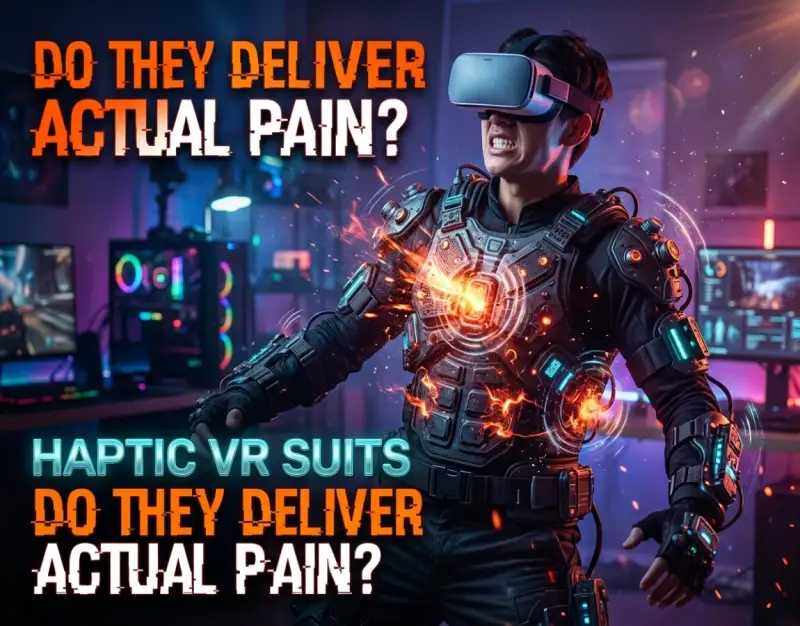
Step onto the virtual battlefield, and your eyes are immediately tricked by stereoscopic lenses rendering hyper-realistic devastation. Yet, for years, the human brain has harbored a persistent cognitive dissonance: the visual cue of a high-velocity plasma round tearing through your abdominal armor is instantly betrayed by the cold, indifferent static of room-temperature air against your chest. This sensory void has long been the final frontier of simulation design. Enter the ecosystem of full-body telemetry and haptic feedback apparatuses, engineered to violently bridge the gap between sight and sensation. These systems promise not merely to rumble, but to translate digital impact into tangible physical trauma—a concept colloquially and technically framed as immersive pain.
As consumer and enterprise adoption accelerates, the underlying technology has shifted drastically from simplistic, unbalanced rumble motors salvaged from legacy gamepads to sophisticated matrices of voice-coil actuators, shape-memory alloys, and localized electrical muscle stimulation (EMS). These systems do not just notify a user that an in-game event has occurred; they seek to rewrite the user's proprioceptive loop, tricking the central nervous system into bracing for impact, wincing at kinetic concussions, and recoiling from localized thermal or pressure spikes. This paradigm shift intersects heavily with high-performance computing requirements, matching the architectural demands seen when optimizing Zero-Latency Cloud Gaming: Overcoming the Physics of Input Lag in Competitive Esports, where every millisecond dictates whether a simulation feels authentic or fundamentally broken.
However, the transition from sci-fi tropes like the 'Ready Player One' X1 suit to consumer-ready hardware is fraught with engineering trade-offs, ergonomic bottlenecks, and deep psychological questions about the utility of pain in entertainment. Does a localized jolt of electricity or a sharp pneumatic pinch actually elevate presence, or is it an expensive gimmick that induces sensory fatigue within minutes? This investigative deep dive explores the mechanics, strategic deployment, real-world case studies, and critical pitfalls of modern VR haptic suits, assessing whether full-body feedback systems genuinely deliver immersive pain.
Foundational Principles and Mechanics of Virtual Reality Haptics
To evaluate whether modern haptic vests and full-body suits can simulate genuine pain, one must first deconstruct the physics and neurobiology of human touch. Haptics is divided into two primary sub-modalities: tactile feedback and kinesthetic feedback. Tactile feedback deals with skin-level sensations—texture, vibration, friction, and localized pressure—communicated via mechanoreceptors in the dermis and epidermis, such as Meissner’s corpuscles and Merkel disks. Kinesthetic feedback, conversely, deals with force-torque perception, muscle tension, and joint angles, registered by proprioceptors in muscles, tendons, and joints.
In the context of virtual reality immersion, recreating pain requires exploiting both modalities without crossing the threshold into actual tissue damage. True biological pain (nociception) is mediated by specialized free nerve endings called nociceptors, which respond to extreme mechanical, thermal, or chemical stimuli. Because consumer hardware cannot legally or safely cause tissue damage, haptic designers use psychoacoustics, targeted pressure gradients, and neural stimulation to trick the brain into synthesizing the sensation of pain from harmless physical inputs.
Achieving this illusion relies on three primary hardware methodologies currently dominating the market: Eccentric Rotating Mass (ERM) motors, Linear Resonant Actuators (LRAs), and Transcutaneous Electrical Nerve Stimulation (TENS) / Electrical Muscle Stimulation (EMS). ERMs provide broad, heavy rumbles but lack spatial precision and response speed. LRAs offer faster response times and variable frequency ranges, allowing for crisp, localized impacts like bullet strikes or blade stabs. Meanwhile, electrical stimulation systems bypass mechanical motors entirely, sending micro-currents through the skin to depolarize motor neurons, causing instantaneous muscle contractions and sharp stinging sensations that mimic ballistic trauma with terrifying accuracy.
Engineering the Sensory Loop: Actuator Typologies and Spatial Mapping
Linear Resonant Actuators Versus Voice-Coil Arrays
When selecting or evaluating full-body feedback systems, understanding the underlying actuator typology is paramount. Linear Resonant Actuators (LRAs) operate via a spring-mass system driven by an electromagnetic field, oscillating along a single axis. This allows developers to program distinct frequency profiles—a low, thunderous thud for a nearby explosion versus a high-frequency buzz for a swarm of nanobots. However, LRAs have a narrow frequency bandwidth; if pushed outside their resonant frequency, their output drops off precipitously.
Conversely, high-end voice-coil actuators function similarly to audio speakers, translating complex audio waveforms directly into physical vibrations across a broad frequency spectrum. When integrated into a VR haptic suit, voice-coil arrays can replicate the subtle patter of rainfall, the heavy engine vibration of a starfighter, or the distinct tearing sensation of a kinetic projectile. Integrating these systems requires robust audio-haptic rendering pipelines, mirroring the hardware tuning complexity found when building out systems like Advanced Flight Sim Hardware: Force Feedback Rudder Pedals and Cyclic Controls, where precise physical resistance defines the credibility of the simulation.
Insiders note that the spatial distribution of these actuators is just as critical as their mechanical type. A vest with forty poorly mapped ERM motors will feel like a vibrating massage chair rather than a tactical combat harness. True immersion requires dense, anatomically mapped node clusters aligned with major muscle groups and skeletal landmarks—specifically targeting the sternum, clavicle, latissimus dorsi, and lumbar regions to register the visceral shock of impact.
Pneumatic Bladders and Shape-Memory Alloys
Vibration alone cannot simulate the feeling of a heavy blow or being crushed in a virtual environment; vibration implies high frequency and low displacement, whereas blunt trauma involves low frequency and high displacement. To bridge this gap, advanced full-body suits incorporate pneumatic bladders or shape-memory alloy (SMA) lattices that physically inflate or contract against the user's body.
Pneumatic systems rely on compressed air micro-compressors or onboard CO2 cartridges to rapidly pressurize specific zones of the vest. When a virtual debris cloud hits the player, the chest bladders inflate within milliseconds, exerting several pounds of compressive force that physically restricts the user's thoracic expansion. This forces the subconscious reaction of holding one's breath, dramatically amplifying psychological immersion.
Shape-memory alloys offer an alternative approach by utilizing nitinol wire networks that contract when an electrical current heats them. While SMAs allow for incredibly thin, lightweight form factors compared to bulky pneumatic tubes, their thermal dissipation cycles can be sluggish, limiting the frequency of impacts in fast-paced combat scenarios. Engineers must balance weight, power consumption, and thermal management to prevent the suit from becoming an unwearable sauna.
Electrical Muscle Stimulation (EMS): The Frontier of Simulated Pain
Harnessing Micro-Currents for Nociceptive Illusion
The holy grail—and ethical lightning rod—of VR haptic suits is the implementation of Electrical Muscle Stimulation (EMS) and Transcutaneous Electrical Nerve Stimulation (TENS). While traditional vibration merely shakes the skin, EMS applies controlled electrical impulses directly to the motor nerves governing specific muscle groups. This causes involuntary muscle twitching, spasms, or rigid contractions.
When calibrated correctly, a localized burst of current can make a user's arm instantly buckle under the simulated weight of a Warhammer blow, or cause a sharp, stinging sensation across the abdomen that mimics the sting of a laser bolt. This bypasses the cognitive delay of interpreting visual damage; the body reacts physically before the brain has time to process the abstraction of the virtual world.
However, implementing EMS requires rigorous safety protocols. Current amplitudes must be strictly capped to prevent cardiac interference, muscle tearing, or severe skin irritation. Developers must also account for individual physiological differences in skin resistance and body fat percentage, ensuring that a current setting that feels like a mild pinch to one user does not cause debilitating cramping in another.
Software Integration and Biometric Feedback Loops
Hardware is only as effective as the middleware and game engines translating spatial telemetry into electrical and mechanical output. Modern haptic suits rely on dedicated software development kits (SDKs) that hook directly into engines like Unreal Engine 5 and Unity. These plugins intercept raycasts, collision volumes, and damage events, converting raw vector data into multidimensional haptic maps.
Advanced implementations incorporate closed-loop biometric feedback. By monitoring heart rate variability, galvanic skin response (GSR), and pupillometry via integrated eye-tracking headsets, the haptic software can dynamically scale the intensity of feedback. If a player shows signs of extreme physiological distress or panic, the system can dial back the intensity, ensuring that the pursuit of immersive pain does not cross the line into genuine trauma or motion sickness.
Furthermore, maintaining visual and tactile synchronization is critical. If a haptic impact registers 50 milliseconds before or after the visual cue, the human brain instantly breaks the immersion. Achieving this real-time alignment requires optimized wireless protocols, low-latency Bluetooth Low Energy (BLE) iterations, or proprietary 2.4GHz RF dongles that match the zero-latency thresholds demanded by competitive esports ecosystems.
Ergonomics, Thermal Management, and Power Delivery Architecture
Balancing Weight Distribution Across Full-Body Rigs
One of the most persistent bottlenecks preventing mainstream adoption of full-body haptic suites is ergonomic fatigue. A vest housing dozens of voice-coil actuators, lithium-ion battery packs, pneumatic compressors, and wiring harnesses can easily tip the scales past 15 to 20 pounds. When suspended entirely from the shoulders, this weight causes rapid fatigue in the trapezius muscles, ruining long gaming sessions.
To mitigate this, elite industrial designers utilize load-bearing tactical chassis borrowed from military plate carrier systems. Weight is redistributed downward via rigid waist belts and lumbar supports, transferring the load directly to the user's hips and core. Ergonomic articulation points—such as flexible side panels, adjustable shoulder straps, and breathable, moisture-wicking synthetic mesh—ensure the suit moves naturally with the human torso during aggressive ducking, leaning, and dodging maneuvers.
Similar meticulous attention to hardware ergonomics is mandatory when configuring extreme aesthetic setups, echoing the hardware discipline seen in projects focusing on Cyberpunk Aesthetics in Real Hardware: Building the Ultimate Neon-Drenched Custom Rig, where form and function must coexist without compromising structural integrity or thermal limits.
Thermal Dissipation and Battery Chemistry Challenges
Packing high-density electronics, continuous wireless transmitters, and powerful actuators into a sealed, wearable garment creates a severe thermal trap. Without active or passive cooling channels, a full-body haptic suit can rapidly elevate skin temperature, leading to excessive sweating and material degradation.
Engineers combat this by incorporating phase-change cooling materials (PCMs) and high-airflow perforated neoprene panels. These materials absorb excess body heat during high-intensity gameplay and release it slowly during lulls in the action. Simultaneously, power delivery architecture must be meticulously managed. High-drain voice coils and pneumatic pumps demand substantial amperage, requiring high-discharge lithium-polymer (LiPo) battery cells equipped with advanced battery management systems (BMS) to prevent thermal runaway and ensure safe, consistent operation over multi-hour sessions.
Real-World Case Studies and Scenario Analysis
To understand how these systems perform in the wild, we must examine concrete implementations across high-end entertainment, tactical military simulation, and consumer gaming environments.
Case Study A: Competitive Tactical Shooters in Location-Based VR Arenas
In a controlled deployment at a premier location-based VR facility running a competitive squad-based tactical shooter, twenty participants were equipped with full-body haptic suits featuring a combination of LRA actuators and pneumatic chest compressors. The objective was to measure the psychological impact of tactile feedback on player decision-making and immersion retention.
The Outcome: Players equipped with the haptic suits exhibited radically altered tactical behaviors compared to the control group wearing standard VR headsets and controllers. When fired upon, the localized impact of the pneumatic vest triggered an immediate, instinctual duck-and-cover reflex. Players stopped treating virtual cover as a purely visual shield; they respected the danger of the virtual environment because their nervous system registered kinetic feedback. Consequently, engagement durations increased, and team coordination improved as players sought to protect their virtual flanks.
The Failure Point: However, three participants experienced severe sensory fatigue and minor bruising after sustaining prolonged heavy-weapon fire during a 45-minute continuous session. This highlighted a critical lesson: intensity scaling must be user-configurable, as universal default settings can easily alienate users with lower pain thresholds or slender physical builds.
Case Study B: Enterprise Firefighting and Hazardous Environment Simulation
An industrial training firm integrated thermal haptic vests and localized EMS armbands into a virtual reality simulation designed to train oil refinery workers on emergency containment procedures and explosive gas leak responses.
The Outcome: The integration of thermal heating elements—which raised the surface temperature of the vest when approaching virtual fire hazards—combined with sharp electrical stings to simulate steam burns, resulted in a 40% increase in knowledge retention and hazard recognition speed during post-training evaluations. Trainees reported that the simulated pain broke through the psychological detachment typical of traditional classroom or monitor-based training.
The Failure Point: Early iterations suffered from catastrophic battery drain when all thermal elements and actuators fired simultaneously during a simulated blast scenario, causing the system to reboot mid-session. Engineers subsequently implemented tiered power prioritization protocols, ensuring that safety-critical telemetry and vital feedback nodes remained active even under peak electrical load.
Critical Mistakes and How to Avoid Them
Integrating full-body haptic ecosystems into a virtual reality workflow is fraught with technical and physiological pitfalls. Avoiding these five costly mistakes ensures hardware longevity, user safety, and optimal immersion.
- Neglecting Latency Synchronization: Allowing haptic feedback to lag behind visual and auditory cues by more than 30 milliseconds. Countermeasure: Utilize dedicated 2.4GHz RF wireless dongles or optimized low-latency Bluetooth protocols, and calibrate middleware render queues to prioritize haptic packet delivery alongside visual frame rendering.
- Ignoring Individual Anatomical Variance: Applying uniform EMS current levels or pneumatic pressure across diverse body types without calibration. Countermeasure: Implement a mandatory onboarding calibration wizard that maps user height, weight, pain tolerance, and muscle conductivity profiles before every play session.
- Overlooking Thermal Management: Enclosing high-discharge batteries and voice-coil arrays in unventilated synthetic fabrics, leading to overheating and user discomfort. Countermeasure: Integrate phase-change cooling materials, perforated neoprene mesh panels, and active monitoring sensors that throttle actuator output if internal temperatures exceed safe thresholds.
- Failing to Provide Fail-Safe Overrides: Designing systems without easily accessible emergency kill switches for electrical or high-pressure pneumatic components. Countermeasure: Incorporate a physical, hardware-level emergency cutoff toggle on the vest's main control module, alongside software hotkeys that instantly purge all pneumatic pressure and cut electrical current.
- Treating Haptics as a Simple Audio Filter: Directly routing raw game audio into haptic actuators without spatial optimization or frequency filtering. Countermeasure: Utilize advanced developer SDKs that isolate specific collision, raycast, and damage telemetry channels, ensuring actuators fire exclusively based on physical game events rather than background music or ambient noise.
Comprehensive Comparison Table of VR Haptic Feedback Approaches
| Haptic Technology | Primary Mechanism | Immersion Quality | Ergonomic Impact | Primary Use Case |
|---|---|---|---|---|
| ERM Motors | Eccentric rotating mass weights spinning on a DC motor axis | Low (Broad, muddy vibration) | Lightweight, minimal power draw | Budget consumer accessories, basic rumble notifications |
| Linear Resonant Actuators (LRAs) | Spring-mass electromagnetic oscillation along a single axis | Medium-High (Crisp, directional pulses) | Moderate weight, efficient power usage | Tactical shooters, rhythmic feedback, precise bullet strikes |
| Voice-Coil Arrays | Audio-driven electromagnetic voice coils across a broad spectrum | Very High (Complex textures, engine roars, impacts) | Moderate-Heavy, requires good weight distribution | High-end simulation, multi-purpose VR gaming |
| Pneumatic Bladders | Compressed air inflation exerting compressive body force | High (Blunt trauma, crushing weight, breath restriction) | Heavy, bulky, requires compressors/cartridges | Melee combat, explosive shockwaves, military training |
| Electrical Muscle Stimulation (EMS) | Micro-current nerve/muscle depolarization | Extreme (Involuntary contractions, sharp stinging pain) | Lightweight form factor, requires careful calibration | Advanced pain simulation, physical resistance training |
Frequently Asked Questions About VR Haptic Suits
Can VR haptic suits cause actual physical injury?
When operating certified consumer hardware within manufacturer safety parameters, physical injury is exceptionally rare. Reputable consumer vests use tightly regulated current caps for electrical stimulation and safe operating pressures for pneumatic systems. However, users with implanted medical devices such as pacemakers must strictly avoid electrical haptic systems (EMS/TENS). Additionally, users with pre-existing musculoskeletal conditions should exercise caution, as the reflexive flinching induced by heavy pneumatic impacts can strain unconditioned muscle groups.
How do haptic suits connect to standalone and PC VR headsets?
Connectivity varies depending on the manufacturer and ecosystem. Most wireless haptic vests interface via Bluetooth Low Energy (BLE) or proprietary 2.4GHz RF USB dongles plugged directly into a gaming PC or standalone headset like the Meta Quest. For PC-driven setups, middleware bridges intercept game data and route telemetry to the suit. For standalone mobile VR, developers must integrate the vest's SDK directly into the application build, ensuring the headset can natively transmit spatial impact coordinates to the wearable hardware over Wi-Fi or local Bluetooth.
Are haptic suits compatible with all VR games out of the box?
No. Unlike standard gamepads or VR controllers that benefit from universal operating system drivers, haptic suits require dedicated integration. While major titles often feature official, developer-supported native integration, many indie or older VR games require community-made mods, middleware wrappers (such as HapticPlayer software), or audio-to-haptic conversion filters. These translation layers convert standard game audio or generic rumble telemetry into spatial haptic feedback, though native SDK integration always yields superior, pinpoint accuracy.
Do haptic vests work well for non-gaming applications like virtual tourism or social VR?
While haptic vests were initially commercialized for combat-heavy gaming and military training, their utility in social VR and virtual tourism is expanding rapidly. In social platforms, localized tactile feedback allows users to experience virtual hugs, handshakes, or light physical contact, dramatically enhancing the psychological sense of co-presence. In virtual tourism or cultural heritage simulations, environmental haptics simulate elements like warm desert winds, ocean spray, or the subtle rumbling of ancient architectural structures, enriching non-combat immersion.
What is the typical battery life of a full-body haptic rig during active gameplay?
Battery longevity is directly tied to the hardware typology and the intensity of the simulation. Lightweight vests utilizing primarily LRA actuators can easily sustain 6 to 8 hours of continuous active gameplay on a single charge. Conversely, high-end rigs incorporating dense voice-coil arrays, pneumatic compressors, or active thermal heating/cooling elements will drain their lithium-ion power cells much faster, typically averaging between 2 to 4 hours of intense combat simulation before requiring a recharge.
Strategic Roadmap and Final Takeaway
The evolution of virtual reality haptic suits represents a profound leap toward true sensory integration, shifting VR from a purely audio-visual medium into a visceral, full-body experience. While early iterations struggled with muddy vibration profiles, excessive weight, and poor spatial mapping, modern engineering has successfully harnessed voice coils, pneumatic bladders, and electrical muscle stimulation to forge convincing simulations of kinetic impact and immersive pain.
Over the next two to five years, expect the industry to pivot heavily toward ultra-thin smart textiles, conductive polymer fabrics, and AI-driven predictive haptic rendering. These advancements will shed the bulky plate-carrier aesthetics of current generation hardware, replacing them with lightweight, breathable garments that seamlessly blend into everyday consumer apparel. For developers and enthusiasts alike, the question is no longer whether full-body feedback systems can deliver immersive pain, but how society will ethically and psychologically integrate a medium where virtual actions carry tangible physical consequences.
Be the first to share a gentle reflection on this story.